
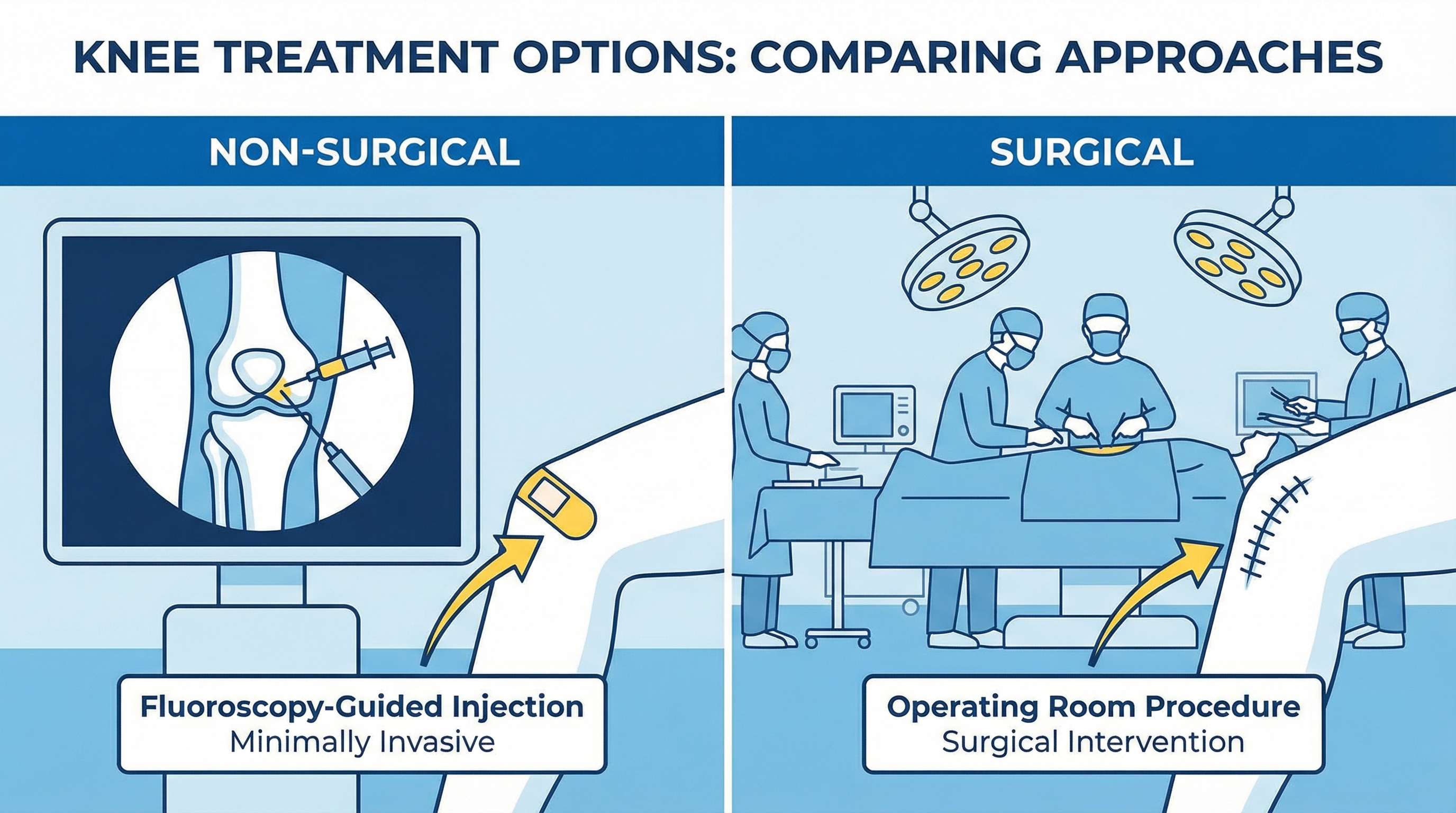
What Is the Best Alternative to Knee Surgery?
If you’ve been told you need knee surgery, you’re likely wondering whether there are effective alternatives that can help you avoid the operating room. The good news: multiple non-surgical treatment options exist that can significantly reduce pain, improve function, and delay or even eliminate the need for surgery.
According to recent research, conservative treatment approaches can delay knee replacement surgery in 95% of patients at the end of one year [1]. For many people with knee osteoarthritis, exploring surgery alternatives before committing to an invasive procedure makes both medical and financial sense.
At Joint Relief Institute, we’ve helped over 40,000 patients avoid surgery through advanced, non-surgical treatments, with more than 400,000 procedures performed and a 4.9 Google rating. Our founder, Dr. Michael Hana, specializes in fluoroscopy-guided viscosupplementation, offering precision that traditional blind injections cannot match.
Understanding Your Surgery Alternative Options
When it comes to knee pain relief without surgery, several evidence-based treatments have demonstrated clinical effectiveness. The best alternative depends on your specific condition, severity of arthritis, age, activity level, and treatment goals.
What Makes a Good Surgery Alternative?
Before exploring specific treatments, it’s important to understand what qualifies as an effective surgery alternative:
- Evidence-based efficacy: Peer-reviewed studies demonstrating pain reduction and functional improvement
- Safety profile: Minimal risk of serious complications compared to surgery
- Duration of relief: Sustained benefits lasting months to years
- Quality of life improvement: Ability to return to daily activities and exercise
- Cost-effectiveness: Lower financial burden than surgical intervention
The Top 7 Knee Surgery Alternatives
1. Viscosupplementation (Hyaluronic Acid Gel Injections)
Viscosupplementation involves injecting hyaluronic acid directly into the knee joint to restore natural lubrication and cushioning properties that deteriorate with arthritis.
How It Works: Hyaluronic acid is a naturally occurring substance in healthy joint fluid that acts as both a lubricant and shock absorber. In arthritic knees, the quality and quantity of this fluid decreases, leading to pain and stiffness. Viscosupplementation replenishes this crucial component [2].
Effectiveness: Clinical research shows that viscosupplementation effectively reduces pain, increases functionality, and delays surgery in the knee to treat osteoarthritis [3]. Studies demonstrate that 60-70% of patients experience significant pain relief, with benefits most pronounced between 5-13 weeks post-injection and lasting up to 6 months [4].
One particularly compelling study found that 75% of 1,863 patients with grade IV knee osteoarthritis delayed total knee replacement by 7 years or more following viscosupplementation treatment [5].
Best Candidates:
- Patients with mild to moderate knee osteoarthritis
- Those who haven’t responded adequately to physical therapy or oral medications
- Individuals seeking to delay surgery
- People looking for longer-lasting relief than cortisone injections provide
The Fluoroscopy Advantage: At Joint Relief Institute, all viscosupplementation procedures are performed under fluoroscopy guidance. Research shows that non-guided injections miss the joint up to 30% of the time, and when injections miss, the treatment is completely ineffective [6]. Fluoroscopy-guided injections ensure precise medication delivery, maximizing therapeutic benefits and minimizing complications.
Treatment Protocol: Most patients receive 1-5 injections over several weeks, depending on the specific hyaluronic acid product used. Relief typically begins within 5-8 weeks and can last 6 months or longer.
2. Platelet-Rich Plasma (PRP) Therapy
PRP therapy uses concentrated platelets from your own blood to promote healing and reduce inflammation in damaged knee tissues.
How It Works: A small blood sample is drawn and processed to concentrate healing growth factors. This platelet-rich solution is then injected into the affected knee joint, stimulating tissue repair and reducing inflammation.
Effectiveness: Research demonstrates that PRP shows greater efficacy in reducing pain scores while improving stiffness and general physical function compared to corticosteroid injections [7]. The benefits become statistically significant from 3 months onwards and are most pronounced from 6 to 9 months [8].
A key advantage of PRP is its duration of effect. While both PRP and corticosteroid injections improve short-term pain scores, treatment response with corticosteroid therapy is shorter when compared to PRP injection therapy [9].
Best Candidates:
- Patients with mild to moderate knee osteoarthritis (Kellgren-Lawrence grades 2-3)
- Athletes seeking to continue sports participation
- Those looking for longer-lasting relief than cortisone provides
- Patients interested in regenerative medicine approaches
Considerations: PRP typically requires multiple injections and may not be covered by insurance, making it more expensive than some alternatives.
3. Physical Therapy and Exercise Programs
Structured physical therapy combines therapeutic exercise, manual therapy, and patient education to strengthen muscles, improve joint mobility, and reduce pain.
Effectiveness: Physical therapy has demonstrated remarkable success in delaying surgery. Research shows that at one year post-treatment, only 5% of the physical therapy treatment group required total knee arthroplasty, compared to 20% of the control group [10].
How It Works: Physical therapists design individualized programs that:
- Strengthen quadriceps and hamstring muscles to support the knee
- Improve range of motion through targeted stretching
- Enhance balance and proprioception to prevent falls
- Teach activity modification strategies
- Provide manual therapy to reduce pain and stiffness
Best Candidates:
- Patients with any stage of knee osteoarthritis
- Those willing to commit to regular exercise
- People seeking to avoid or delay surgery
- Individuals who prefer non-invasive treatment approaches
Duration: Most programs involve 6-12 weeks of supervised sessions, followed by ongoing home exercise maintenance.
4. Weight Management and Lifestyle Modification
Weight reduction has been shown as an effective strategy to improve pain and functionality in knee osteoarthritis patients, decreasing the urgency for surgery [11].
The Impact: Every pound of body weight translates to approximately 4 pounds of pressure on the knee joint during walking. For someone carrying 20 extra pounds, that equals 80 additional pounds of force with each step, accelerating joint deterioration.
Evidence: Studies consistently demonstrate that losing just 10% of body weight can reduce knee pain by 50% and significantly improve physical function in overweight individuals with knee osteoarthritis.
Complementary Strategies:
- Anti-inflammatory diet emphasizing omega-3 fatty acids
- Low-impact exercises like swimming and cycling
- Activity modification to reduce knee stress
- Proper footwear with adequate cushioning
5. Corticosteroid Injections
Cortisone steroid injections reduce pain, swelling, and inflammation by locally concentrating anti-inflammatory medication in the knee [12].
Effectiveness: Corticosteroid injections provide rapid pain relief, typically within 24-48 hours, making them excellent for short-term symptom management.
Duration: Effects last for a few months on average, with significant individual variation.
Limitations:
- Repeated injections may accelerate cartilage breakdown
- Most physicians limit frequency to 3-4 injections per year
- Benefits diminish with repeated use
- Less effective for long-term management compared to viscosupplementation or PRP
Best Use: Cortisone injections work well for acute flare-ups or as a bridge treatment while pursuing other alternatives like physical therapy or weight loss.
6. Genicular Artery Embolization (GAE)
GAE is a promising minimally invasive procedure that targets inflammation by reducing abnormal blood flow to the knee [13].
How It Works: An interventional radiologist threads a tiny catheter through blood vessels to reach the genicular arteries supplying the knee. Microscopic particles are then injected to block blood flow to inflamed tissue, reducing pain signals.
Effectiveness: Early research shows promising results for patients with mild to moderate osteoarthritis who haven’t responded to conservative treatments.
Best Candidates:
- Patients with chronic knee pain from osteoarthritis
- Those who have failed physical therapy and injections
- Individuals seeking to avoid surgery
- People with medical conditions making surgery high-risk
Considerations: GAE is a newer procedure with less long-term data compared to established alternatives. Insurance coverage varies.
7. Radiofrequency Ablation (RFA)
RFA is a non-surgical procedure that offers longer-term relief by using targeted heat to disrupt pain signals from the genicular nerves [14].
How It Works: Using image guidance, a physician places a specialized needle near the genicular nerves that transmit pain signals from the knee. Radiofrequency energy heats the nerve tissue, temporarily interrupting pain transmission.
Effectiveness: Relief can last several months to over a year, significantly longer than cortisone injections.
Best Candidates:
- Patients with chronic knee pain unresponsive to other treatments
- Those who responded well to diagnostic genicular nerve blocks
- Individuals seeking intermediate-duration relief while avoiding surgery
- People unable to undergo surgery due to medical conditions
Procedure: Performed on an outpatient basis with local anesthesia, typically taking less than an hour.
Comparing Surgery Alternatives: Which Is Best?
The “best” alternative depends on your unique situation. Here’s a comparison to help guide your decision:
| Treatment | Pain Relief Duration | Invasiveness | Evidence Level | Best For |
|---|---|---|---|---|
| Viscosupplementation | 6+ months | Minimal (injection) | Strong | Mild-moderate OA, surgery delay |
| PRP Therapy | 6-12 months | Minimal (injection) | Moderate-Strong | Active patients, regenerative approach |
| Physical Therapy | Ongoing with maintenance | None | Very Strong | All OA stages, long-term management |
| Weight Loss | Ongoing | None | Strong | Overweight patients, foundational treatment |
| Cortisone Injections | 1-3 months | Minimal (injection) | Strong | Acute flares, short-term relief |
| GAE | 6-12+ months | Minimally invasive | Emerging | Conservative treatment failures |
| RFA | 6-12+ months | Minimally invasive | Moderate | Chronic pain, nerve block responders |
Why Viscosupplementation Stands Out
For patients with mild to moderate knee osteoarthritis seeking a proven surgery alternative, viscosupplementation offers several distinct advantages:
- Strong Evidence Base: Decades of research demonstrating consistent pain reduction and functional improvement
- Extended Relief: Benefits lasting 6 months or more, significantly longer than cortisone
- Minimal Invasiveness: Simple injection procedure with minimal downtime
- Surgery Delay: Studies show 75% of patients with advanced arthritis delayed knee replacement by 7+ years
- Safety Profile: Well-established safety with minimal adverse effects
- Insurance Coverage: Medicare and most major insurance plans provide coverage
When combined with fluoroscopy guidance, as provided at Joint Relief Institute, the effectiveness increases substantially by ensuring precise intra-articular delivery every time.
When Surgery May Still Be Necessary
While surgery alternatives are highly effective for many patients, knee replacement may be the most appropriate choice when:
- Conservative treatments have been exhausted over 6+ months without adequate relief
- Severe osteoarthritis (bone-on-bone) causes debilitating daily pain
- Significant deformity affects knee alignment and stability
- Quality of life is severely compromised despite all non-surgical interventions
- Pain prevents essential activities of daily living and sleep
Total knee replacement has a success rate exceeding 85%, with symptomatic improvement in about 95% of patients and long-term failure rates of less than 1% per year [15]. However, complications occur in 2-5% of cases, and 15-19% of patients report dissatisfaction one year post-operation [16].
Making the Right Choice: A Step-by-Step Approach
Follow this evidence-based decision framework to identify your best surgery alternative:
Step 1: Get an Accurate Diagnosis
- Obtain imaging (X-rays, possibly MRI) to assess arthritis severity
- Understand your Kellgren-Lawrence grade (1-4 scale)
- Identify any additional knee pathology beyond osteoarthritis
Step 2: Assess Your Treatment History
- Document what you’ve already tried and the results
- Note duration of relief from previous interventions
- Identify treatments you haven’t yet explored
Step 3: Consider Your Goals and Lifestyle
- Define your functional objectives (walking, sports, work requirements)
- Determine acceptable downtime for treatment
- Assess willingness to commit to ongoing therapies like exercise
Step 4: Evaluate Treatment Options
- Discuss evidence-based alternatives with a qualified specialist
- Consider combination approaches (e.g., viscosupplementation + physical therapy)
- Review insurance coverage and out-of-pocket costs
Step 5: Try Conservative Approaches First
- Start with least invasive options (physical therapy, weight loss)
- Progress to minimally invasive treatments (injections) if needed
- Reserve surgery as the last option after exhausting alternatives
Why Joint Relief Institute for Your Surgery Alternative
At Joint Relief Institute, we specialize in helping patients avoid surgery through advanced, evidence-based treatments. Here’s what sets us apart:
Fluoroscopy-Guided Precision: Unlike traditional blind injections that miss the joint up to 30% of the time, our fluoroscopy-guided approach ensures accurate medication delivery every time, maximizing treatment effectiveness.
Experience That Matters: With over 400,000 procedures performed and 40,000+ patients successfully treated, Dr. Michael Hana and our team have the expertise to optimize your outcomes.
Comprehensive Approach: We don’t just perform injections. We create individualized treatment plans that may include viscosupplementation, lifestyle counseling, and coordination with physical therapy.
Insurance Accepted: We accept Medicare and most major insurance plans, making treatment accessible and affordable.
Proven Results: Our 4.9 Google rating reflects the real-world satisfaction of thousands of patients who avoided surgery and returned to the activities they love.
Take the Next Step Toward Pain-Free Movement
If you’re facing knee surgery and want to explore proven alternatives first, Joint Relief Institute can help. Our specialized, fluoroscopy-guided viscosupplementation treatments have helped thousands of patients delay or avoid surgery while achieving significant pain relief and functional improvement.
Don’t let knee pain control your life. Contact Joint Relief Institute today to schedule a consultation and discover which surgery alternative is right for you.
Call (800) 238-9307 or visit our website to learn more about our non-surgical knee treatment options.
Frequently Asked Questions
What is the most effective non-surgical treatment for knee pain?
The most effective non-surgical treatment varies by individual, but research shows that viscosupplementation combined with physical therapy provides sustained pain relief for 60-70% of patients with knee osteoarthritis, with benefits lasting 6 months or more.
Can you avoid knee replacement surgery permanently?
Many patients successfully avoid knee replacement long-term through conservative treatments. One study found 75% of patients with advanced arthritis delayed surgery by 7+ years using viscosupplementation, while physical therapy reduced one-year surgery rates by 75% compared to no treatment.
How long do gel injections for knee pain last?
Hyaluronic acid gel injections (viscosupplementation) typically provide pain relief lasting 6 months on average, though individual results vary. Some patients experience benefits extending beyond a year, while others may need repeat treatments sooner.
Are fluoroscopy-guided injections better than blind injections?
Yes, significantly better. Research shows that non-guided blind injections miss the joint space up to 30% of the time, rendering treatment completely ineffective. Fluoroscopy guidance ensures precise intra-articular delivery, maximizing therapeutic benefits.
What is the success rate of PRP injections for knee osteoarthritis?
PRP therapy demonstrates greater efficacy than corticosteroid injections, with benefits becoming statistically significant from 3 months onwards and most pronounced from 6-9 months. The treatment works best for patients with mild to moderate knee osteoarthritis.
Does insurance cover viscosupplementation?
Medicare and most major insurance plans provide coverage for viscosupplementation when medical necessity criteria are met. Coverage policies vary by carrier and region, so verification with your specific plan is recommended.
How do I know if I’m a candidate for non-surgical treatment?
Ideal candidates have mild to moderate knee osteoarthritis, have not found adequate relief from medications or basic therapies, but are not yet at the bone-on-bone stage requiring replacement. A consultation with a knee specialist can determine your candidacy.
Can I combine multiple surgery alternatives?
Yes, combination therapy often produces superior results. Research shows that PRP combined with hyaluronic acid was most successful in improving function and alleviating pain at 3, 6, and 12-month follow-ups. Physical therapy enhances all injection-based treatments.
Sources
-
HealthPartners/TRIA. “7 alternatives to knee replacement surgery.” TRIA Blog. https://www.healthpartners.com/blog/alternatives-to-knee-replacement/
-
Cleveland Clinic. “Knee Gel Injections (Viscosupplementation): Uses & Side Effects.” https://my.clevelandclinic.org/health/procedures/knee-gel-injections-viscosupplementation
-
Maheu E, et al. “A Comprehensive Review of Viscosupplementation in Osteoarthritis of the Knee.” PMC, 2021. https://pmc.ncbi.nlm.nih.gov/articles/PMC8567800/
-
Maheu E, et al. “A Comprehensive Review of Viscosupplementation in Osteoarthritis of the Knee.” PMC, 2021. https://pmc.ncbi.nlm.nih.gov/articles/PMC8567800/
-
Maheu E, et al. “A Comprehensive Review of Viscosupplementation in Osteoarthritis of the Knee.” PMC, 2021. https://pmc.ncbi.nlm.nih.gov/articles/PMC8567800/
-
Athens Heart Center. “Fluoroscopic Guided Injections for Knee Pain.” https://www.ahcspc.com/how-fluoroscopic-guided-injection-helps-alleviate-chronic-knee-pain/
-
BMC Musculoskeletal Disorders. “Intra-articular platelet-rich plasma injections versus intra-articular corticosteroid injections for symptomatic management of knee osteoarthritis.” 2021. https://bmcmusculoskeletdisord.biomedcentral.com/articles/10.1186/s12891-021-04308-3
-
Archives of Rheumatology. “Comparison of Efficiency Between Corticosteroid and Platelet Rich Plasma Injection Therapies in Patients With Knee Osteoarthritis.” 2018. https://www.archivesofrheumatology.org/full-text/922
-
Archives of Rheumatology. “Comparison of Efficiency Between Corticosteroid and Platelet Rich Plasma Injection Therapies in Patients With Knee Osteoarthritis.” 2018. https://www.archivesofrheumatology.org/full-text/922
-
PMC. “Surgical Versus Non-Surgical Treatments for the Knee: Which Is More Effective?” 2023. https://pmc.ncbi.nlm.nih.gov/articles/PMC10010196/
-
HealthPartners/TRIA. “7 alternatives to knee replacement surgery.” TRIA Blog. https://www.healthpartners.com/blog/alternatives-to-knee-replacement/
-
HealthPartners/TRIA. “7 alternatives to knee replacement surgery.” TRIA Blog. https://www.healthpartners.com/blog/alternatives-to-knee-replacement/
-
CardioVascular Health Clinic. “Exploring GAE: An Alternative to Knee Replacement Surgery.” https://cvhealthclinic.com/news/exploring-gae-an-alternative-to-knee-replacement-surgery/
-
CFI Pain. “Fluoroscopy Guided Injections: How Precision Helps Pain.” https://cfipain.com/fluoroscopy-guided-injections-how-precision-helps-pain/
-
StatPearls - NCBI Bookshelf. “Total Knee Arthroplasty Techniques.” https://www.ncbi.nlm.nih.gov/books/NBK499896/
-
PMC. “Patient Satisfaction after Total Knee Arthroplasty: Who is Satisfied and Who is Not?” 2009. https://pmc.ncbi.nlm.nih.gov/articles/PMC2795819/


