
Can a Knee Be Repaired Without Surgery? The Answer Might Surprise You
If you’re experiencing chronic knee pain, you’ve likely heard the same advice from well-meaning friends and family: “You’ll probably need surgery.” But here’s the truth that thousands of patients have discovered—non-surgical knee repair is not only possible, it’s often the better choice.
Approximately 13% of women and 10% of men aged 60 and older experience knee osteoarthritis symptoms globally [1], and many assume surgery is inevitable. However, modern non-surgical treatments can effectively restore knee function, reduce pain, and help you return to the activities you love—without going under the knife.
Understanding What “Knee Repair” Means in Non-Surgical Treatment
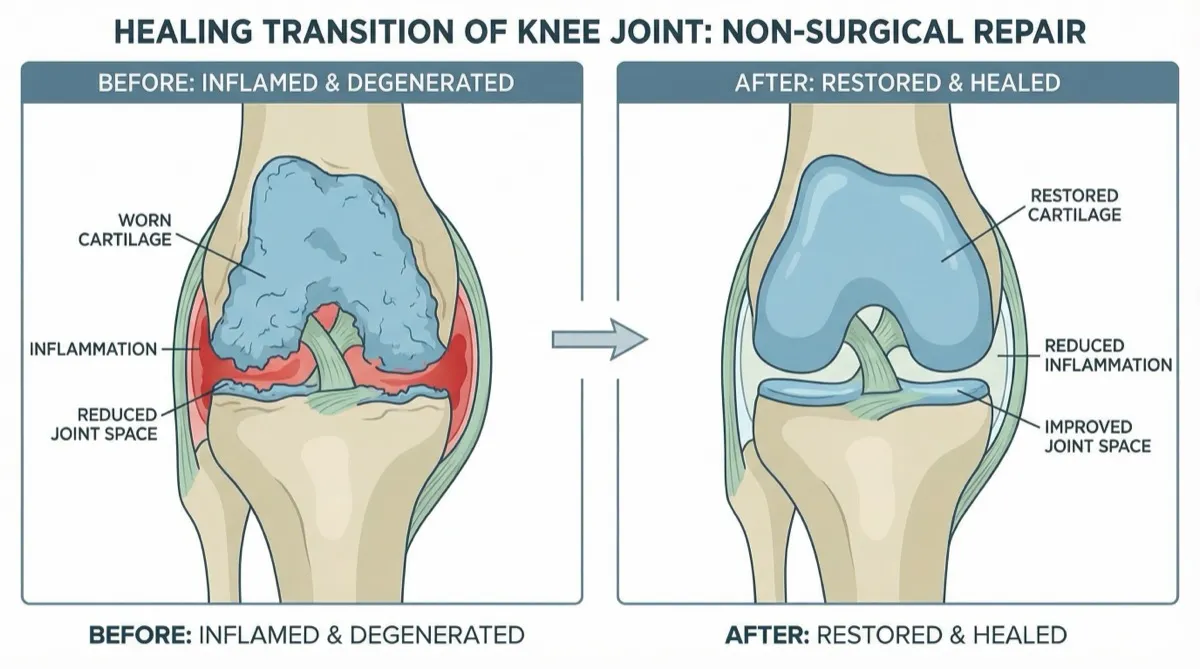
When we talk about repairing a knee without surgery, we’re referring to treatments that restore joint function, reduce inflammation, and promote natural healing processes. While non-surgical methods cannot physically reconstruct torn ligaments or replace severely damaged joints, they can effectively:
- Restore lubrication to the joint space, reducing friction between bones
- Stimulate natural healing responses through regenerative medicine approaches
- Reduce inflammation that causes pain and limits mobility
- Strengthen supporting structures through targeted physical therapy
- Improve overall joint function and quality of life
The goal isn’t always to “fix” the knee to its pre-injury state, but rather to optimize its function and minimize pain through evidence-based, conservative approaches.
Evidence-Based Non-Surgical Knee Treatment Options
1. Viscosupplementation: Gel Injections for Long-Lasting Relief
Viscosupplementation involves injecting hyaluronic acid—a gel-like substance that naturally occurs in healthy joint fluid—directly into the knee joint. This treatment works by:
- Lubricating the joint to reduce bone-on-bone friction
- Cushioning the knee during weight-bearing activities
- Neutralizing harmful inflammatory chemicals
- Stimulating the production of natural joint-protecting proteins
Research shows that patients with mild to moderate arthritis experience the best results, with 91% of grade I patients and 80% of grade II patients reporting improvement after viscosupplementation [2]. Pain relief can last up to six months or longer, making it a viable alternative to surgery for many patients.
At the Joint Relief Institute, we take viscosupplementation to the next level with fluoroscopy-guided injections. This real-time imaging technology ensures 100% accurate needle placement—critical because studies show that non-guided injections miss the joint up to 30% of the time [3]. When injections miss the target, the treatment is completely ineffective.
2. Physical Therapy and Structured Exercise Programs
Physical activity might seem counterintuitive when your knee hurts, but structured exercise is one of the most effective non-surgical treatments available. Physical therapy combines:
- Targeted strengthening exercises to support the knee joint
- Flexibility training to improve range of motion
- Gait training to reduce harmful stress patterns
- Education on joint protection strategies
According to current medical guidelines, structured land-based exercise programs are considered a core treatment for knee osteoarthritis [4]. The benefits are substantial: each pound of weight lost can reduce the load on your knees by 3 to 6 times [1], and regular exercise significantly improves muscle strength while reducing symptom severity.
3. Regenerative Medicine Approaches
Cutting-edge regenerative therapies harness your body’s natural healing capabilities:
Platelet-Rich Plasma (PRP) Injections: PRP uses concentrated platelets from your own blood to boost tissue regeneration and repair cartilage. Research indicates that in active, younger individuals with early-stage osteoarthritis, PRP is more effective than hyaluronic acid [1].
Stem Cell Therapy: Mesenchymal stem cells taken from bone marrow or fat tissue are injected into the damaged joint, where they release healing compounds that support cartilage regeneration [5]. While still considered investigational by the FDA, emerging research shows promise for cartilage repair.
Novel Biomaterials: Researchers have observed evidence of enhanced cartilage repair within six months using bioactive materials, including the growth of new cartilage containing natural biopolymers [5].
4. Targeted Injection Therapies
Beyond viscosupplementation, several injection options provide relief:
Corticosteroid Injections: These anti-inflammatory injections are often recommended for acute flare-ups, typically dosed at 40 mg and spaced three months apart [1]. While they don’t repair cartilage, they effectively reduce inflammation and pain.
Radiofrequency Ablation (RFA): This minimally invasive procedure uses heat to interrupt pain signals from the knee. A meta-analysis of 15 randomized controlled trials involving 1,009 patients found that RFA proved efficient after 12 weeks [1], with most research showing safe and effective pain reduction for 3-12 months [6].
5. Complementary Conservative Treatments
A comprehensive non-surgical approach often includes:
- Weight management programs to reduce joint stress
- Bracing and orthotics to improve alignment and stability (studies show brace modalities demonstrate significant pain and functional improvements [6])
- Low-level laser therapy combined with exercise
- Aquatic therapy for low-impact strengthening
- Topical NSAIDs for localized pain relief (strongly recommended in medical guidelines [4])
The Science Behind Non-Surgical Knee Repair
Understanding how non-surgical treatments work requires a look at the knee osteoarthritis disease process:
When knee cartilage is damaged through routine wear and tear, it triggers the release of inflammatory chemicals into the synovial fluid—the natural lubricant between your bones. This inflammatory cascade:
- Damages cartilage-producing cells (chondrocytes), accelerating bone degeneration
- Stimulates pain-sensing nerve fibers, causing chronic discomfort
- Thins the synovial fluid, reducing its lubricating properties
- Increases friction between bones, leading to painful bone spurs
Non-surgical treatments interrupt this destructive cycle at multiple points. Viscosupplementation replenishes lost lubricant, PRP delivers healing growth factors, and physical therapy strengthens the supporting muscles that reduce joint stress.
However, it’s important to understand that adult hyaluronic cartilage has limited natural regenerative capacity due to reduced blood flow [5]. This is why early intervention with non-surgical treatments often yields better results than waiting until the arthritis is severe.
Who Is a Good Candidate for Non-Surgical Knee Repair?
Non-surgical treatments work best for patients who:
- Have mild to moderate osteoarthritis (grades I-III)
- Experience pain that limits daily activities but can still bear weight
- Have not found adequate relief from over-the-counter medications
- Want to avoid surgical risks and lengthy recovery periods
- Are motivated to participate in physical therapy and lifestyle modifications
- Have realistic expectations about treatment outcomes
Even patients with more advanced arthritis can benefit from non-surgical approaches. A 5-year follow-up study found that 76% of patients who received structured non-operative care experienced clinically important improvements [6], with many successfully avoiding surgery.
Real Patient Outcomes: What to Expect
While individual results vary, research provides encouraging data on non-surgical treatment effectiveness:
- Pain reduction: Most patients experience significant pain relief within weeks to months
- Improved function: Studies show meaningful improvements in knee function scores
- Surgery avoidance: Many patients successfully delay or avoid knee replacement
- Quality of life: Patients report being able to return to activities they love
“I didn’t know how much LIFE and SLEEP I was missing because of my knee pain, until it went away with this wonderful treatment.”
— George R., Joint Relief Institute Patient
“Every day was hard. I couldn’t enjoy my favorite activities anymore. But thankfully, I’m back in full form. I am doing yard work for the first time in years!”
— Phil M., Joint Relief Institute Patient
It’s worth noting that success isn’t always measured by complete pain elimination. As one long-term study found, most patients experienced clinically important improvements regardless of initial treatment strategy [6]. The key is finding the right combination of treatments for your specific situation.
Why the Joint Relief Institute’s Approach Is Different
At the Joint Relief Institute, we’ve treated over 40,000 patients with more than 400,000 procedures, earning a 4.9 Google rating through our commitment to precision and patient care.
Our key differentiator is fluoroscopy-guided viscosupplementation—we use real-time X-ray imaging for every single injection to guarantee 100% accurate placement. This matters because even experienced physicians miss the knee joint space up to 30% of the time without imaging guidance [3], and when injections miss, the treatment is completely ineffective.
Founded by Dr. Michael Hana, the Joint Relief Institute was built on a simple mission: “I wanted to make sure that as many people as possible with knee pain can undergo a simple, low-risk, low-cost procedure that could change their lives.”
Our approach includes:
- Board-certified physicians with specialized training
- State-of-the-art fluoroscopy technology for every procedure
- Comprehensive evaluation to determine if you’re a good candidate
- Medicare and most insurance plans accepted
- Same-day appointments often available
- Honest guidance—if we think surgery is your best option, we’ll tell you
Frequently Asked Questions
Can knee cartilage actually regenerate without surgery?
While researchers have yet to develop an FDA-approved injection that significantly regenerates damaged articular cartilage [5], regenerative therapies like PRP and stem cells can stimulate repair responses. Emerging biomaterial approaches show promise, with studies observing new cartilage growth within six months [5]. However, current non-surgical treatments focus primarily on restoring function and reducing pain rather than complete cartilage regeneration.
How long does viscosupplementation relief last?
Pain relief from hyaluronic acid injections typically lasts up to six months, and sometimes longer [2]. The duration varies based on arthritis severity, activity level, and individual response. Many patients receive repeated treatments to maintain benefits.
Is non-surgical treatment as effective as knee replacement surgery?
For appropriate candidates with mild to moderate arthritis, non-surgical treatments can provide excellent results without surgical risks. However, patients with severe bone-on-bone arthritis may ultimately need surgery. A 5-year study found that while many patients avoid surgery through conservative care, outcomes vary significantly [6]. The best approach depends on your specific condition.
Does insurance cover non-surgical knee treatments?
Most insurance plans, including Medicare, cover medically necessary viscosupplementation and physical therapy. At the Joint Relief Institute, we accept Medicare and most major insurance plans. Our team can verify your coverage before treatment.
What happens if non-surgical treatment doesn’t work?
If conservative treatments don’t provide adequate relief after a reasonable trial period (typically 3-6 months), surgical options can still be pursued. Non-surgical treatments don’t “burn bridges”—you can always proceed to surgery if needed. Many patients find that trying non-surgical approaches first gives them peace of mind that they’ve explored all options.
Are there any risks with non-surgical knee treatments?
Non-surgical treatments carry significantly lower risks than surgery. Viscosupplementation side effects are typically mild, with 99% classified as mild-to-moderate and rarely requiring hospital admission [7]. The most common side effects include temporary injection site pain, warmth, or swelling that resolves quickly with ice. Physical therapy is extremely safe when performed under professional guidance.
Take the Next Step Toward Pain-Free Knees
The answer to “Can a knee be repaired without surgery?” is a resounding yes—for many patients, non-surgical treatments provide effective, lasting relief without the risks and recovery time of surgery.
If you’re experiencing chronic knee pain and want to explore your options, the team at the Joint Relief Institute is here to help. After answering a few quick questions to determine your eligibility, we can often book you an appointment the same day.
Contact us today:
Call: (800) 238-9307
Our friendly team of board-certified providers has helped thousands determine if viscosupplementation is the right course of treatment—and if surgery is truly necessary, we’ll be honest about that too.
You have nothing to lose but pain. Take the first step toward reclaiming your mobility today.
Sources
-
National Center for Biotechnology Information. “Current Non-surgical Management of Knee Osteoarthritis.” PMC, 2023. https://pmc.ncbi.nlm.nih.gov/articles/PMC10370281/
-
American Academy of Orthopaedic Surgeons. “Viscosupplementation Treatment for Knee Arthritis.” OrthoInfo, 2024. https://orthoinfo.aaos.org/en/treatment/viscosupplementation-treatment-for-knee-arthritis/
-
Arthritis Knee Pain Centers. “What Is a Fluoroscopy Injection?” AKPC Wellness Blog, 2024. https://arthritiskneepain.com/wellness-blog/what-is-a-fluoroscopy-injection/
-
ScienceDirect. “Non-pharmacological and non-surgical interventions to manage patients with knee osteoarthritis: An umbrella review 5-year update.” 2024. https://www.sciencedirect.com/science/article/pii/S2665913124000645
-
National Center for Biotechnology Information. “Treatment of knee cartilage lesions in 2024: From hyaluronic acid to regenerative medicine.” PMC, 2024. https://pmc.ncbi.nlm.nih.gov/articles/PMC10985633/
-
ScienceDirect. “The Functional Outcomes of Patients With Knee Osteoarthritis Managed Nonoperatively at 5-Year Follow-Up: Does Surgical Avoidance Mean Success?” 2020. https://www.sciencedirect.com/science/article/abs/pii/S0883540320304757
-
Johns Hopkins Medicine. “Knee Replacement Alternatives to Consider.” Health Library, 2024. https://www.hopkinsmedicine.org/health/treatment-tests-and-therapies/knee-replacement-alternatives-to-consider
-
Penn Medicine. “Nonsurgical Treatments for Knee Pain.” Orthopaedics, 2024. https://www.pennmedicine.org/specialties/orthopaedics/knee-pain/nonsurgical-treatments
-
Cleveland Clinic. “Knee Gel Injections (Viscosupplementation): Uses & Side Effects.” Health Library, 2024. https://my.clevelandclinic.org/health/procedures/knee-gel-injections-viscosupplementation
-
Hospital for Special Surgery. “What to Know About Knee Gel Injections (Viscosupplementation).” Health Library, 2024. https://www.hss.edu/health-library/conditions-and-treatments/knee-gel-injections-viscosupplementation
-
BMC Musculoskeletal Disorders. “The global state of research in nonsurgical treatment of knee osteoarthritis: a bibliometric and visualized study.” 2019. https://bmcmusculoskeletdisord.biomedcentral.com/articles/10.1186/s12891-019-2804-9
-
Annals of Translational Medicine. “Non-operative treatment options for knee osteoarthritis.” 2019. https://atm.amegroups.org/article/view/27053/html


