
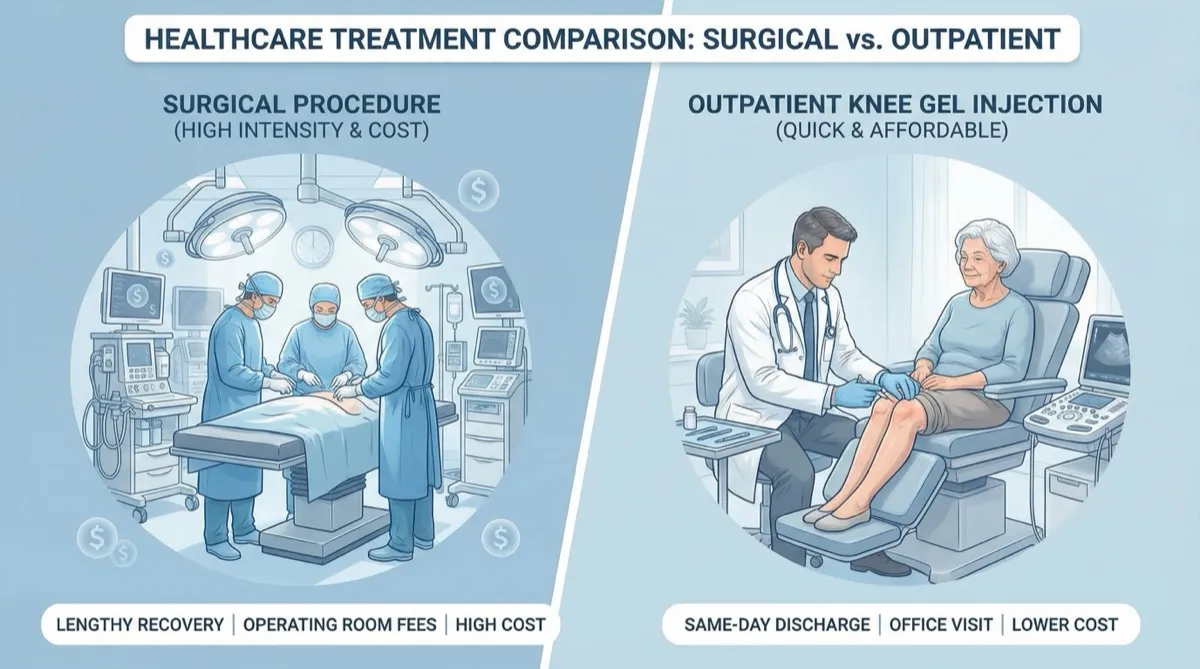
Knee Surgery Cost vs. Gel Injections: What Medicare Actually Pays
If you’re a Medicare beneficiary dealing with knee osteoarthritis, you’ve likely wondered how much surgery would actually cost you out of pocket — and whether there’s a more affordable path to relief. Thanks to publicly available CMS Medicare data, we can now show you exactly what Medicare pays and what you’d owe for knee surgery versus gel injections (viscosupplementation).
The difference is striking.
Medicare Knee Surgery Costs: The Real Numbers
The following data comes from the CMS Medicare Provider Utilization & Payment Data (CY2023) and the OPPS Fee Schedule (FY2025) for Illinois providers. These are average allowed amounts — what Medicare approves as the total cost of care.
Knee Surgery Cost Breakdown
| Procedure | Total Allowed | Medicare Pays | Your Out-of-Pocket |
|---|---|---|---|
| Total Knee Replacement (DRG 470) | $15,934 | $12,814 | $3,120 |
| Complex Knee Replacement (DRG 469) | $26,964 | $23,900 | $3,064 |
| Knee Revision Surgery (DRG 467) | $31,453 | $24,924 | $6,529 |
Even with Medicare covering the majority, your share for a standard total knee replacement is over $3,100. If complications require a revision, you could owe more than $6,500 out of pocket.
Gel Injection (Viscosupplementation) Cost Breakdown
| Procedure | Total Allowed | Medicare Pays | Your Out-of-Pocket |
|---|---|---|---|
| Viscosupplementation (gel injection series) | $826 | $645 | ~$180 |
A complete gel injection series under Medicare costs you approximately $180 out of pocket.
The Math Is Clear
When you compare these numbers side by side, the financial case for trying gel injections before surgery is overwhelming:
- You save at least $2,940 in out-of-pocket costs by choosing gel injections over a standard knee replacement
- You could have approximately 17 gel injection series for the same out-of-pocket cost as one total knee replacement
- A knee revision surgery costs you 36 times more out of pocket than a gel injection series
And this doesn’t account for the additional costs of surgery that Medicare data alone doesn’t capture: physical therapy co-pays, prescription medications during recovery, home modifications, lost income if you’re still working, and potential complications that require additional care.
Beyond the Dollar Signs: What Surgery Really Costs
Financial cost is only part of the picture. Knee replacement surgery also demands:
- Weeks to months of recovery — most patients need 3 to 6 months before returning to normal activities, and full recovery can take a year or more
- Hospital stay — typically 1 to 3 days for a standard replacement
- Physical therapy — usually 2 to 3 sessions per week for several months, each with its own co-pay
- Risk of complications — infection, blood clots, implant failure, and nerve damage are all documented surgical risks
- Potential revision surgery — knee implants don’t last forever, and a revision (DRG 467) costs significantly more than the original procedure
What Gel Injections Offer Instead
Viscosupplementation (gel injections) provides a fundamentally different experience:
- No surgery, no anesthesia, no hospital stay
- Treatment takes about 15 minutes in an office setting
- No downtime — many patients return to normal activities the same day
- Covered by Medicare for diagnosed knee osteoarthritis
- Can be repeated — if injections work well, the series can be repeated when the benefits wear off
At Joint Relief Institute, our advanced fluoroscopy-guided technique has helped over 30,000 patients find relief from knee pain without surgery, with a 90% success rate.
Who Should Consider Gel Injections First?
Gel injections are worth exploring if you:
- Have been diagnosed with knee osteoarthritis
- Are looking for a non-surgical option before committing to replacement
- Want to stay active with minimal disruption to your daily life
- Are concerned about surgical risks, especially if you have other health conditions
- Want to keep your out-of-pocket Medicare costs as low as possible
Surgery may still be the right choice for some patients with advanced joint damage. But the CMS data makes a strong case for trying the least invasive, most affordable option first.
Take the Next Step
If you’re a Medicare beneficiary with knee osteoarthritis, you owe it to yourself to explore gel injections before scheduling surgery. Learn more about how gel injections compare to knee surgery, or call us today at (708) 963-0064 to schedule a consultation.
Our team will verify your Medicare coverage and help you understand your options — with no obligation.
Data sources: CMS Medicare Provider Utilization & Payment Data (CY2023); CMS OPPS Fee Schedule (FY2025), Illinois providers. Costs shown are averages and may vary by provider and individual Medicare plan. This article is for informational purposes only and does not constitute medical advice. Individual results may vary. Medicare coverage is subject to eligibility requirements and plan terms. Consult your physician to determine the best treatment for your condition.


