
The #1 Mistake That Makes Bad Knees Worse (And What to Do Instead)
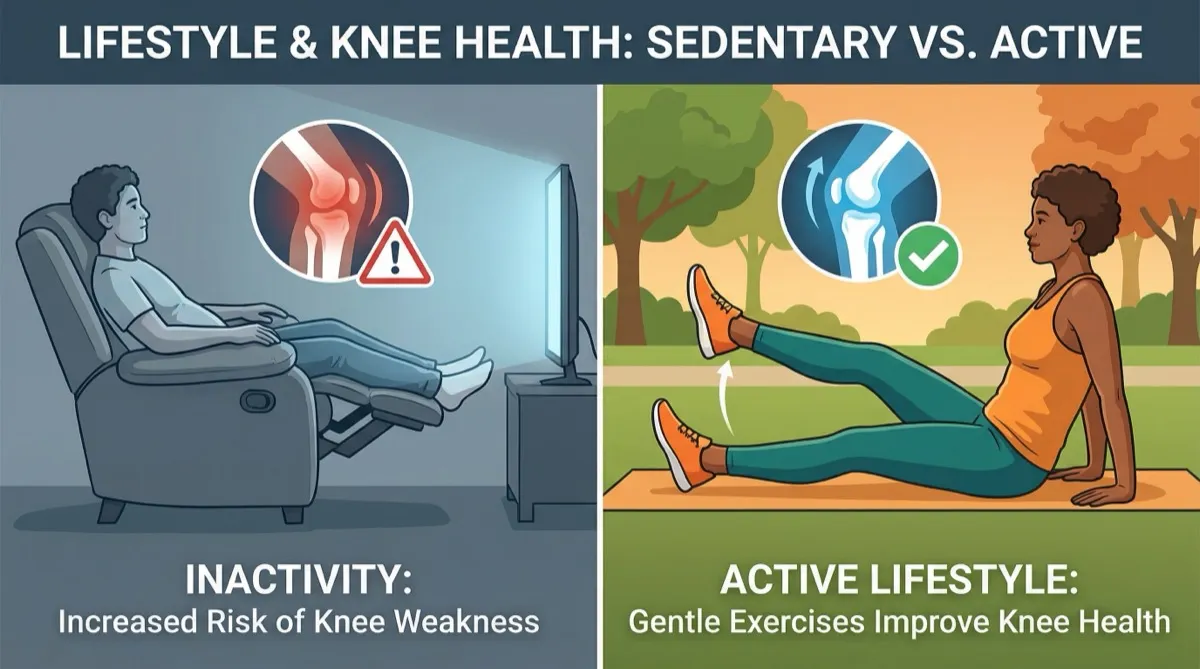
If you’re dealing with knee pain, you’ve probably heard the same advice from well-meaning friends and family: “Just rest it.” It sounds logical. Your knee hurts, so you should give it a break, right?
Wrong.
Resting too much is actually the single biggest mistake people make when dealing with knee pain—and it’s making millions of knees progressively worse. In fact, research shows that adults with knee osteoarthritis spend two-thirds of their day in sedentary behavior, which directly correlates with declining physical function [1].
If you’ve been babying your knee, sitting more, and moving less, this article will explain why that approach backfires—and what you should do instead to find lasting relief.
Why “Rest Is Best” Is a Dangerous Myth
The “rest is best” philosophy for knee pain is one of the most persistent medical myths, and it’s causing real harm. While rest has its place in acute injuries (like immediately after a trauma), prolonged rest for chronic knee pain leads to a devastating cycle [2].
Here’s what actually happens when you rest too much:
1. Muscle Atrophy Happens Fast—Really Fast
You can start losing muscle within just 3-5 days of total rest. This process, called muscle atrophy, is one of the fastest ways you lose strength, coordination, and confidence [3].
For people with knee osteoarthritis, the numbers are even more alarming. Studies document a 12% reduction in quadriceps cross-sectional area in women with radiographic evidence of knee OA [4]. Your quadriceps muscles—the powerful muscles on the front of your thigh—are critical for knee stability and function. When they weaken, your knee joint loses essential support.
2. Joint Stiffness Increases
When you avoid moving your knee, the joint becomes stiffer. This creates a vicious cycle: stiffness causes more pain, which makes you want to move even less, which increases stiffness further [5].
Prolonged rest weakens the muscles supporting your knees and exacerbates the problem, leading to decreased joint functionality [6].
3. Pain Sensitivity Heightens
Perhaps most surprisingly, inactivity can actually make you more sensitive to pain. Research reveals that 69% of people with knee pain hold stronger implicit (unconscious) beliefs that exercise is dangerous compared to people without pain [7]. Even among those who said they weren’t fearful about exercise, they held unconscious beliefs that movement was dangerous.
This psychological barrier reinforces physical inactivity, creating a self-fulfilling prophecy where fear of movement leads to less movement, which leads to worse outcomes.
The Scope of the Problem: Knee Pain by the Numbers
Knee pain isn’t just common—it’s reaching epidemic proportions:
- 15% of all people aged 30 and older experience osteoarthritis globally, with the knee being the most affected joint [8]
- The knee accounts for 85% of all osteoarthritis cases worldwide [8]
- By 2050, osteoarthritis of the knee will increase by 75% due to aging, population growth, and obesity [9]
- Despite physical activity being proven to ease symptoms, only 1 in 10 people with knee OA regularly exercise [10]
These statistics paint a clear picture: we’re in a knee pain crisis, and our instinctive response—rest—is making it worse.
The Other Common Mistakes That Compound the Problem
While excessive rest is the #1 mistake, several other behaviors work together to worsen knee pain:
Doing the Wrong Exercises (Or Weekend Warrior Syndrome)
There’s a fine line between beneficial movement and harmful exercise. The most aggravating activities for patients with knee problems are endless squats and lunges, which put high forces repeatedly through the knee [11].
Similarly, “weekend warrior” behavior—playing hard on weekends but neglecting exercise the rest of the week—concentrates all physical activity into a short period, risking serious knee injury [12].
Wearing Improper Footwear
Worn-out or improper footwear that doesn’t support your feet creates a chain reaction affecting your knees, hips, and lower back. This seemingly minor mistake can prevent knee pain from resolving [13].
Ignoring the Pain Until It’s Severe
Choosing to ignore knee pain may only make the problem worse by causing further joint damage or injury. Early intervention is crucial for the best outcomes [14].
What You Should Do Instead: The Evidence-Based Approach
If rest isn’t the answer, what is? The research is clear: controlled, appropriate movement is essential for knee health.
1. Engage in Low-Impact, Consistent Exercise
Exercise therapy, including both global and targeted resistance training, is effective in reducing pain and improving function in people with knee osteoarthritis [15]. The key is consistency and choosing the right activities:
Recommended activities:
- Swimming or water aerobics
- Cycling (stationary or outdoor)
- Elliptical training
- Walking on flat, even surfaces
- Tai chi or gentle yoga
Activities to avoid:
- High-impact exercises that “jar” the leg (running, jumping, kickboxing)
- Deep squats and repetitive lunges
- Sudden pivoting movements
2. Strengthen the Muscles Around Your Knee
Quadriceps strengthening is particularly important. These muscles act as shock absorbers for your knee joint. Even simple exercises like straight leg raises and seated leg extensions can make a significant difference.
3. Maintain a Healthy Weight
Carrying extra pounds puts additional pressure on your knees. For every pound of body weight lost, there’s a four-pound reduction in knee joint stress during walking [16].
4. Consider Advanced Treatment Options When Conservative Measures Aren’t Enough
For many people, lifestyle modifications alone aren’t sufficient. When basic conservative treatments have been exhausted, advanced interventions like viscosupplementation may be appropriate.
When to Consider Viscosupplementation for Knee Pain
Viscosupplementation—gel injections containing hyaluronic acid—is a non-surgical treatment option that can provide significant relief for knee osteoarthritis. This treatment works by supplementing the natural lubricating fluid in your knee joint [17].
The Precision Advantage: Fluoroscopy-Guided Injections
Not all knee injections are created equal. Traditional “blind” injections rely on anatomical landmarks, but fluoroscopy-guided injections use real-time X-ray imaging to ensure precise needle placement.
Research confirms that fluoroscopy-guided injections demonstrate correct needle placement and reliable medication delivery into the knee joint [18]. Studies show that fluoroscopic guidance achieves 100% accuracy in joint injections, with 83% success on the first attempt [19].
Patients who receive fluoroscopy-guided injections experience significantly more pain relief and improved joint function compared to those who receive traditional blind injections [20].
What to Expect from Viscosupplementation
While viscosupplementation won’t cure or reverse arthritis, it can provide meaningful pain relief. Most individuals can expect approximately 3 months of relief, though results vary [21]. The earlier you begin treatment after diagnosis, the more effective it tends to be, particularly for mild to moderate arthritis [22].
Important considerations:
- Try all other nonsurgical treatment methods first
- Avoid excessive activity for 48 hours after injection
- Understand that it’s not a cure—it’s a pain management tool
- Results are variable; some people respond better than others
The Joint Relief Institute Difference
At Joint Relief Institute, we’ve helped over 40,000 patients find relief through precision-guided viscosupplementation. Our approach combines:
- Fluoroscopy-guided injections for maximum accuracy and effectiveness
- Over 400,000 procedures performed by our experienced team
- 4.9 Google rating from thousands of satisfied patients
- Medicare and most insurance plans accepted
Under the leadership of Dr. Michael Hana, our team specializes in non-surgical solutions that help you avoid or delay knee replacement surgery while maintaining an active lifestyle.
Take Action Today
If you’ve been resting your knee hoping the pain would go away, it’s time to change your approach. The science is clear: controlled movement, appropriate exercise, and when necessary, advanced treatments like fluoroscopy-guided viscosupplementation offer the best path to relief.
Don’t let the #1 mistake—excessive rest—rob you of the active life you deserve.
Ready to explore your options?
Call Joint Relief Institute at (800) 238-9307 to schedule a consultation. Our specialists will evaluate your specific condition and create a personalized treatment plan designed to get you back to the activities you love.
Frequently Asked Questions
How much rest is too much for knee pain?
While you should avoid activities that cause severe pain, complete rest for more than a few days can lead to muscle atrophy and increased stiffness. Gentle, low-impact movement is typically beneficial even during flare-ups, but consult with a healthcare provider for personalized advice.
Can exercise really help arthritic knees?
Yes. Multiple studies confirm that exercise therapy, including resistance training, effectively reduces pain and improves function in people with knee osteoarthritis. The key is choosing appropriate, low-impact exercises and building up gradually.
How long does it take to regain muscle strength after prolonged rest?
Muscle loss can begin in just 3-5 days of inactivity, but the good news is that targeted strengthening exercises can help you regain strength. Most people see noticeable improvements within 4-6 weeks of consistent, appropriate exercise.
Is viscosupplementation right for everyone with knee pain?
No. Viscosupplementation is typically considered after other conservative treatments have been tried. It may not be appropriate if you have a knee joint infection, skin disease, or certain bleeding disorders. A thorough evaluation by a specialist can determine if you’re a good candidate.
What’s the difference between fluoroscopy-guided and blind injections?
Fluoroscopy-guided injections use real-time X-ray imaging to ensure precise needle placement and medication delivery directly into the knee joint. Blind injections rely on anatomical landmarks alone. Research shows fluoroscopy-guided injections achieve significantly better accuracy and clinical outcomes.
Sources
-
National Institutes of Health. “Sedentary behavior and physical function: Objective Evidence from the Osteoarthritis Initiative.” PMC, 2015. https://pmc.ncbi.nlm.nih.gov/articles/PMC4336845/
-
Crouch Physio. “Busting Knee Pain Myths: Insights From A Physiotherapist.” 2024. https://crouchphysio.com/busting-knee-pain-myths-insights-from-a-physiotherapist/
-
UNITE Rehab Perform. “Why Rest Isn’t Always The Best.” 2024. https://uniterehabperform.com/why-rest-isnt-always-the-best/
-
American Academy of Physical Medicine and Rehabilitation. “Muscle Impairments in Patients With Knee Osteoarthritis.” PMC, 2012. https://pmc.ncbi.nlm.nih.gov/articles/PMC3435919/
-
Preferred Physical Therapy. “3 Common Mistakes That Make Your Knee Pain Worse.” 2024. https://preferredptaz.com/3-common-mistakes-that-make-your-knee-pain-worse/
-
Knee Pain Centers of America. “The Importance of Rest and Recovery in Treating Knee Pain.” 2024. https://www.kneepaincentersofamerica.com/blog/the-importance-of-rest-and-recovery-in-treating-knee-pain
-
ScienceDaily. “Painful truth about knee osteoarthritis: Why inactivity may be more complex than we think.” June 2024. https://www.sciencedaily.com/releases/2024/06/240611194717.htm
-
Institute for Health Metrics and Evaluation. “The Lancet: New study reveals the most common form of arthritis, osteoarthritis, affects 15% of the global population over the age of 30.” 2023. https://www.healthdata.org/news-events/newsroom/news-releases/lancet-new-study-reveals-most-common-form-arthritis
-
Osteoarthritis Action Alliance. “OA Prevalence and Burden.” 2024. https://oaaction.unc.edu/oa-module/oa-prevalence-and-burden/
-
University of South Australia. “Painful truth about knee osteoarthritis: Why inactivity may be more complex than we think.” 2024. https://unisa.edu.au/media-centre/Releases/2024/painful-truth-about-knee-osteoarthritis—why-inactivity-may-be-more-complex-than-we-think/
-
King Edward VII’s Hospital. “9 things you could be doing that will make your knee pain worse.” 2024. https://www.kingedwardvii.co.uk/health-hub/9-things-you-could-be-doing-that-will-make-your-knee-pain-worse
-
Dr. Louis Keppler & Associates. “6 Mistakes You’re Making That Contribute to Knee Problems.” 2024. https://drlouiskeppler.com/6-mistakes-youre-making-that-contribute-to-knee-problems/
-
Rheumatology Center of New Jersey. “Bad Habits That Could Be Making Your Knee Pain Worse.” 2024. https://www.rhcnj.com/blog/bad-habits-that-could-be-making-your-knee-pain-worse
-
Coastal Empire Orthopedics. “5 Ways You Could be Making Your Knee Pain Worse.” 2024. https://www.jonathanshultsmd.com/blog/5-ways-you-could-be-making-your-knee-pain-worse
-
National Institutes of Health. “Muscle Impairments in Patients With Knee Osteoarthritis.” PMC, 2012. https://pmc.ncbi.nlm.nih.gov/articles/PMC3435919/
-
Cleveland Clinic. “Knee Pain: What It Is, Causes, Treatment & Relief.” 2024. https://my.clevelandclinic.org/health/symptoms/21207-knee-pain
-
Cleveland Clinic. “Knee Gel Injections (Viscosupplementation): Uses & Side Effects.” 2024. https://my.clevelandclinic.org/health/articles/14982-viscosupplementation-for-osteoarthritis-of-the-knee
-
National Institutes of Health. “Accuracy of ultrasound-guided knee injections confirmed by fluoroscopy.” PMC, 2024. https://pmc.ncbi.nlm.nih.gov/articles/PMC11372981/
-
Nature Scientific Reports. “Efficacy of three different techniques in the fluoroscopy-guided intra-articular steroid injection of the hip: a randomized controlled trial.” 2023. https://www.nature.com/articles/s41598-023-44595-5
-
Athens Heart Center. “Fluoroscopic Guided Injections for Knee Pain.” 2024. https://www.ahcspc.com/how-fluoroscopic-guided-injection-helps-alleviate-chronic-knee-pain/
-
Brian Waterman, MD. “Viscosupplementation Treatment for Knee Arthritis.” 2024. https://www.brianwatermanmd.com/knee/viscosupplementation-treatment-for-knee-arthritis/
-
Advanced Sports & Spine. “Viscosupplementation for Knee Osteoarthritis: What You Need to Know.” 2024. https://www.advancedsportsandspine.com/viscosupplementation-for-knee-osteoarthritis-what-you-need-to-know/
Disclaimer: This article is for informational purposes only and does not constitute medical advice. Always consult with a qualified healthcare provider before starting any new treatment or exercise program.


