
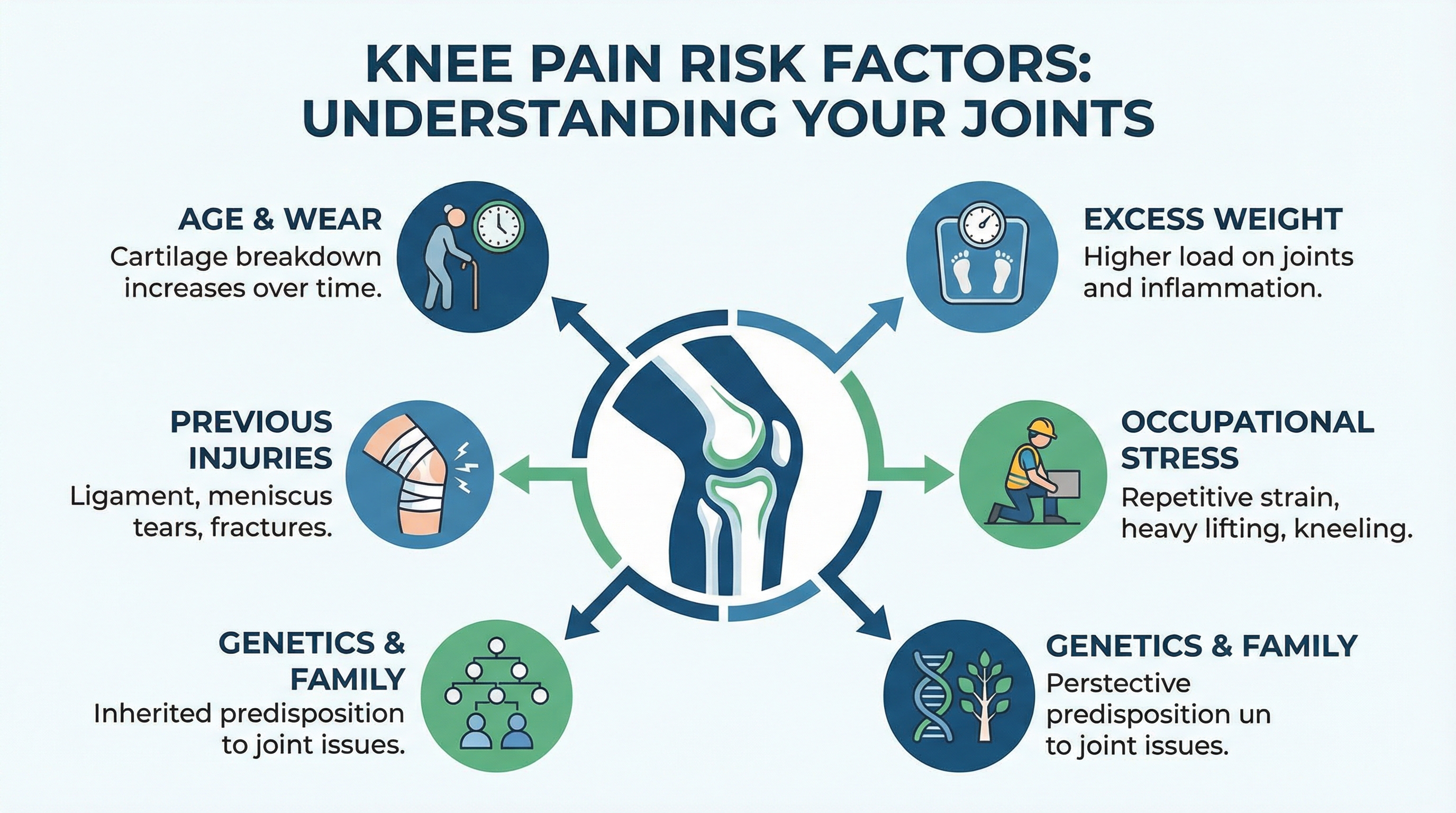
What Are the Risk Factors for Developing Knee Pain?
Knee pain affects millions of Americans, disrupting daily activities and reducing quality of life. Understanding the risk factors for developing knee pain is crucial for prevention and early intervention. Whether you’re an athlete, office worker, or retiree, knowing what increases your risk can help you take proactive steps to protect your knee health.
The lifetime risk of developing symptomatic knee osteoarthritis is approximately 45%, with 40% in men and 47% in women [1]. This striking statistic underscores the importance of understanding what puts you at risk and how to minimize those factors.
What Causes Knee Pain?
Knee pain develops when the structures within the knee joint—including cartilage, ligaments, tendons, and bones—experience damage, inflammation, or degeneration. While acute injuries can cause immediate pain, chronic knee pain often develops gradually over time as risk factors accumulate and compound.
Osteoarthritis, the most common cause of chronic knee pain, occurs when the protective cartilage cushioning your knee joint breaks down. Various factors contribute to this process, including mechanical stress, inflammatory responses, aging, and metabolic disorders [2].
Major Risk Factors for Knee Pain
Age: The Unavoidable Factor
Age is one of the strongest predictors of knee osteoarthritis. The prevalence of osteoarthritis increases dramatically with age, affecting 13.9% of adults aged 25 and older but jumping to 33.6% in adults aged 65 and older [1].
The incidence rates for knee osteoarthritis increase significantly after age 40, with notable spikes between ages 55-60 and again between 70-75 [3]. As we age, cartilage naturally loses its ability to repair itself, making the knee more vulnerable to wear and tear.
Weight and Obesity: The Most Modifiable Risk
Obesity stands as the greatest modifiable risk factor for knee osteoarthritis. The statistics are striking:
- Individuals with a BMI over 30 kg/m² are 6.8 times more likely to develop knee osteoarthritis than normal-weight individuals [3]
- Obese women face nearly 4 times the risk compared to non-obese women
- Obese men experience nearly 5 times greater risk [3]
- The maximum incidence rate reaches 19.5 per 1,000 person-years for those with grade II obesity, compared to just 3.7 for normal-weight individuals [3]
The good news? Weight loss significantly reduces risk. For women of average height, every 11-pound weight loss (approximately 2 BMI units) reduces knee osteoarthritis risk by more than 50% [3].
Excess weight affects knees through multiple mechanisms:
- Mechanical stress: Additional load on weight-bearing joints accelerates cartilage breakdown
- Inflammatory factors: Adipose tissue releases pro-inflammatory substances that damage joint tissues
- Metabolic effects: Obesity contributes to systemic inflammation affecting all joints
Occupation and Physical Demands
Your job can significantly impact your knee health. Occupational risk factors for knee osteoarthritis include:
High-Risk Occupations:
- Mining, construction, and carpentry workers show elevated risk
- Agricultural, forestry, and fishery workers have 1.94 times higher odds of knee osteoarthritis [4]
- Male construction workers and builders demonstrate statistically significant increased risk [4]
High-Risk Activities:
- Kneeling and squatting: Repeated or prolonged kneeling dramatically increases risk
- Heavy lifting: Combined heavy lifting and kneeling show odds ratios ranging from 1.8 to 7.9 [4]
- Physically demanding work: Heavy physical occupations carry pooled odds of 1.65 for knee osteoarthritis [4]
Research indicates that up to one in seven knee osteoarthritis cases can be directly attributed to work-related factors [4]. The overall occupational risk shows an odds ratio of 1.61, meaning most studies demonstrate at least a doubled risk with high exposure to these activities.
Previous Knee Injuries
Knee injuries significantly increase your risk of developing chronic knee pain and osteoarthritis later in life. Injuries such as anterior cruciate ligament (ACL) tears can lead to osteoarthritis occurring much earlier than it typically would [5].
Traumatic knee injury ranks among the three major risk factors for knee osteoarthritis, alongside obesity and physically demanding work [1]. Once a knee joint is injured, the damaged structures may not heal completely, leaving the joint vulnerable to accelerated degeneration.
Genetics and Family History
While you can’t change your genetic makeup, understanding your hereditary risk is valuable. Research shows that approximately 40-70% of osteoarthritis cases have a genetic component, with heritability varying by joint location [5]:
- Spine: 70%
- Hand: 65%
- Hip: 60%
- Knee: 40%
More than 300 genomic loci have been identified as associated with osteoarthritis at different joints [5]. Key genes involved include:
- COL2A1: Affects collagen production, a crucial structural protein in cartilage
- ASPN: Influences cartilage matrix organization
- GDF5: Linked to developmental hip dysplasia and knee osteoarthritis [5]
Importantly, people inherit an increased susceptibility to developing osteoarthritis, not the condition itself. Genetic factors interact with environmental and lifestyle factors to determine whether osteoarthritis develops.
Gender Differences
Women face a slightly higher lifetime risk of knee osteoarthritis (47%) compared to men (40%) [1]. This difference becomes more pronounced after menopause, suggesting hormonal factors may play a protective role earlier in life.
Other Contributing Factors
Additional risk factors include:
- Previous joint surgery: Any surgical intervention can alter joint mechanics
- Joint malalignment: Bowlegs or knock-knees create uneven stress distribution
- Muscle weakness: Weak quadriceps and hamstrings reduce joint support
- Smoking: Increases inflammation and impairs healing
- Hypertension and metabolic conditions: Contribute to systemic inflammation
Prevention Strategies to Protect Your Knees
While some risk factors like age and genetics can’t be modified, several effective strategies can reduce your knee pain risk:
Maintain a Healthy Weight
Weight management stands as the most impactful prevention strategy. Since obesity is one of the most significant risk factors for knee osteoarthritis, combining diet and exercise is crucial, especially when BMI exceeds 30 [2].
Strengthen Supporting Muscles
Strengthening the muscles that support your knee reduces stress on the joint. Strong muscles help absorb shock and stabilize the knee during movement [6]. Focus on:
- Quadriceps
- Hamstrings
- Glutes
- Hip muscles
- Core muscles
Effective injury prevention programs include dynamic stretches, flexibility drills, running drills, strength training (squats, lunges, Nordic hamstring exercises), and plyometric exercises [6].
Choose Low-Impact Activities
The best exercises for people concerned about knee health include:
- Walking on level ground
- Elliptical training
- Stationary cycling
- Swimming
- Water aerobics [6]
These activities provide cardiovascular benefits while minimizing joint stress.
Practice Proper Technique
Whether at work or during exercise:
- Use proper lifting mechanics
- Avoid prolonged kneeling or squatting when possible
- Wear appropriate footwear with good support
- Warm up before physical activity with 5-10 minutes of low-impact movement [6]
Address Injuries Promptly
Seek appropriate treatment for knee injuries to minimize long-term damage. Proper rehabilitation helps restore function and may reduce osteoarthritis risk.
When to Seek Professional Treatment
Early intervention can prevent minor knee issues from becoming chronic problems. Consider seeing a doctor if you experience:
Seek immediate medical attention if:
- Your knee injury involves a deformed joint, popping noise, inability to bear weight, intense pain, or sudden swelling [7]
- There’s significant swelling with inability to fully extend your leg [7]
Schedule an appointment within a few days if:
- Persistent knee pain affects your daily function or ability to exercise [7]
- You wake up with consistent knee stiffness
- Pain persists more than a few days or is accompanied by swelling, redness, or sensitivity [7]
- At-home remedies haven’t provided relief after several days
- Your knee discomfort has worsened despite previous treatments [7]
Advanced Treatment Options at Joint Relief Institute
At Joint Relief Institute, we specialize in non-surgical treatments for knee pain, particularly for patients with osteoarthritis. Our signature treatment, viscosupplementation with hyaluronic acid gel injections, provides cushioning and lubrication to arthritic knee joints.
What sets us apart:
- Fluoroscopy-guided injections: We use real-time X-ray guidance to ensure precise injection placement, maximizing effectiveness
- Extensive experience: Over 40,000 patients treated with 400,000+ procedures performed
- Outstanding patient satisfaction: 4.9 Google rating from thousands of reviews
- Insurance accepted: We accept Medicare and most insurance plans
Our approach focuses on helping patients avoid or delay knee surgery while maintaining active, pain-free lifestyles.
Take Control of Your Knee Health
Understanding your risk factors for knee pain empowers you to take preventive action. While you can’t change your age or genetics, you can:
- Maintain a healthy weight through diet and exercise
- Strengthen the muscles supporting your knees
- Modify high-risk occupational activities when possible
- Address injuries promptly and completely
- Stay physically active with low-impact exercises
If you’re experiencing knee pain that’s interfering with your quality of life, don’t wait for it to worsen. The specialists at Joint Relief Institute can evaluate your condition and recommend appropriate treatment options.
Ready to address your knee pain? Call (800) 238-9307 to schedule a consultation with our experienced team. We’re here to help you get back to the activities you love.
Sources
-
Frontiers in Medicine. “Recent advances in the management of knee osteoarthritis: a narrative review.” Frontiers, January 2025. https://www.frontiersin.org/journals/medicine/articles/10.3389/fmed.2025.1523027/full
-
eClinicalMedicine. “Global, regional prevalence, incidence and risk factors of knee osteoarthritis in population-based studies.” The Lancet, 2020. https://www.thelancet.com/journals/eclinm/article/PIIS2589-5370(20)30331-X/fulltext
-
National Center for Biotechnology Information. “Obesity & osteoarthritis.” PMC, 2013. https://pmc.ncbi.nlm.nih.gov/articles/PMC3788203/
-
National Center for Biotechnology Information. “Occupational risk in knee osteoarthritis: a systematic review and meta-analysis of observational studies.” PMC, 2020. https://pmc.ncbi.nlm.nih.gov/articles/PMC7116019/
-
Brown University Health. “Is Arthritis Hereditary? Understanding Genetic Predisposition to Osteoarthritis.” Brown Health, 2025. https://www.brownhealth.org/be-well/arthritis-hereditary-understanding-genetic-predisposition-osteoarthritis
-
American Academy of Orthopaedic Surgeons. “Knee Conditioning Program.” OrthoInfo - AAOS. https://orthoinfo.aaos.org/en/recovery/knee-conditioning-program/
-
Mayo Clinic. “Knee pain: When to see a doctor.” Mayo Clinic, 2024. https://www.mayoclinic.org/symptoms/knee-pain/basics/when-to-see-doctor/sym-20050688
-
National Center for Biotechnology Information. “Workplace-based prevention and management of knee pain: a systematic review.” PMC, December 2024. https://pmc.ncbi.nlm.nih.gov/articles/PMC11696606/


