
Surgical Options for Knee Pain: A Complete Guide to Your Choices
If you’re struggling with chronic knee pain, you’ve likely wondered whether surgery is your only option. While surgical interventions can provide relief for severe cases, understanding all your options—including less invasive alternatives—is crucial for making an informed decision about your health.
This comprehensive guide explores the primary surgical options for knee pain, their risks and benefits, recovery timelines, and why conservative treatments like viscosupplementation should be considered before going under the knife.
What Causes Knee Pain That Might Require Surgery?
Knee pain severe enough to warrant surgical consideration typically stems from osteoarthritis, the most common form of joint disease. Osteoarthritis occurs when the protective cartilage cushioning your knee joint gradually wears away, leading to bone-on-bone contact, inflammation, and chronic pain.
Other conditions that may lead to surgical discussions include meniscus tears, ligament injuries, and severe joint deformities. However, not all knee pain requires surgery—in fact, conservative management is conventionally the first line of treatment to avoid or delay the need for surgical intervention [1].
Conservative Treatment: The Essential First Step
Before exploring surgical options, it’s critical to understand that non-surgical treatments should always be attempted first. Research consistently demonstrates that conservative treatment is effective, even in most people with advanced osteoarthritis, and can help delay knee surgery for several years or even avoid the need for it altogether [2].
Evidence-Based Conservative Options
According to recent systematic reviews, these non-surgical approaches have strong evidence supporting their effectiveness:
Physical Therapy and Exercise: Patients with knee osteoarthritis who received manual physical therapy with supervision showed 55% improvement in WOMAC scores compared to control groups. Remarkably, at one year post-treatment, only 5% of the treatment group received a total knee replacement compared to 20% of the control group [3].
Weight Management: Every kilogram lost in body weight results in a 2.2 kg reduction in peak knee joint loading [4]. Given that every pound of body weight places an additional four pounds of pressure on the knee joint, weight loss can dramatically reduce joint stress.
Viscosupplementation (Gel Injections): Hyaluronic acid injections can effectively reduce pain, increase functionality, and delay surgery. In a network meta-analysis, HA viscosupplementation was ranked as the most effective treatment for knee osteoarthritis, with an effect size of 0.63—much higher than that of NSAIDs [5].
Studies show that 67% of people with knee osteoarthritis who had conservative treatment only experienced noticeable symptom improvement and managed without surgery for the next two years [6].
Understanding Viscosupplementation: A Proven Alternative to Surgery
At Joint Relief Institute, we specialize in viscosupplementation—a minimally invasive treatment that can help you avoid or delay knee surgery. This FDA-approved therapy involves injecting hyaluronic acid directly into the knee joint to restore lubrication and reduce pain.
How Viscosupplementation Works
People with osteoarthritis have lower-than-normal concentrations of hyaluronic acid in their joints. Viscosupplementation replenishes this natural lubricant, helping the joint move more smoothly and reducing inflammation. Some studies suggest hyaluronic acid may also be chondroprotective, potentially slowing arthritis progression [7].
The JRI Advantage: Fluoroscopy-Guided Precision
Unlike traditional blind injections, Joint Relief Institute uses fluoroscopy-guided injections for maximum accuracy and effectiveness. This real-time imaging technology ensures:
- Precise Placement: The medication is injected directly into the exact location needed, maximizing treatment effectiveness [8]
- First-Attempt Accuracy: Proper needle placement on the first try, reducing procedure time and patient discomfort [9]
- Safety: Real-time visualization minimizes risk of accidental injury to nerves or blood vessels [10]
- Confirmation: Visual confirmation that the medication disperses properly throughout the joint space [11]
Treatment Protocol and Results
Depending on the specific product used, treatment involves 1 to 5 injections over several weeks. For patients who respond well to an initial series, repeat treatments are typically administered when at least 6 months have elapsed since the previous series [12].
With over 40,000 patients treated and 400,000+ procedures performed, Joint Relief Institute has established itself as a leader in non-surgical knee pain treatment, maintaining a 4.9 Google rating from satisfied patients who avoided surgery.
When Conservative Treatment Isn’t Enough: Surgical Options Explained
If you’ve exhausted conservative treatments without adequate relief, surgery may become necessary. Understanding your surgical options is essential for informed decision-making.
1. Arthroscopic Surgery
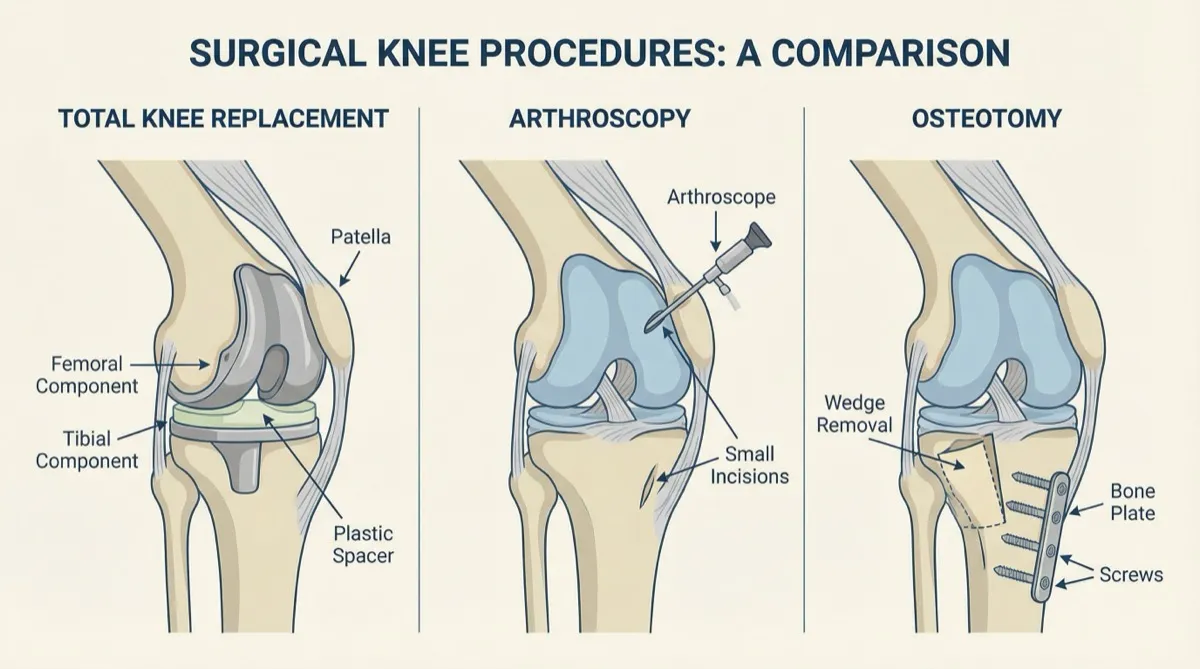
What It Is: Arthroscopy involves making small incisions in the knee to insert a camera and surgical instruments. The surgeon can irrigate the joint and remove loose pieces of cartilage or repair damaged tissue.
Best For: Younger patients with traumatic meniscus tears in areas with good blood supply. About 85% of meniscus repairs heal well, especially in younger patients with recent injuries [13].
Limitations: For degenerative tears and arthritis, the evidence is less promising. Randomized trials report little to no lasting benefit over structured physical therapy or even sham surgery at the one- to two-year mark [14]. An international panel of experts concluded that arthroscopy is no better for arthritis, meniscus tears, and other knee problems than sham surgery in many cases [15].
Recovery Time: Most patients return to normal activities within 6-8 weeks, though full recovery may take 3-6 months depending on the extent of the procedure.
Risks: Infection, blood clots, nerve damage, and continued pain. Importantly, arthroscopic partial meniscectomy is not cost-effective compared with conservative treatment for degenerative meniscus tears [16].
Current Recommendations: Medical consensus now recommends 3-6 months of non-operative treatment prior to surgical decision-making for most arthroscopic procedures [17].
2. High Tibial Osteotomy (HTO)
What It Is: Osteotomy involves cutting and repositioning one of the bones around the knee joint to redistribute weight-bearing loads to healthier portions of the joint. This “realignment” procedure shifts stress away from the damaged compartment.
Best For: Younger, active patients (typically under age 40, though this is flexible) who want to return to high-level athletic activity or physical work. HTO is mainly used to reduce single-compartment load by correcting lower limb alignment, thereby relieving pain, delaying knee replacement, and restoring high patient activity levels [18].
Benefits: Osteotomy and unicompartmental knee arthroplasty (UKA) show better functional improvements at six months and one year post-surgery compared to total knee replacement for appropriately selected patients [19].
Recovery Time: Initial recovery takes 6-8 weeks with crutches, but full return to high-impact activities may require 6-12 months.
Risks: Delayed bone healing, infection, blood clots, nerve damage, and the possibility that arthritis may still progress over time, eventually requiring knee replacement.
Long-Term Outlook: HTO can delay the need for total knee replacement by 10-15 years in successful cases, allowing younger patients to maintain active lifestyles.
3. Total Knee Replacement (TKR)
What It Is: Total knee replacement is the most definitive surgical option, involving removal of damaged cartilage and bone from the thigh bone, shin bone, and kneecap, which are then replaced with artificial metal and plastic components.
Best For: Patients with severe, end-stage arthritis who have exhausted all conservative options and whose quality of life is significantly impaired by knee pain.
Benefits: TKR is considered the gold standard when conservative treatment has failed, providing 90-95% pain relief with a 1-2% complication rate [20]. Approximately 90% of replaced knees remain satisfactory twenty years after surgery [21].
Recovery Timeline: Full recovery typically takes around one year, though most people can resume usual activities within six weeks. The detailed breakdown includes:
- Same day or next day: Hospital discharge
- Within 3 weeks: Walking with a cane or without assistance
- 3-6 weeks: Return to most daily activities
- 6-12 weeks: Complete physical therapy
- 3-6 months: Near-full recovery
- 12+ weeks: Return to low-impact activities like golf, dancing, and cycling [22]
Return to Work: Desk workers may return in 2-4 weeks, active jobs require 4-6 weeks, and heavy labor jobs may need 6-12 weeks [23].
Risks and Complications: While serious complications occur in less than 2% of knee replacement surgeries, potential risks include:
- Blood clots: Increased risk due to reduced mobility, though preventable with compression stockings and blood thinners [24]
- Infection: May require joint removal or exchange to clear the infection [25]
- Implant issues: Loosening, fracture, or dislocation requiring revision surgery [26]
- Other complications: Breathing problems, heart attack, stroke, urinary tract infection, and poor wound healing [27]
Long-Term Success: Almost everyone who has a knee replacement experiences improved knee function for at least 10-15 years, and most knee implants last for 20 years [28].
Limitations: While highly effective for pain relief, knee replacement doesn’t restore the knee to “normal.” Many patients report that the replaced knee never quite feels like their original knee, and high-impact activities may remain restricted.
4. Partial Knee Replacement (Unicompartmental Knee Arthroplasty)
What It Is: A less extensive procedure that replaces only the damaged portion of the knee—either the inner (medial), outer (lateral), or kneecap compartment—while preserving healthy tissue.
Best For: Patients with arthritis limited to a single compartment of the knee.
Benefits:
- Smaller incision and less tissue disruption
- Faster recovery than total knee replacement
- More natural knee feel and function
- Better functional outcomes in the first 1-2 years compared to TKR [29]
Recovery Time: Typically 4-6 weeks for basic activities, with full recovery in 3-4 months.
Risks: Higher revision rate than total knee replacement—approximately 10-15% may eventually require conversion to total knee replacement within 10 years.
Long-Term Considerations: While initial outcomes are excellent, partial knee replacement has a higher long-term failure rate than total replacement, particularly in patients with progression of arthritis to other knee compartments.
Comparing Your Options: Which Treatment Is Right for You?
| Treatment Option | Pain Relief | Recovery Time | Longevity | Ideal Candidate |
|---|---|---|---|---|
| Viscosupplementation | 60-70% improvement | Immediate to 2 weeks | 6-12 months per series | Mild to moderate OA, wants to avoid surgery |
| Physical Therapy | 55% improvement | 6-12 weeks | Ongoing with maintenance | All OA severity levels |
| Arthroscopy | Variable (limited for OA) | 6-8 weeks | Variable | Traumatic tears, not degenerative OA |
| Osteotomy | 70-80% improvement | 6-12 months | 10-15 years | Young, active, single-compartment OA |
| Partial Replacement | 85-90% improvement | 3-4 months | 10-15 years | Single-compartment OA |
| Total Replacement | 90-95% improvement | 6-12 months | 15-20+ years | Severe, end-stage OA |
Why Try Non-Surgical Options First?
The medical evidence overwhelmingly supports attempting conservative treatment before surgery:
-
High Success Rates: 67% of patients with conservative-only treatment avoid surgery for at least two years [30]
-
Surgery Delay = Better Outcomes: Delaying knee replacement until absolutely necessary means you’ll be older when you need it, reducing the likelihood of requiring a revision surgery in your lifetime
-
Lower Risk: Non-surgical treatments carry virtually no risk of serious complications compared to surgical interventions
-
Reversibility: Conservative treatments can be adjusted or discontinued without permanent changes to your anatomy
-
Cost-Effectiveness: Non-surgical options are significantly less expensive than surgery, even when multiple treatment series are needed
-
No Downtime: Unlike surgery, treatments like viscosupplementation require minimal recovery time
The Joint Relief Institute Approach
At Joint Relief Institute, we believe surgery should be the last resort, not the first option. Our specialized approach focuses on:
Fluoroscopy-Guided Precision
Every injection is performed under real-time imaging guidance, ensuring optimal accuracy and treatment effectiveness that blind injections simply cannot match.
Comprehensive Care
We don’t just treat symptoms—we develop personalized treatment plans that may include viscosupplementation, lifestyle modifications, and referrals for physical therapy to address the root causes of your knee pain.
Evidence-Based Medicine
Our protocols are based on the latest clinical research and international consensus guidelines, ensuring you receive treatments proven to work.
Insurance Acceptance
We accept Medicare and most major insurance plans, making effective non-surgical treatment accessible and affordable.
Proven Track Record
With 40,000+ patients treated, 400,000+ procedures performed, and a 4.9 Google rating, our results speak for themselves.
Making Your Decision: Questions to Ask Your Doctor
Before committing to surgery, have an in-depth conversation with your healthcare provider about:
-
Have I exhausted all conservative options? Ensure you’ve tried physical therapy, weight management, medications, and viscosupplementation for adequate durations.
-
What are my realistic outcome expectations? Understand that even successful surgery may not return your knee to “normal” function.
-
What are the specific risks for my age and health status? Older patients and those with comorbidities face higher surgical risks.
-
What does recovery really look like? Get detailed information about pain levels, mobility restrictions, and rehabilitation requirements.
-
What happens if I wait? In many cases, delaying surgery doesn’t worsen outcomes and may improve them.
-
Am I a candidate for fluoroscopy-guided viscosupplementation? Many patients haven’t even tried this proven alternative before jumping to surgery.
When Surgery Becomes Necessary
Despite our emphasis on conservative care, we recognize that some patients do ultimately need surgery. Surgery becomes appropriate when:
- You’ve genuinely exhausted all conservative treatments for adequate durations (typically 3-6 months minimum)
- Pain significantly impairs your quality of life and prevents essential daily activities
- Conservative treatments have provided insufficient relief
- Joint damage is severe and progressive despite optimal non-surgical management
- You have realistic expectations about surgical outcomes and are committed to rehabilitation
If you reach this point, the surgical options outlined in this guide can provide excellent pain relief and functional improvement.
Take the Next Step: Start with the Least Invasive Option
If you’re experiencing knee pain and wondering whether surgery is inevitable, we encourage you to explore conservative options first. At Joint Relief Institute, we’ve helped tens of thousands of patients find relief without going under the knife.
Our process is simple:
- Schedule a consultation to evaluate your knee condition and treatment history
- Receive a personalized treatment plan based on your specific diagnosis and goals
- Undergo fluoroscopy-guided viscosupplementation with real-time imaging for maximum precision
- Follow up to monitor your progress and adjust treatment as needed
Don’t let knee pain control your life, and don’t assume surgery is your only option. Conservative treatments work—and they work well.
Contact Joint Relief Institute Today
Call us at (800) 238-9307 to schedule your consultation and discover if fluoroscopy-guided viscosupplementation can help you avoid knee surgery.
With Medicare acceptance, most major insurance plans accepted, and a proven track record of success, there’s no reason to suffer in pain or rush into surgery when effective alternatives exist.
Frequently Asked Questions
How long should I try conservative treatment before considering surgery?
Medical consensus recommends 3-6 months of comprehensive conservative treatment before making surgical decisions. This should include physical therapy, appropriate medications, lifestyle modifications, and interventions like viscosupplementation.
Is knee replacement my only option for severe arthritis?
No. Even patients with advanced osteoarthritis often respond well to conservative treatments. Research shows that 67% of people with knee OA who receive conservative-only treatment manage without surgery for at least two years. Fluoroscopy-guided viscosupplementation, in particular, can provide significant relief even in moderate to severe cases.
How effective is viscosupplementation compared to surgery?
While knee replacement provides the highest degree of pain relief (90-95%), viscosupplementation offers 60-70% improvement in pain and function without surgical risks, downtime, or permanent anatomical changes. Many patients experience excellent quality of life with periodic viscosupplementation series, delaying or avoiding surgery indefinitely.
What makes fluoroscopy-guided injections better than regular injections?
Fluoroscopy provides real-time X-ray imaging during injection, ensuring the medication is placed precisely in the joint space rather than surrounding tissue. Studies confirm this improves treatment effectiveness, reduces the need for multiple attempts, and minimizes patient discomfort compared to blind injections.
Will my insurance cover viscosupplementation?
Most insurance plans, including Medicare, cover hyaluronic acid injections for symptomatic knee osteoarthritis that hasn’t responded to other treatments. Joint Relief Institute accepts Medicare and most major insurance plans. Contact us at (800) 238-9307 to verify your specific coverage.
How many viscosupplementation treatments will I need?
Initial treatment typically involves 1-5 injections over several weeks, depending on the specific product used. For patients who respond well, repeat series are administered when at least 6 months have elapsed since the previous treatment. Many patients receive 1-2 treatment series per year to maintain symptom relief.
Am I too old for non-surgical treatment?
Absolutely not. In fact, non-surgical treatments are often ideal for older patients who may face higher surgical risks due to age-related health conditions. Viscosupplementation is FDA-approved and safe for patients of all ages.
Can I avoid knee replacement forever with conservative treatment?
While not everyone can avoid surgery indefinitely, many patients successfully manage knee osteoarthritis for years or even decades with conservative treatments. By delaying surgery, you may avoid it altogether or postpone it until you’re older, reducing the likelihood of needing revision surgery in your lifetime.
Sources
-
Conservative management of knee osteoarthritis: A review of the literature. PMC
-
Osteoarthritis of the knee: Joint replacement in osteoarthritis of the knee. NCBI Bookshelf
-
Surgical Versus Non-Surgical Treatments for the Knee: Which Is More Effective? PMC
-
Conservative Treatment Options to Consider Before Joint Replacement Surgery. Central Ohio Spine and Joint
-
A Comprehensive Review of Viscosupplementation in Osteoarthritis of the Knee. PMC
-
Osteoarthritis of the knee: Joint replacement in osteoarthritis of the knee. NCBI Bookshelf
-
Knee Gel Injections (Viscosupplementation): Uses & Side Effects. Cleveland Clinic
-
Fluoroscopic Guided Injections for Knee Pain. Athens Heart Center
-
Fluoroscopy Guided Injections. OrthoZane
-
Fluoroscopy Guided Injections. VINMED
-
Accuracy of ultrasound-guided knee injections confirmed by fluoroscopy. ScienceDirect
-
Viscosupplementation Treatment for Knee Arthritis. OrthoInfo - AAOS
-
How Successful is Arthroscopic Surgery on a Torn Meniscus? OAWJ
-
Understand Your Joint Surgery Options. Arthritis Foundation
-
Knee Arthroscopy in 2025: What Surgeons Don’t Say—and Better Options. Spectrum Therapy NJ
-
Arthroscopic surgery for degenerative tears of the meniscus: a systematic review and meta-analysis. PMC
-
The Formal EU-US Meniscus Rehabilitation 2024 Consensus. PMC
-
Early results of high tibial osteotomy versus combined arthroscopic surgery. Frontiers in Surgery
-
Current Surgical Treatment of Knee Osteoarthritis. PMC
-
Surgical Options for Knee Arthritis. AAHKS
-
Total Knee Replacement: A Patient’s Guide. UW Orthopaedic Surgery
-
Knee Replacement Recovery Time: What to Expect in the First 12 Weeks. Healthline
-
Knee Replacement Recovery Time What You Need To Know. Powers Health
-
Knee Replacement (Arthroplasty): What It Is & Recovery Time. Cleveland Clinic
-
Knee replacement. Mayo Clinic
-
Risks of hip and knee replacement. MedlinePlus
-
Knee Replacement Pros & Cons. Mass General Brigham
-
Knee Replacement (Arthroplasty): What It Is & Recovery Time. Cleveland Clinic
-
Current Surgical Treatment of Knee Osteoarthritis. PMC
-
Osteoarthritis of the knee: Joint replacement in osteoarthritis of the knee. NCBI Bookshelf


