
What Are the Different Types of Knee Pain? A Complete Guide
Knee pain affects approximately 25% of U.S. adults, making it one of the most common musculoskeletal complaints [1]. Understanding the different types of knee pain—and where you feel it—is crucial for getting the right diagnosis and treatment. The location of your knee pain can reveal what’s causing it, whether it’s osteoarthritis, a ligament injury, or tendon inflammation.
At Joint Relief Institute, we’ve treated over 40,000 patients with various forms of knee pain using advanced, non-surgical treatments. This comprehensive guide will help you identify your knee pain type and understand your treatment options.
Understanding Knee Pain by Location
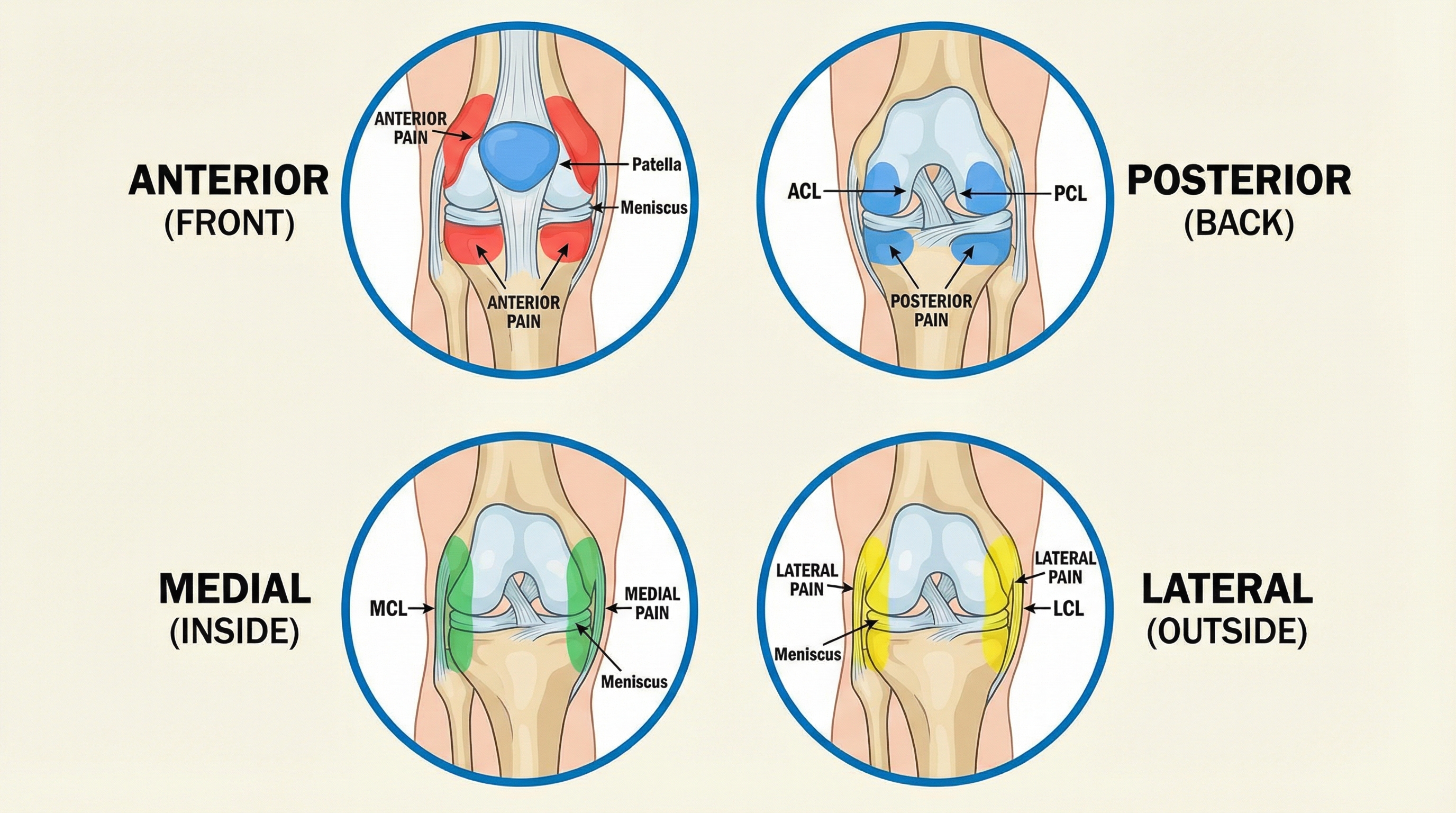
The knee is a complex joint where the thighbone (femur), shinbone (tibia), and kneecap (patella) meet. Four main locations of knee pain correspond to specific conditions:
- Anterior (Front) Knee Pain: Often related to the kneecap and surrounding structures
- Posterior (Back) Knee Pain: Usually involves cysts, tendon issues, or arthritis
- Medial (Inside) Knee Pain: Typically indicates ligament sprains or cartilage damage
- Lateral (Outside) Knee Pain: Often caused by IT band syndrome or lateral meniscus tears
Let’s examine each type in detail.
Front Knee Pain (Anterior Knee Pain)
What Causes Front Knee Pain?
Front knee pain is one of the most common types of knee discomfort. The pain typically occurs at the front of the knee, around, or behind the kneecap (patella).
Common Conditions:
1. Patellofemoral Pain Syndrome (Runner’s Knee)
Patellofemoral pain syndrome (PFPS), commonly called runner’s knee, is one of the most common causes of anterior knee pain encountered by clinicians [2]. This condition causes pain under or around your kneecap and is particularly common in athletes and active individuals.
Causes: Overusing your knees through repetitive motion like running, jumping, or working on your hands and knees can trigger PFPS. It may also result from a structural defect or the way you walk or run [3].
Symptoms:
- Pain that worsens when bending the knees to squat or climb stairs
- Pain after sitting with knees bent for extended periods
- Rubbing, grinding, or clicking sensations in the kneecap
Treatment: Most cases improve with conservative care including rest, ice, compression, and elevation. Strengthening and stretching exercises are essential. The typical recovery time is four to six weeks [3].
2. Chondromalacia Patella
This condition involves damage to the cartilage on the underside of the kneecap, causing pain and a grinding sensation during movement.
3. Prepatellar Bursitis (Housemaid’s Knee)
Inflammation of the prepatellar bursa—a fluid-filled sac in front of the kneecap—most commonly affects people who spend significant time kneeling [4].
4. Patellar Tendinitis (Jumper’s Knee)
Inflammation of the patellar tendon, which connects the kneecap to the shinbone, commonly occurs in athletes who jump frequently.
When Front Knee Pain Indicates Arthritis
Osteoarthritis can cause pain in the kneecap area, especially during movement or at rest. Over 365 million people globally suffer from knee osteoarthritis, with prevalence increasing significantly with age [5]. By age 75, up to 50% of individuals report knee-related discomfort.
Back Knee Pain (Posterior Knee Pain)
What Causes Pain Behind the Knee?
Pain at the back of the knee typically involves different structures than front knee pain and warrants specific evaluation.
Common Conditions:
1. Baker’s Cyst (Popliteal Cyst)
A Baker’s cyst is a fluid-filled bump that forms on the back of your knee, also called a popliteal cyst [6]. These cysts often cause stiffness and discomfort behind the knee.
Causes: Baker’s cysts typically result from an underlying problem inside the knee joint, such as osteoarthritis or a meniscus tear. These conditions cause the joint to produce excess fluid that can accumulate in a one-way valve at the back of the knee [6].
Symptoms:
- Visible bump or swelling behind the knee
- Tightness, discomfort, or pain behind the knee
- Stiffness and reduced range of motion
- Pain with terminal knee extension
Treatment: Most Baker’s cysts improve with nonsurgical treatment including anti-inflammatory medications, ice, compression wraps, and corticosteroid injections into the knee joint [6]. Surgical removal is rarely needed.
Important Note: A Baker’s cyst will often recur if the underlying cause (such as osteoarthritis or meniscus tear) hasn’t been addressed.
2. Hamstring Tendinitis
Inflammation of the hamstring tendons where they attach behind the knee can cause posterior knee pain, especially in runners and athletes.
3. Posterior Meniscus Tear
Tears in the back portion of the meniscus—the C-shaped cartilage cushion—can cause pain and swelling at the back of the knee and down into the calf.
Inside Knee Pain (Medial Knee Pain)
What Causes Pain on the Inner Knee?
Medial knee pain occurs on the inside of your knee and often indicates ligament or cartilage damage.
Common Conditions:
1. MCL Sprain or Tear
MCL (medial collateral ligament) tears are the most common knee ligament injury, accounting for approximately 40% of all knee injuries [7]. The MCL provides side-to-side stability on the inside of the knee.
Causes: MCL injuries typically result from overstretching or tearing of the ligament due to a knee twisting injury or direct impact to the outside of the knee [4].
Symptoms:
- Pain on the inner aspect of the knee
- Clear point of maximal tenderness along the MCL
- Swelling and stiffness
- Knee instability or buckling sensation
Treatment: Most people with an MCL tear recover with non-surgical treatment because the MCL has a good blood supply, which facilitates healing [7]. Full recovery typically takes up to 3 months, and surgery is rarely required. Treatment includes rest, ice, compression, elevation, physical therapy, and bracing.
2. Medial Meniscus Tear
The medial meniscus is the cartilage cushion on the inside of the knee. Meniscal tears are common, with an incidence of 61 cases per 100,000 people [5]. The prevalence increases significantly with age—ranging from 31.8% in people aged 65-70 to 52.2% in those over 80 [5].
Connection to Arthritis: Meniscal tears are associated with a 4-fold increase in the long-term risk of knee osteoarthritis [5]. Research shows that in patients with radiographic evidence of osteoarthritis, the prevalence of a meniscal tear was 63% among those with knee pain.
3. Medial Compartment Osteoarthritis
Osteoarthritis commonly affects the medial (inner) compartment of the knee, causing pain on the inside of the knee joint that worsens with activity.
Outside Knee Pain (Lateral Knee Pain)
What Causes Pain on the Outer Knee?
Lateral knee pain occurs on the outside of your knee and has distinct causes from medial knee pain.
Common Conditions:
1. IT Band Syndrome (Iliotibial Band Syndrome)
IT band syndrome is the most common cause of lateral knee pain in runners and cyclists [4]. The iliotibial band is a strong, thick band of tissue that runs down the outside of your thigh from your hip bones to the top of your shinbone.
Causes: With repeated bending and extending of the knee, the IT band moves over the outer lower edge of your thighbone. This repetitive movement can irritate surrounding tissues, causing inflammation and pain [8].
Symptoms:
- Aching, burning pain on the outside of the knee
- Pain that sometimes spreads up the thigh to the hip
- Pain that worsens during running or cycling, especially downhill
Treatment: Most patients respond to conservative treatment including rest, ice, NSAIDs (like ibuprofen), stretching, and strengthening exercises [8]. Physical therapy focuses on stretching and strengthening the IT band and hip muscles. Roughly 50% to 90% of patients improve with 4 to 8 weeks of non-operative treatment, and most are able to return to running within 6 weeks [8]. Surgery is rarely needed.
2. LCL Sprain (Lateral Collateral Ligament)
The LCL is located on the outside of the knee, holding the knee bones together. Injuries to the LCL are the least common of the major knee ligament injuries [7].
Symptoms: Pain on the outside of the knee, swelling, and instability with side-to-side movement.
3. Lateral Meniscus Tear
Common sports-related injuries that occur when a person damages the tissue between the bones in their knee joint, causing pain on the outer side of the knee [4].
How Common Is Knee Pain?
Understanding the scope of knee pain can help you realize you’re not alone:
- 25% of U.S. adults experience frequent knee pain [1]
- 10-60% of people globally may experience knee pain at some point [5]
- Over 365 million people worldwide suffer from knee osteoarthritis [5]
- Knee OA prevalence has increased by 113% since 1990, and by 2050, cases could affect nearly 1 billion people globally [5]
Risk Factors for Knee Pain
Several factors increase your risk of developing knee pain:
- Age: Prevalence increases significantly with age
- Obesity: Places extra strain on knee joints, increasing osteoarthritis risk by up to four times [5]
- Previous knee injury: Meniscal tears increase long-term OA risk by 4-fold [5]
- Repetitive stress: Athletes and workers who perform repetitive knee movements
- Gender: Some conditions like patellofemoral pain syndrome are more common in women
Non-Surgical Treatment Options for Knee Pain
At Joint Relief Institute, we specialize in advanced, non-surgical treatments that address the root cause of knee pain rather than just masking symptoms.
Viscosupplementation: Gel Injections for Knee Pain
Viscosupplementation involves injecting hyaluronic acid (a gel-like substance) directly into the knee joint to restore lubrication and cushioning.
How It Works: Hyaluronic acid is a natural component of healthy joint fluid. In osteoarthritic knees, this fluid becomes thin and less effective. Viscosupplementation replenishes the joint’s natural lubricant, reducing pain and improving mobility.
Effectiveness: Recent EUROVISCO consensus guidelines from 2024-2025 provided strong recommendations for the use of intra-articular hyaluronic acid (HA) knee injections, facilitating individualized treatment decision algorithms for knee osteoarthritis [9]. In a network meta-analysis by Bannuru et al., HA viscosupplementation was ranked as the most effective treatment for knee OA, with an effect size of 0.63—significantly higher than NSAIDs [10].
Who Benefits: HA can be considered for patients of any age with symptomatic knee osteoarthritis, including those with diabetes, moderate to severe obesity, gout, meniscocalcinosis, and mild-to-moderate varus/valgus malalignment [9].
Results Timeline: Benefits typically appear 4 to 6 weeks after treatment and can last up to 6 months or longer [10].
The JRI Difference: Fluoroscopy-Guided Precision
What sets Joint Relief Institute apart is our use of fluoroscopy-guided injections for maximum precision and effectiveness.
Why Precision Matters: “The ability of intra-articular injections to provide relief in patients with knee osteoarthritis is contingent upon the accurate delivery of the injectate into the joint space” [11]. Research shows that without imaging guidance, clinicians may inadvertently inject fat pads instead of the joint space.
Fluoroscopy Benefits:
- Real-time visualization of needle placement [11]
- Confirmed accuracy on the first attempt, minimizing discomfort
- Maximized effectiveness by ensuring medication reaches the intended location
- Reduced complications by avoiding nerves and blood vessels [11]
Fluoroscopy is widely used to guide joint injections because it is readily available, low-cost, quick, and easy to use [11].
Other Conservative Treatments
Before considering surgery, these non-surgical treatments may provide relief:
- Physical therapy: Strengthening and stretching exercises
- Anti-inflammatory medications: NSAIDs like ibuprofen reduce pain and inflammation
- RICE protocol: Rest, Ice, Compression, Elevation for acute injuries
- Weight management: Reducing stress on knee joints
- Corticosteroid injections: For short-term inflammation relief
- Bracing or orthotics: To stabilize and support the knee
When to See a Doctor for Knee Pain
While minor knee pain often improves with home care, certain warning signs require immediate medical attention:
Seek Emergency Care If You Experience:
- Severe pain and significant swelling
- Inability to bear weight on the knee
- Acute injury accompanied by a popping noise
- Joint appears deformed
- Sudden and intense pain that persists [12]
Schedule a Doctor’s Appointment If:
- Knee pain persists beyond a few days despite home care
- Pain worsens over time
- Swelling, redness, bruising, or tenderness develops
- You experience knee instability or the feeling that your knee will collapse
- Decreased range of motion lasts more than 24 hours
- Pain interferes with daily activities or sleep [12]
Signs of Infection (Septic Arthritis):
- Sudden swelling with redness
- Fever and chills
- Warm feeling in the knee
- Nausea [12]
Important: If knee pain lasts more than two weeks, it may indicate an underlying issue requiring professional evaluation [12].
Why Choose Joint Relief Institute?
Joint Relief Institute has established itself as a leader in non-surgical knee pain treatment:
- 40,000+ patients treated with proven results
- 400,000+ procedures performed with expertise and precision
- 4.9 Google rating reflecting patient satisfaction
- Fluoroscopy-guided injections for maximum accuracy
- Medicare accepted along with most insurance plans
- Specialized focus on viscosupplementation and advanced gel injections
Our physicians use cutting-edge techniques to deliver treatments with precision, ensuring you get the best possible outcome without surgery.
Take the Next Step Toward Knee Pain Relief
Don’t let knee pain limit your life. Whether you’re experiencing front knee pain from runner’s knee, inside knee pain from an MCL injury, or outside knee pain from IT band syndrome, understanding the type and location of your pain is the first step toward effective treatment.
Joint Relief Institute offers advanced, non-surgical solutions tailored to your specific condition. Our fluoroscopy-guided viscosupplementation treatments have helped thousands of patients return to the activities they love without the need for surgery.
Ready to find relief?
Call Joint Relief Institute today at (800) 238-9307 to schedule your consultation. Our expert team will evaluate your knee pain, determine the underlying cause, and create a personalized treatment plan to get you back to living without pain.
Frequently Asked Questions
What is the most common type of knee pain?
Front knee pain, particularly patellofemoral pain syndrome (runner’s knee), is one of the most common types. However, knee osteoarthritis is the most common cause of chronic knee pain overall, affecting over 365 million people globally.
How do I know if my knee pain is serious?
Seek immediate care if you cannot bear weight, experience severe swelling or pain, hear a popping sound during injury, or notice joint deformity. Pain lasting more than two weeks or interfering with daily activities warrants a doctor’s evaluation.
Can knee pain go away without treatment?
Minor knee pain from overuse may improve with rest, ice, and over-the-counter pain relievers. However, conditions like osteoarthritis, meniscus tears, and ligament injuries typically require medical treatment to prevent worsening and restore function.
What are gel injections for knee pain?
Gel injections, also called viscosupplementation, involve injecting hyaluronic acid into the knee joint. This treatment restores lubrication and cushioning in arthritic knees, reducing pain and improving mobility for up to 6 months or longer.
Are fluoroscopy-guided injections better than regular injections?
Yes. Fluoroscopy provides real-time X-ray visualization, ensuring accurate delivery of medication into the joint space. This precision maximizes effectiveness and reduces the risk of injecting into surrounding tissues like fat pads, which would diminish results.
Does insurance cover viscosupplementation for knee pain?
Many insurance plans, including Medicare, cover viscosupplementation for knee osteoarthritis. Joint Relief Institute accepts Medicare and most major insurance plans. Contact our office at (800) 238-9307 to verify your specific coverage.
How long does it take to recover from an MCL tear?
Most MCL tears heal with non-surgical treatment within 3 months. The MCL has excellent blood supply, which promotes natural healing. Grade I sprains may heal in 2-4 weeks, while Grade III tears may take 8-12 weeks.
What’s the difference between a Baker’s cyst and a meniscus tear?
A Baker’s cyst is a fluid-filled swelling behind the knee, often caused by an underlying condition like osteoarthritis or a meniscus tear. A meniscus tear is damage to the cartilage inside the knee joint. Baker’s cysts are often secondary to meniscus tears.
Sources
-
QC Kinetix. “Knee Pain Statistics: 2025 Facts and Treatment Trends.” QC Kinetix Blog, 2025. https://qckinetix.com/blog/knee-pain-statistics-facts/
-
Johns Hopkins Medicine. “Patellofemoral Pain Syndrome (Runner’s Knee).” Johns Hopkins Medicine, 2025. https://www.hopkinsmedicine.org/health/conditions-and-diseases/patellofemoral-pain-syndrome-runners-knee
-
Cleveland Clinic. “Patellofemoral Pain Syndrome (PFPS): Symptoms & Treatment.” Cleveland Clinic, 2025. https://my.clevelandclinic.org/health/diseases/17914-patellofemoral-pain-syndrome-pfps
-
Medical News Today. “Sites of different knee injuries.” Medical News Today, 2025. https://www.medicalnewstoday.com/articles/knee-pain-location-chart
-
National Center for Biotechnology Information. “Global, regional prevalence, incidence and risk factors of knee osteoarthritis in population-based studies.” PMC, 2025. https://pmc.ncbi.nlm.nih.gov/articles/PMC7704420/
-
Cleveland Clinic. “Baker Cyst (Popliteal Cyst): Symptoms, Causes & Treatment.” Cleveland Clinic, 2025. https://my.clevelandclinic.org/health/diseases/15183-bakers-cyst
-
Cleveland Clinic. “Medial Collateral Ligament (MCL) Tear: Treatment & Recovery Time.” Cleveland Clinic, 2025. https://my.clevelandclinic.org/health/diseases/21979-mcl-tear
-
Cleveland Clinic. “Iliotibial Band Syndrome (ITBS): Causes, Symptoms & Treatment.” Cleveland Clinic, 2025. https://my.clevelandclinic.org/health/diseases/21967-iliotibial-band-syndrome
-
SAGE Journals. “EUROVISCO Consensus Guidelines for the Use of Hyaluronic Acid Viscosupplementation in Knee Osteoarthritis Based on Patient Characteristics.” Cartilage, 2024. https://journals.sagepub.com/doi/10.1177/19476035241271970
-
Hospital for Special Surgery. “What to Know About Knee Gel Injections (Viscosupplementation).” HSS, 2025. https://www.hss.edu/health-library/conditions-and-treatments/knee-gel-injections-viscosupplementation
-
National Center for Biotechnology Information. “Fluoroscopic-guided procedures of the lower extremity.” PMC, 2022. https://pmc.ncbi.nlm.nih.gov/articles/PMC9362560/
-
Mayo Clinic. “Knee pain: When to see a doctor.” Mayo Clinic, 2025. https://www.mayoclinic.org/symptoms/knee-pain/basics/when-to-see-doctor/sym-20050688


