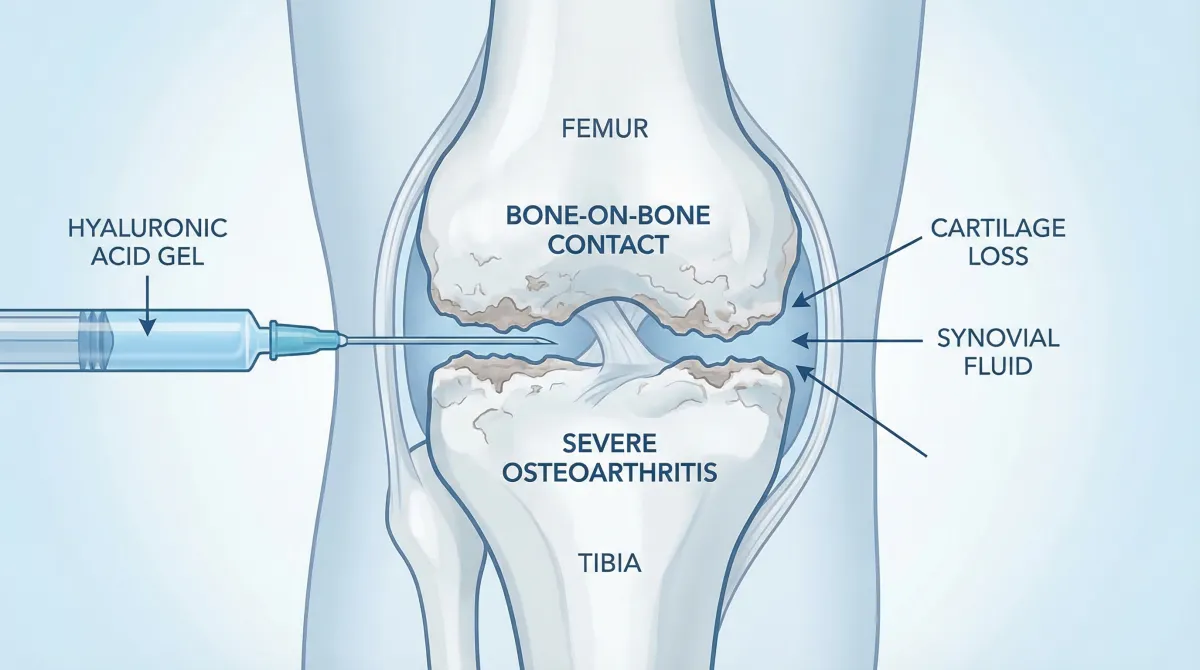
If you’ve been researching treatments for knee osteoarthritis, you’ve probably come across hyaluronic acid injections—also called viscosupplementation or “gel injections.” But beyond the marketing, what does the medical science actually say? How does hyaluronic acid work at the molecular level, and is it truly effective?
Let’s break down the evidence.
What Is Hyaluronic Acid? The Science Behind the “Goo”
Hyaluronic acid (HA) is a naturally occurring molecule found throughout your body—in your skin, eyes, and especially in your joints. It’s not a drug or a synthetic chemical. It’s something your body already makes and depends on.
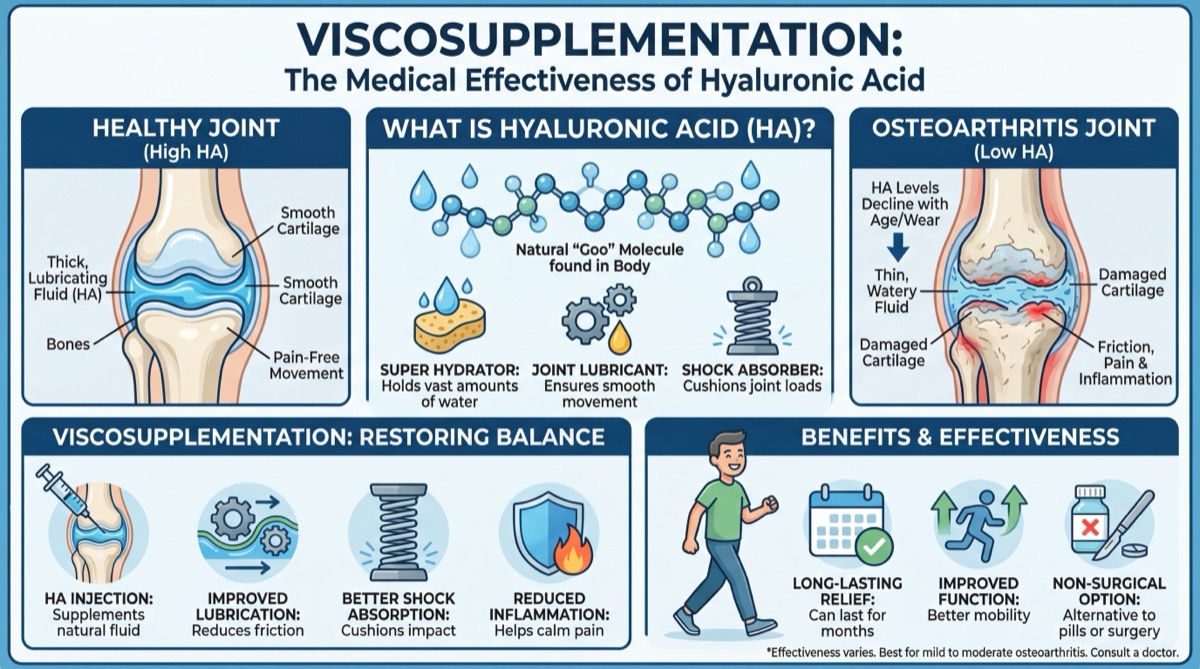
At the molecular level, hyaluronic acid is a glycosaminoglycan—a long chain of sugar molecules that has three remarkable properties:
1. Super Hydrator
A single gram of hyaluronic acid can hold up to six liters of water. In your joints, this creates a thick, gel-like fluid that maintains the proper environment for cartilage health.
2. Joint Lubricant
HA gives your synovial fluid its viscosity—that slippery quality that allows joint surfaces to glide past each other with minimal friction. Think of it as the motor oil for your joints.
3. Shock Absorber
When you walk, run, or climb stairs, your knees absorb significant impact. Hyaluronic acid cushions these forces, protecting your cartilage from mechanical stress.
Healthy Joints vs. Osteoarthritic Joints: What Changes?
Understanding the difference between a healthy knee and an arthritic knee helps explain why hyaluronic acid injections work.
In a Healthy Joint (High HA)
- Cartilage surfaces are smooth and intact
- Synovial fluid is thick and viscous
- Adequate lubrication prevents friction
- Movement is pain-free
In an Osteoarthritic Joint (Low HA)
- HA levels decline with age and wear
- Synovial fluid becomes thin and watery
- Cartilage surfaces become rough and damaged
- Friction increases, causing pain and inflammation
Research published in the Journal of Orthopaedic Research has shown that osteoarthritic joints have significantly lower concentrations of hyaluronic acid—and the HA that remains has a lower molecular weight, making it less effective as a lubricant.
This isn’t just wear and tear. It’s a measurable biochemical change that directly contributes to your symptoms.
How Viscosupplementation Restores Balance
Viscosupplementation works by directly addressing what osteoarthritis takes away. When we inject medical-grade hyaluronic acid into your knee joint, four things happen:
1. Supplements Natural Fluid
The injection immediately increases the concentration of HA in your joint, restoring the thick, viscous quality your synovial fluid has lost.
2. Improves Lubrication
With restored viscosity, your joint surfaces can glide more smoothly. Many patients describe this as their knee feeling “looser” or “less sticky.”
3. Enhances Shock Absorption
The cushioning effect returns, reducing the mechanical stress on your remaining cartilage with every step you take.
4. Reduces Inflammation
Beyond its mechanical benefits, hyaluronic acid has been shown to have anti-inflammatory properties. It can help calm the chronic low-grade inflammation that drives osteoarthritis progression and pain.
What Does the Clinical Research Show?
The medical literature on viscosupplementation is extensive. Here’s what the evidence tells us:
Pain Relief
A meta-analysis published in the Annals of Internal Medicine reviewed 89 clinical trials and found that hyaluronic acid injections provide clinically meaningful pain relief for knee osteoarthritis, with benefits typically appearing 4-8 weeks after treatment.
Duration of Effect
Unlike cortisone injections that wear off in weeks, the effects of viscosupplementation can last 6-12 months. Some studies have shown benefits persisting even longer in certain patients.
Function Improvement
Multiple randomized controlled trials have demonstrated improvements in physical function scores, with patients reporting better ability to walk, climb stairs, and perform daily activities.
Safety Profile
Viscosupplementation has an excellent safety record. The most common side effects are temporary and localized—mild pain or swelling at the injection site that resolves within a few days.
Disease Modification Potential
Emerging research suggests that hyaluronic acid may do more than just relieve symptoms. Some studies indicate it may help slow cartilage breakdown, though more research is needed to confirm these disease-modifying effects.
Who Benefits Most from Hyaluronic Acid Injections?
Viscosupplementation works best for specific patient profiles:
Ideal Candidates
- Mild to moderate osteoarthritis — X-rays showing cartilage loss but not complete “bone-on-bone”
- Age 50+ — When natural HA production has declined
- Failed conservative treatment — Physical therapy, oral medications, and lifestyle changes haven’t provided adequate relief
- Want to avoid or delay surgery — Looking for a non-surgical option that provides meaningful, lasting relief
- Active lifestyle goals — Want to return to activities like walking, golf, gardening, or playing with grandchildren
Less Ideal Candidates
- Severe bone-on-bone arthritis — May still provide some benefit but typically less dramatic
- Inflammatory arthritis — Conditions like rheumatoid arthritis have different underlying causes
- Infection or skin disease — Active infection near the injection site is a contraindication
At Joint Relief Institute, we evaluate each patient individually. We review your X-rays, assess your symptoms, and discuss your goals to determine if viscosupplementation is the right treatment for you.
How Viscosupplementation Compares to Other Treatments
| Treatment | Mechanism | Duration | Evidence Level |
|---|---|---|---|
| Hyaluronic Acid | Restores joint lubrication | 6-12 months | Strong |
| Cortisone | Reduces inflammation | 4-8 weeks | Strong |
| Oral NSAIDs | Systemic pain relief | Hours | Strong |
| Physical Therapy | Strengthens supporting muscles | Ongoing | Strong |
| PRP | Growth factors for healing | Variable | Moderate |
| Knee Replacement | Replaces joint | 15-20 years | Strong |
The key advantage of viscosupplementation: it addresses a specific deficiency (low HA) rather than just masking symptoms, and it does so without the systemic side effects of oral medications or the finality of surgery.
The Joint Relief Institute Difference
Not all viscosupplementation is created equal. At Joint Relief Institute, we’ve refined our approach based on treating over 40,000 patients:
Fluoroscopy-Guided Precision
We use real-time X-ray imaging to ensure the hyaluronic acid is placed exactly where it needs to go. Studies show that even experienced physicians miss the optimal injection site up to 30% of the time without imaging guidance. We eliminate that uncertainty.
Fluid Aspiration First
Before injecting HA, we drain any excess fluid from your knee. This maximizes the effectiveness of the treatment and often provides immediate relief from swelling.
Multiple HA Options
We offer over ten different hyaluronic acid products, allowing us to match the treatment to your specific needs—and work around any allergies or sensitivities.
Comprehensive Care
Viscosupplementation is most effective as part of a broader treatment plan. Our physicians provide guidance on exercise, weight management, and other strategies to maximize your results.
Frequently Asked Questions
Is hyaluronic acid the same as cortisone?
No. Cortisone is a steroid that reduces inflammation but doesn’t restore joint lubrication. Hyaluronic acid supplements what your joint is missing. They work through completely different mechanisms and can sometimes be used together.
How quickly will I feel results?
Most patients notice improvement within 2-4 weeks, with maximum benefits developing over 4-8 weeks. Unlike cortisone, which works quickly but wears off fast, HA builds gradually but lasts longer.
Are hyaluronic acid injections FDA approved?
Yes. Multiple hyaluronic acid products are FDA-approved for the treatment of knee osteoarthritis, including Synvisc, Euflexxa, Supartz, and others.
Does Medicare cover hyaluronic acid injections?
Yes, Medicare typically covers viscosupplementation for knee osteoarthritis when medical necessity criteria are met. Most private insurance plans cover it as well.
Can I get injections in both knees?
Yes. Many patients have osteoarthritis in both knees and receive bilateral treatment. We can treat both knees in the same visit or stage the treatments based on your preference.
What are the risks?
The most common side effects are mild and temporary—some pain, swelling, or warmth at the injection site. Serious complications are rare. Because HA is a naturally occurring substance, allergic reactions are uncommon.
The Bottom Line on Medical Effectiveness
The science is clear: hyaluronic acid injections are a medically proven treatment for knee osteoarthritis. They work by restoring what your joint has lost—the thick, lubricating fluid that allows pain-free movement.
Are they right for everyone? No. They work best for mild to moderate osteoarthritis in patients who want a non-surgical option that provides lasting relief. But for the right candidates, viscosupplementation can be genuinely life-changing—reducing pain, improving mobility, and helping delay or avoid knee replacement surgery.
Ready to See If Viscosupplementation Is Right for You?
At Joint Relief Institute, we’ve helped over 40,000 patients find relief from knee pain using evidence-based treatments like hyaluronic acid injections. Our fluoroscopy-guided technique ensures precision, and our experienced team is dedicated to helping you achieve the best possible outcome.
Schedule your risk-free consultation today. We’ll review your imaging, assess your condition, and give you an honest recommendation about whether viscosupplementation is appropriate for your situation.
Call us at (800) 238-9307 or book online to take the first step toward a life with less pain and more mobility.
Effectiveness of viscosupplementation varies by individual. Best results are typically seen in patients with mild to moderate osteoarthritis. Always consult with a qualified healthcare provider to determine if this treatment is appropriate for your specific condition.