If you’re living with knee osteoarthritis, you’ve likely heard about viscosupplementation—also known as knee gel injections or “rooster comb” injections. But with mixed opinions online and varying insurance coverage, you’re probably asking yourself: Is viscosupplementation worth it?
The answer depends on several factors: your current pain level, treatment goals, budget, and what alternatives you’ve already tried. After treating over 40,000 patients at Joint Relief Institute, we’ve seen firsthand what works—and for whom. Let’s break down the real-world evidence to help you make an informed decision.
What Is Viscosupplementation?
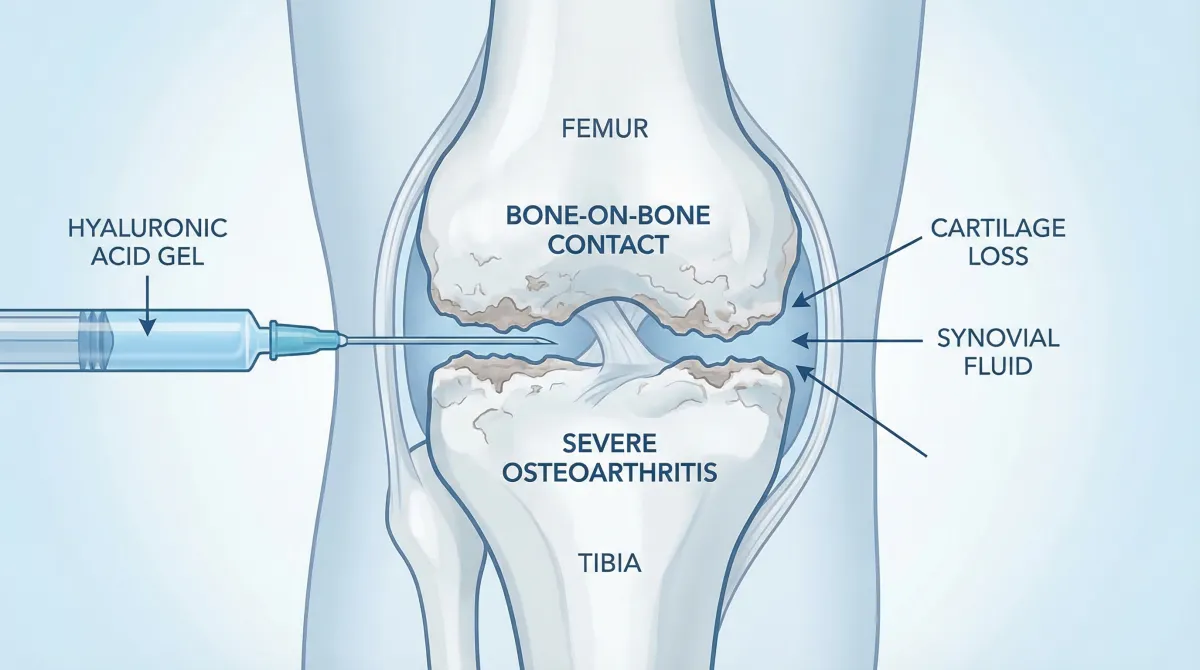
Viscosupplementation involves injecting hyaluronic acid (HA) directly into the knee joint to supplement the natural lubricating fluid that diminishes with osteoarthritis. Think of it as adding oil to a squeaky hinge—the treatment restores cushioning, reduces friction, and helps protect remaining cartilage from further damage [1].
Unlike cortisone shots that simply mask pain, viscosupplementation addresses underlying joint mechanics while providing long-term relief lasting six months or more [2].
The Evidence: What 88.7% Patient Satisfaction Really Means
Real-world clinical data paints a compelling picture. A comprehensive study tracking 782 patients across 16 clinics over six years found that 88.7% were satisfied with their viscosupplementation treatment [3]. But satisfaction is just one metric. Let’s look at the measurable outcomes:
Pain Reduction Results
- Single treatment course: 38% improvement in pain scores
- Multiple courses: Up to 66% improvement after four treatment courses
- Six-month follow-up: 79% of patients remained satisfied with results
- Clinically significant relief: 73.6% experienced at least 50% pain reduction [3]
Functional Improvements
After four treatment courses, patients experienced:
- 74% improvement in pain during daily activities
- 66% improvement in physical function
- 61% improvement in joint stiffness [3]
These aren’t marginal gains—they represent the difference between struggling to walk your dog and returning to activities you love.
The Cost Question: Breaking Down Value
Cost is often the biggest concern when considering viscosupplementation. Let’s address it head-on.
What You’ll Actually Pay
With Medicare coverage:
- Medicare covers 80% of approved costs for qualifying patients
- You or your supplemental insurance pay the remaining 20%
- Repeat treatment requires at least 6 months between series [4]
With private insurance:
- Coverage varies significantly by plan
- When covered, out-of-pocket costs range from $450-$1,000 per treatment
- Some insurers have discontinued coverage entirely [5]
Without insurance:
- Full self-pay costs range from $1,000-$2,500 per treatment series
- Average cost is approximately $1,019 per session [5]
Medicare Qualification Requirements
To qualify for Medicare coverage, you must have [4]:
- Documented radiographic evidence of knee osteoarthritis
- Tried at least three months of conservative treatments (physical therapy, analgesics, etc.)
- These treatments proved ineffective
Comparing the Math: Is It Worth the Investment?
Consider this cost-benefit analysis:
Viscosupplementation (assuming 2 series over 3 years):
- Cost: $2,000-$5,000 total
- Recovery time: None (outpatient procedure, 5-10 minutes)
- Risk level: Minimal (99% of side effects are mild) [6]
Total knee replacement:
- Cost: $30,000-$50,000+ (even with insurance, out-of-pocket can exceed $5,000)
- Recovery time: 3-6 months of intense rehabilitation
- Hospital stay: Average 3 days
- Risk level: Significant complications including infection, bleeding, nerve damage [6]
For many patients, viscosupplementation offers 6-12 months of relief at a fraction of knee surgery’s cost and risk—making it a compelling value proposition, especially if it delays or eliminates the need for surgery.
Viscosupplementation vs. Your Alternatives
Viscosupplementation vs. Cortisone Injections
Many patients wonder whether they should choose gel injections or stick with cortisone shots. Here’s what the research shows [7]:
| Factor | Viscosupplementation | Cortisone Injections |
|---|---|---|
| How it works | Restores joint lubrication and protects cartilage | Reduces inflammation temporarily |
| Speed of relief | Gradual (1-2 weeks) | Fast (2-3 days) |
| Duration of relief | 6+ months | 2-3 months |
| Frequency limits | Can repeat every 6 months | Limited to 2-3 per year maximum |
| Long-term effects | May protect cartilage | Can accelerate cartilage damage with repeated use |
The bottom line: Cortisone works faster for acute flare-ups, but viscosupplementation provides longer-lasting relief without the cartilage damage risk. After the first month, viscosupplementation consistently outperforms cortisone for pain reduction [7].
Viscosupplementation vs. Knee Replacement Surgery
Surgery should be a last resort, not a first option. Here’s why viscosupplementation is worth trying first [6]:
Safety profile:
- No anesthesia required (avoiding respiratory and cardiovascular risks)
- Outpatient procedure (no hospital admission)
- 99% of side effects are mild-to-moderate
- No surgical complications like infection, blood clots, or nerve damage
Recovery timeline:
- Return to normal activities: Immediately (avoid submerging joint for 24 hours)
- Full mobility: No rehabilitation required
- Time off work: None for most patients
Effectiveness for delaying surgery: Multiple studies show viscosupplementation can effectively delay or eliminate the need for total knee replacement, particularly in patients with mild-to-moderate osteoarthritis [1][2].
Viscosupplementation vs. Doing Nothing
What happens if you skip treatment? Osteoarthritis is progressive. Without intervention:
- Pain and stiffness worsen over time
- Cartilage degradation accelerates
- Joint damage becomes irreversible
- Daily activities become increasingly limited
- You eventually face surgery from a weaker starting position
Early intervention with viscosupplementation can slow disease progression and preserve your quality of life.
Who Gets the Best Results?
Viscosupplementation isn’t one-size-fits-all. Recent consensus guidelines from European experts (EUROVISCO) identified key factors that predict success [1]:
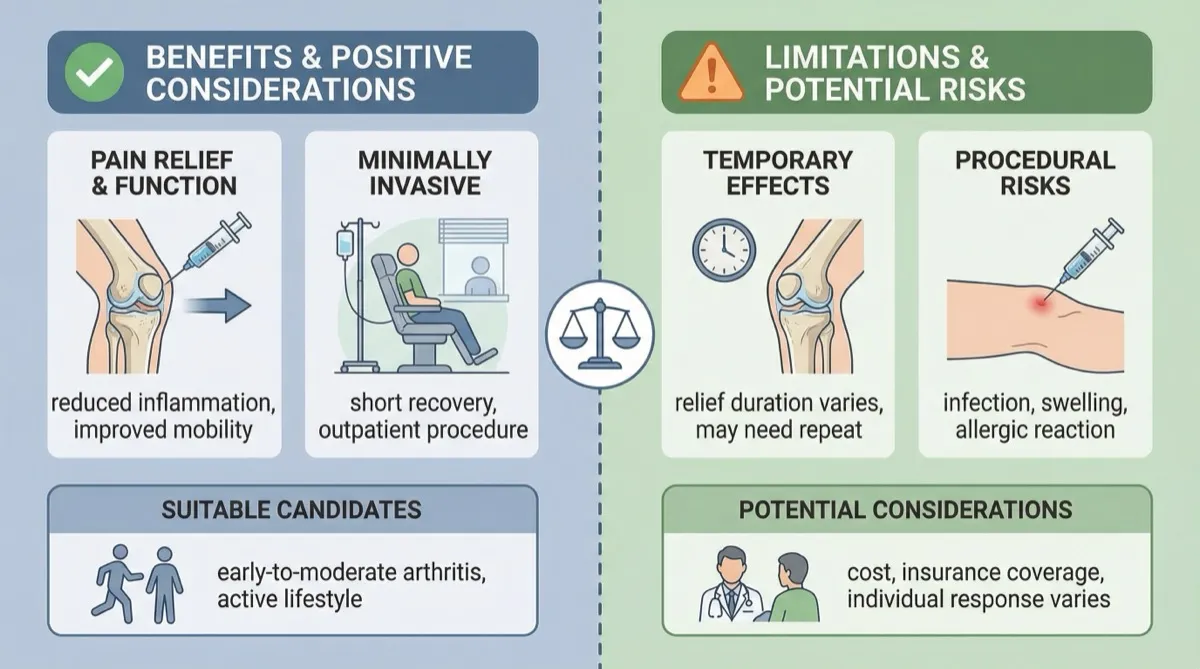
Ideal Candidates
You’re likely to benefit if you:
- Have mild-to-moderate knee osteoarthritis (not bone-on-bone)
- Tried conservative treatments (physical therapy, NSAIDs) without adequate relief
- Want to delay or avoid surgery
- Maintain an active lifestyle
- Have realistic expectations about gradual improvement
Less Ideal Candidates
You may see limited results if you:
- Have severe, end-stage osteoarthritis with significant bone-on-bone contact
- Have Kellgren-Lawrence grade 4 classification (advanced degeneration)
- Recently had multiple cortisone injections
- Have unrealistic expectations about immediate pain relief
The Accuracy Advantage: Why Fluoroscopy Matters
Here’s something most clinics won’t tell you: without advanced imaging guidance, even experienced physicians miss the knee joint space up to 30% of the time [6]. If the injection doesn’t reach the joint, it can’t work.
At Joint Relief Institute, our board-certified doctors use fluoroscopy (real-time X-ray imaging) for every single procedure, guaranteeing 100% accurate placement. This precision is one reason our patient satisfaction rates exceed national averages.
What Our 40,000+ Patients Say
With a 5.0 Google rating and decades of combined experience, Joint Relief Institute has helped tens of thousands of patients avoid surgery and reclaim their mobility. Here’s what they tell us:
“I didn’t know how much LIFE and SLEEP I was missing because of my knee pain, until it went away with this wonderful treatment.”
— George R.
“Every day was hard. I couldn’t enjoy my favorite activities anymore. But thankfully, I’m back in full form. I am doing yard work for the first time in years!”
— Phil M.
These aren’t isolated success stories—they reflect the 88.7% satisfaction rate seen in large-scale clinical studies [3].
Making Your Decision: Is Viscosupplementation Worth It for You?
Let’s bring this full circle with a practical framework for deciding:
Viscosupplementation is probably worth it if:
✓ You have mild-to-moderate knee osteoarthritis ✓ Conservative treatments haven’t provided adequate relief ✓ You want to avoid or delay surgery ✓ You can afford the out-of-pocket cost (or qualify for insurance coverage) ✓ You’re willing to give it 1-2 weeks to start working ✓ You value a low-risk, outpatient treatment option
Consider other options first if:
✗ You have severe bone-on-bone arthritis ✗ You need immediate pain relief for an acute flare-up (try cortisone) ✗ You’ve already been told you need surgery and your orthopedic surgeon thinks you’re past the point where injections would help
The Bottom Line
For the majority of patients with mild-to-moderate knee osteoarthritis, viscosupplementation is absolutely worth trying before committing to surgery. The combination of:
- Long-lasting relief (6+ months)
- Minimal risk profile
- No recovery time
- Potential to delay or avoid surgery
- High patient satisfaction (88.7%)
- Fraction of knee replacement cost
…makes it a compelling first-line treatment after conservative options have failed.
The real question isn’t whether viscosupplementation works—the evidence clearly shows it does for most patients. The question is whether you’re a good candidate and whether the investment makes sense for your situation.
Take the Next Step: Find Out If You’re a Candidate
The only way to know if viscosupplementation is worth it for YOUR knees is to get evaluated by specialists who perform thousands of these procedures annually.
At Joint Relief Institute, we’ve perfected the viscosupplementation process with:
- Fluoroscopy-guided injections for 100% accuracy (not just “pretty good” accuracy)
- Board-certified physicians with decades of combined experience
- 40,000+ patients treated since 2015
- 5.0 Google rating reflecting real patient satisfaction
- Same-day appointments available in most cases
Ready to Reclaim Your Mobility?
Call (800) 238-9307 today. After answering a few quick questions about your knee pain, we can often book your consultation the same day.
You have nothing to lose but pain—and potentially years of mobility to gain.
Frequently Asked Questions
How long does viscosupplementation last?
Most patients experience relief for 6-12 months after a treatment series. Some patients see benefits lasting even longer, especially after multiple treatment courses. Studies show that effects can improve with subsequent treatments, with maximal benefits often occurring after the fourth course [3].
Does viscosupplementation hurt?
The injection itself causes minimal discomfort, similar to any injection. Some patients experience temporary mild swelling or stiffness for 1-2 days afterward, but 99% of side effects are mild-to-moderate and resolve quickly [6].
How many injections do I need?
Treatment protocols vary depending on the specific hyaluronic acid product used. Some require 3-5 weekly injections, while single-injection formulations are also available. Your doctor will recommend the best protocol for your situation.
Can I get viscosupplementation if I’ve already had cortisone shots?
Yes, in most cases. However, you may need to wait a few weeks between cortisone and viscosupplementation treatments. Be sure to tell your doctor about any recent injections.
Will my insurance cover viscosupplementation?
Coverage varies. Medicare covers viscosupplementation for qualifying patients who meet specific criteria. Private insurance coverage depends on your specific plan. Call (800) 238-9307 to discuss insurance options and coverage verification.
What if viscosupplementation doesn’t work for me?
While the majority of patients (88.7%) are satisfied with results, viscosupplementation isn’t effective for everyone, particularly those with severe bone-on-bone arthritis. If you don’t respond to treatment, you can discuss other options with your physician, including surgical intervention if appropriate.
Sources
-
EUROVISCO Consensus Guidelines for the Use of Hyaluronic Acid Viscosupplementation in Knee Osteoarthritis Based on Patient Characteristics. Journal of Orthopaedic Surgery and Research, 2024. https://journals.sagepub.com/doi/10.1177/19476035241271970
-
A Comprehensive Review of Viscosupplementation in Osteoarthritis of the Knee. Orthopedic Reviews, 2021. https://orthopedicreviews.openmedicalpublishing.org/article/25549
-
Long-Term Outcomes of Single versus Multiple Courses of Viscosupplementation for Osteoarthritic Knee Pain: Real-World, Multi-Practice Experience Over a Six-Year Period. PMC, 2021. https://pmc.ncbi.nlm.nih.gov/articles/PMC8364370/
-
Medicare Coverage for Hyaluronic Acid Injections for Knee Osteoarthritis. Centers for Medicare & Medicaid Services, 2025. https://www.cms.gov/medicare-coverage-database/
-
Is Viscosupplementation Covered by Insurance? Knee Pain Centers of America, 2024. https://www.kneepaincentersofamerica.com/blog/is-viscosupplementation-covered-by-insurance-b8bc6
-
Viscosupplementation vs Knee Surgery: Is Surgery Your Only Option? Joint Relief Institute Blog. https://jointreliefinstitute.com/blog/viscosupplementation-vs-knee-surgery-is-surgery-your-only-option
-
Viscosupplementation vs Cortisone for Knee Pain Management. Knee Pain Centers of America, 2024. https://www.kneepaincentersofamerica.com/blog/viscosupplementation-vs-cortisone
-
Viscosupplementation for knee osteoarthritis: systematic review and meta-analysis. PubMed, 2022. https://pubmed.ncbi.nlm.nih.gov/36333100/