
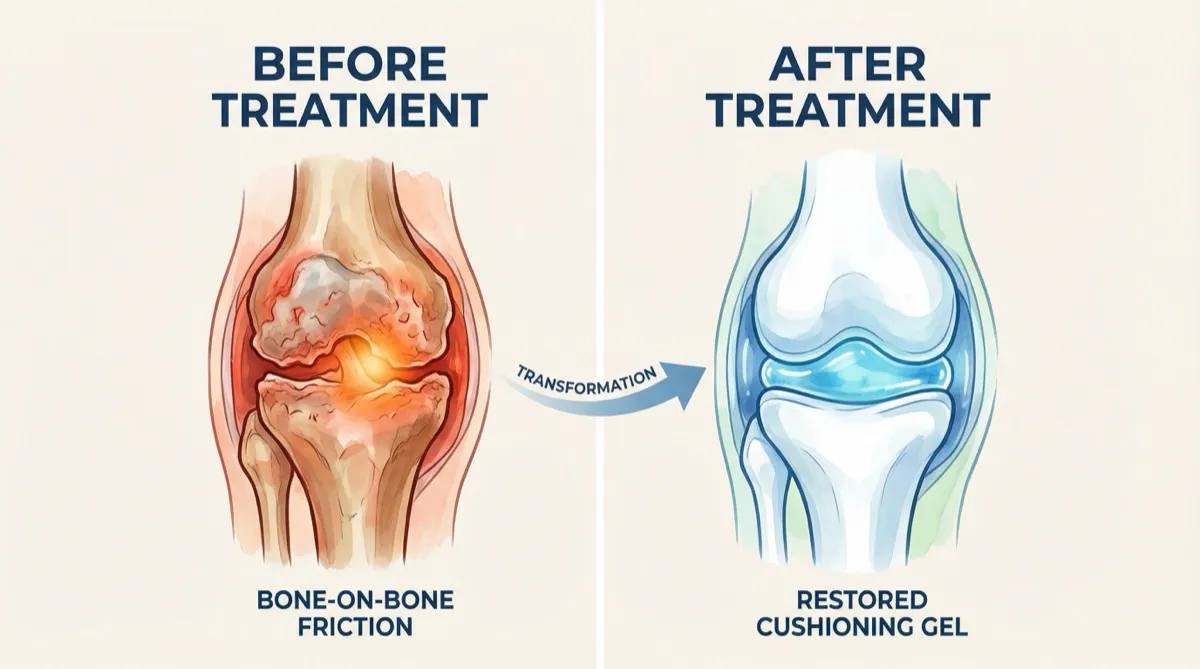
Every week, I sit across from patients who have heard the same three words from another doctor: “You’re bone-on-bone.” And nearly every time, those words came with a single recommendation: knee replacement surgery.
That conversation leaves out a lot. Surgery is a valid treatment for advanced knee osteoarthritis. But it is not the only treatment, it is not always the best first step, and many patients who are told they need it actually have more options than they realize.
After performing over 400,000 procedures at Joint Relief Institute, I’ve seen thousands of patients labeled “bone-on-bone” respond to treatments far less invasive than a total knee replacement. I’ve also seen patients who genuinely needed surgery and were better served by an honest referral. The difference comes down to understanding what’s actually happening inside your knee, knowing the full range of options, and working with a team that evaluates each patient individually rather than defaulting to a single answer.
This guide covers every treatment option available for bone-on-bone knee pain, from the most conservative approaches to surgical intervention, so you can have an informed conversation with your physician about what makes sense for you.
What “Bone-on-Bone” Really Means
The phrase “bone-on-bone” sounds catastrophic. It conjures images of bare bone grinding against bare bone with every step. But the clinical reality is more nuanced than the label suggests.
The Kellgren-Lawrence Grading System
Orthopedic surgeons classify knee osteoarthritis severity using the Kellgren-Lawrence (KL) scale, a 0-to-4 grading system based on X-ray findings [1]:
| KL Grade | Classification | What the X-Ray Shows |
|---|---|---|
| Grade 0 | Normal | Healthy joint, no abnormalities |
| Grade 1 | Doubtful | Possible minor bone spurs, no joint space narrowing |
| Grade 2 | Mild | Definite bone spurs, slight joint space narrowing |
| Grade 3 | Moderate | Multiple bone spurs, definite joint space narrowing, early sclerosis |
| Grade 4 | Severe | Large bone spurs, marked joint space narrowing, significant sclerosis and deformity |
When a doctor says “bone-on-bone,” they’re typically referring to KL Grade 4—the most advanced stage, where X-rays show significant narrowing of the space between the femur and tibia. But here’s what many patients aren’t told: a meaningful number of patients described as bone-on-bone actually fall into KL Grade 3, where cartilage is significantly reduced but not entirely absent.
The X-Ray Doesn’t Tell the Whole Story
This is one of the most important things I explain to patients: X-ray findings and functional impairment don’t always match. Research consistently shows a disconnect between radiographic severity and how a patient actually feels [1].
Some patients with KL Grade 4 on imaging walk comfortably, garden, and play with their grandchildren. Others with KL Grade 2 struggle to climb stairs. The X-ray shows structural damage. It does not measure pain tolerance, muscle strength, inflammation levels, or overall joint stability—all of which affect how a knee actually functions day to day.
This disconnect is exactly why defaulting to surgery based on imaging alone misses the point. Treatment decisions should be based on how your knee affects your life, not solely on how it looks on an X-ray.
Why Doctors Default to Surgery
If you’ve been told you need a knee replacement, that recommendation probably came from a well-meaning physician. But it’s worth understanding the forces that shape that advice.
Orthopedic surgeons are trained to operate. That’s their expertise, and when a knee reaches a certain severity on imaging, surgical replacement becomes the solution they’re most equipped to offer. This isn’t a criticism—it’s a structural reality of specialization in medicine. A surgeon evaluating a bone-on-bone X-ray sees a problem they can definitively fix.
What gets lost in that framework is the full treatment ladder. Conservative and interventional options rarely get adequate discussion in a 15-minute surgical consultation. The patient hears “bone-on-bone” and “knee replacement” in the same sentence and assumes those two things are cause and effect, when they’re not always.
The numbers tell a different story about timing. Studies show that approximately 30% of knee replacements performed in the United States may be inappropriate or premature—meaning the patient hadn’t exhausted less invasive options or didn’t have sufficient functional impairment to justify major surgery [2]. That doesn’t mean surgery is wrong for everyone. It means a significant number of patients could have explored other treatments first.
Knee replacement is a major surgical procedure with real consequences: 3-6 months of rehabilitation, surgical risks including infection and blood clots, an artificial joint with a 15-20 year lifespan, and the possibility of revision surgery later. For patients whose daily function can be meaningfully improved through less invasive means, exploring those options first isn’t avoiding surgery. It’s making sure surgery happens when it’s truly the best choice.
The Complete Treatment Ladder for Bone-on-Bone Knees
Effective osteoarthritis management follows a stepwise approach, starting with the least invasive treatments and escalating only when necessary. If your knee pain has persisted for three months or more, our chronic knee pain treatment guide covers the full progression in detail. Here’s every option on the ladder, from bottom to top.
Step 1: Exercise and Physical Therapy
What it does: Strengthens the muscles surrounding the knee (especially the quadriceps), improves joint stability, reduces stiffness, and helps manage weight—all of which reduce load on the damaged joint.
The evidence: Exercise is the single most consistently recommended treatment across every major osteoarthritis guideline worldwide. A structured physical therapy program can reduce pain by 20-30% and improve function even in patients with advanced arthritis [3]. The benefits persist as long as you maintain the activity.
For bone-on-bone patients: Many patients assume exercise will make bone-on-bone knees worse. The opposite is usually true. Low-impact strengthening and range-of-motion work reduce the forces traveling through the joint. Aquatic therapy is especially effective because water supports body weight while allowing full movement.
Limitations: Exercise alone rarely provides sufficient relief for KL Grade 4 knees. It’s a foundation, not a standalone solution for advanced disease.
Step 2: Weight Management
What it does: Every pound of body weight translates to roughly 4 pounds of force on the knee during walking. Losing 10 pounds removes 40 pounds of pressure from each step [3].
For bone-on-bone patients: Weight loss is one of the highest-impact interventions available. For overweight patients, even modest reductions (5-10% of body weight) produce measurable improvements in pain and function. Combined with exercise, it can meaningfully change the trajectory of osteoarthritis.
Step 3: Bracing and Assistive Devices
What it does: Unloader braces shift weight away from the damaged compartment of the knee. Walking aids reduce joint loading during movement.
For bone-on-bone patients: If your arthritis is concentrated in one compartment (medial or lateral), an unloader brace can provide noticeable relief during activity. They’re particularly useful for patients who want to remain active but find weight-bearing activities painful. Not every patient tolerates bracing, and it doesn’t work well for tricompartmental arthritis (damage on both sides of the knee).
Step 4: Oral Medications
What it does: Over-the-counter options include acetaminophen (Tylenol) and NSAIDs (ibuprofen, naproxen). Prescription options include topical NSAIDs (diclofenac gel) and, for more severe pain, duloxetine—an antidepressant that also modifies pain processing.
For bone-on-bone patients: Oral NSAIDs provide real but limited relief. The concern is long-term use: chronic NSAID use carries risks of gastrointestinal bleeding, kidney damage, and cardiovascular events, particularly in older adults. Topical NSAIDs offer a better safety profile for localized knee pain.
Limitations: Medications manage symptoms. They don’t address the underlying joint damage, and their effectiveness in advanced arthritis is often modest.
Step 5: Cortisone Injections
What it does: Delivers a powerful corticosteroid anti-inflammatory directly into the knee joint. Provides fast relief (2-3 days) by suppressing the inflammatory response [4].
Duration: Typically 6-12 weeks per injection, with diminishing returns over time.
For bone-on-bone patients: Cortisone is effective for acute flare-ups—those episodes where your knee suddenly becomes hot, swollen, and more painful than baseline. It’s a fire extinguisher, not a long-term solution.
The concern: A landmark 2017 JAMA study found that patients receiving cortisone injections every three months for two years showed significantly greater cartilage volume loss compared to placebo [4]. Repeated cortisone may accelerate the very damage you’re trying to manage. Most guidelines now recommend limiting cortisone to 3-4 injections per knee per year.
For a detailed comparison, see our guide on cortisone shots vs. gel shots for knee pain.
Step 6: Gel Injections (Viscosupplementation)
What it does: Injects hyaluronic acid—a substance naturally found in healthy joint fluid—directly into the knee to restore lubrication and cushioning that osteoarthritis has depleted. For a full breakdown of how this treatment works, products available, and what to expect, see our complete viscosupplementation guide.
Duration: 6 months or longer per treatment series, with outcomes improving over repeated courses.
For bone-on-bone patients: This is where most patients are surprised. Gel injections don’t require healthy cartilage to work. They work by restoring the properties of the synovial fluid itself—reducing friction between joint surfaces, providing mechanical cushioning, and modifying the inflammatory environment inside the joint. Even in a knee with minimal remaining cartilage, that lubrication and shock absorption can produce meaningful pain relief [5].
I cover this in depth in the next section, because it’s the option most commonly dismissed for bone-on-bone patients—and the one that most frequently proves the doubters wrong.
Step 7: Partial Knee Replacement (Unicompartmental)
What it does: Replaces only the damaged compartment of the knee, preserving healthy bone and cartilage on the unaffected side.
For bone-on-bone patients: If damage is isolated to one compartment (usually the medial/inner compartment), a partial replacement offers a less invasive surgical option with faster recovery than total replacement. Not all patients are candidates—it requires intact cartilage in the remaining compartments and adequate ligament stability.
Step 8: Total Knee Replacement
What it does: Replaces the entire knee joint with an artificial prosthesis made of metal and polyethylene components.
For bone-on-bone patients: When conservative and interventional treatments no longer provide adequate function, total knee replacement is a highly successful procedure. Modern implants last 15-20 years, and patient satisfaction rates are high when surgery is performed for the right reasons at the right time.
Recovery: 3-6 months of rehabilitation. Most patients achieve full functional recovery by 6-12 months. The commitment is significant, which is exactly why exploring less invasive options first makes sense.
How Gel Injections Work for Bone-on-Bone Knees
This is the section I wish every patient could read before being told gel injections “won’t work” for their bone-on-bone knees. The clinical evidence tells a more complete story.
The Mechanism: It’s About the Fluid, Not the Cartilage
The misconception is that gel injections only work if you have cartilage left to cushion. That misunderstands how viscosupplementation functions.
In a healthy knee, synovial fluid serves as both lubricant and shock absorber. This fluid is rich in hyaluronic acid, giving it a viscous, gel-like consistency that allows joint surfaces to glide smoothly and absorb impact. Osteoarthritis degrades both the quantity and quality of synovial fluid, leaving it thin and watery—unable to provide adequate lubrication or cushioning [5].
Viscosupplementation replaces and supplements this degraded fluid. The injected hyaluronic acid:
- Restores mechanical lubrication between whatever surfaces remain in the joint
- Provides shock absorption during weight-bearing activities
- Reduces inflammatory mediators within the joint environment
- May stimulate the synovium to produce higher-quality natural fluid
- Protects remaining cartilage from further enzymatic degradation [5]
Even in a KL Grade 4 knee where cartilage is severely diminished, the bone surfaces still move within a fluid environment. Improving the properties of that fluid reduces pain, even when the structural damage is advanced.
What the Clinical Evidence Shows
A large real-world study tracking 782 patients across 16 clinics over six years provides the strongest evidence for what bone-on-bone patients can expect from viscosupplementation [5]:
After a single treatment course:
- 38% average improvement in pain scores
- 73.6% of patients experienced at least 50% pain reduction
- 88.7% overall satisfaction rate
After multiple treatment courses (critical for severe arthritis):
- 66% improvement in pain scores after four courses
- 74% improvement in pain during daily activities
- 61% improvement in joint stiffness
- 79% satisfaction rate at six months
The cumulative benefit is particularly important for bone-on-bone patients. A single course provides moderate relief. But patients who commit to treatment every six months often experience significantly better outcomes with each successive course—outcomes that would not have been predicted by the first treatment alone [5].
The 2024 EUROVISCO Guidelines
The most current expert consensus on viscosupplementation—the 2024 EUROVISCO guidelines—confirmed that patients with moderate-to-severe osteoarthritis benefit from hyaluronic acid injections, particularly when they’ve failed other conservative treatments and want to delay or avoid surgery [6]. The guidelines emphasize that accurate injection placement is a critical factor in treatment success.
Why Fluoroscopy Changes Everything
Here’s a clinical reality that directly affects outcomes for bone-on-bone patients: in a severely arthritic knee, the joint space may be only a few millimeters wide. Studies show that even experienced physicians miss the joint space up to 30% of the time when injecting without imaging guidance [7]. In a bone-on-bone knee with minimal joint space, blind injection accuracy drops even further.
If the hyaluronic acid doesn’t reach the joint space, it can’t do its job. Period.
At Joint Relief Institute, we use fluoroscopy—real-time X-ray imaging—for every single injection. This allows us to visualize the needle entering the joint space and confirm that the gel is delivered precisely where it needs to go. For bone-on-bone patients, this precision isn’t optional. It’s the difference between a treatment that works and a frustrating experience that convinces the patient gel injections are ineffective.
JRI’s Approach: Why 400,000+ Procedures Matter
Joint Relief Institute exists specifically to provide the highest-quality joint injection treatments available. Here’s what that means in practice:
Specialization, not generalization. We focus exclusively on knee and shoulder treatments. We don’t perform surgeries, and we don’t try to be everything to every patient. This focus means our physicians perform these procedures every single day, building a level of expertise that a general orthopedic practice performing occasional injections cannot match.
400,000+ procedures and counting. Volume matters in medicine. Our physicians have performed more than 400,000 injection procedures, giving us a depth of clinical experience with every grade of osteoarthritis, every knee anatomy variation, and every patient scenario. With 5,800+ patient reviews, our outcomes are documented and transparent.
Fluoroscopy-guided precision on every injection. No blind injections. Every patient receives real-time X-ray guided placement, regardless of arthritis severity. For a deeper understanding of why imaging guidance matters, read about fluoroscopy’s role in hyaluronic acid injection accuracy.
12+ gel formulations. Different hyaluronic acid products have different molecular weights, viscosities, and injection schedules. Having access to the full range allows us to match the right product to each patient’s specific needs rather than using a one-size-fits-all approach.
20-minute appointments, zero downtime. The procedure itself takes approximately 20 minutes. Patients drive themselves home and resume normal activities immediately. Compare that to the 3-6 month rehabilitation timeline after knee replacement surgery.
Three convenient Chicago-area locations: Orland Park, Oak Brook, and Glenview—serving patients across the greater Chicago metropolitan area and beyond.
Medicare accepted. Viscosupplementation is covered under Medicare Part B for qualifying patients. We verify insurance coverage before treatment so there are no surprises. Learn more about Medicare coverage for gel injections.
What to Try Before Knee Replacement
If you’ve been told you need a knee replacement, here’s the sequence I recommend before scheduling surgery:
1. Get a second opinion on your imaging. Confirm your actual KL grade. “Bone-on-bone” is used loosely, and your treatment options depend on accurate staging.
2. Commit to structured physical therapy. Not casual exercise—a supervised program targeting quadriceps strength, range of motion, and functional movement patterns. Give it 6-8 weeks of consistent effort.
3. Address weight if applicable. Even modest weight loss (10-15 pounds) can meaningfully change symptoms in a bone-on-bone knee.
4. Try viscosupplementation with fluoroscopy guidance. If you’ve tried gel injections before without imaging guidance and didn’t see results, the issue may have been accuracy, not the treatment itself. A fluoroscopy-guided series is worth trying before concluding that gel injections don’t work for you. Explore more about gel injections vs. surgery for knee pain.
5. Complete at least two treatment courses before judging results. The clinical data is clear: outcomes improve with successive courses. A single series that produces modest relief may be the beginning of a trajectory toward significant improvement [5].
6. Reassess with your physician. If multiple courses of viscosupplementation combined with physical therapy and weight management don’t provide adequate functional improvement, then surgery deserves serious consideration—and you’ll know you made that decision after genuinely exhausting your less invasive options.
This sequence doesn’t delay necessary surgery. It ensures that surgery happens for the right reasons, at the right time, for patients who will truly benefit from it. And for the many patients who respond well to conservative and interventional treatment, it avoids major surgery entirely.
For a comprehensive look at how gel injections compare to surgery, including long-term cost analysis, see our detailed comparison guide.
Frequently Asked Questions
Can you get gel injections with bone-on-bone knees?
Yes. This is one of the most common misconceptions in orthopedic medicine. Gel injections do not require healthy cartilage to be effective. They work by restoring the lubrication and cushioning properties of the synovial fluid itself, which benefits the joint regardless of cartilage status. Clinical studies demonstrate meaningful pain relief and functional improvement even in patients with KL Grade 4 (severe) osteoarthritis, particularly with repeated treatment courses [5][6]. The key factor is accurate injection placement—which is why fluoroscopy guidance is essential for bone-on-bone knees. Learn more in our dedicated article on gel injections for bone-on-bone knees.
What stage of arthritis requires knee replacement?
There is no specific stage that automatically requires knee replacement. Surgery is appropriate when functional impairment significantly affects quality of life despite exhausting conservative and interventional treatments. Many patients with KL Grade 4 arthritis manage well with viscosupplementation, physical therapy, and activity modification. Others with KL Grade 3 may benefit from surgery if their symptoms are severe and unresponsive to treatment. The decision should be based on your symptoms, functional limitations, and treatment response—not imaging alone [1][2].
How long do gel injections last for bone-on-bone knees?
Most patients experience 6-12 months of relief per treatment series. Patients with more advanced arthritis may experience shorter initial duration (closer to 6 months), but outcomes typically improve with each successive course. Studies show 79% patient satisfaction at the six-month mark, with cumulative improvements of up to 66% in pain scores after four treatment courses [5]. Medicare allows repeat treatments every six months, aligning with the treatment schedule that produces the best clinical outcomes. For a deeper dive, see our article on how long gel injections last.
Are gel injections covered by Medicare for bone-on-bone patients?
Yes. Medicare Part B covers viscosupplementation (hyaluronic acid injections) for qualifying patients with knee osteoarthritis. Bone-on-bone patients are often strong candidates for coverage because they’ve typically already completed the conservative treatment trials that Medicare requires. Most patients pay only the 20% coinsurance after meeting their annual deductible. We verify coverage before treatment at all three of our locations. Read our complete guide on Medicare coverage for gel knee injections.
Is it too late for gel injections if I’m bone-on-bone?
In most cases, no. While gel injections produce the strongest results in mild-to-moderate osteoarthritis (KL Grades 2-3), they can still provide meaningful relief for many patients with KL Grade 4 arthritis. The patients who benefit most from viscosupplementation at advanced stages are those willing to commit to repeated treatment courses every six months and who maintain realistic expectations about gradual improvement rather than instant transformation [5]. The only way to know if you’re a candidate is a proper evaluation.
What’s the difference between cortisone and gel injections for bone-on-bone?
Cortisone suppresses inflammation and provides fast relief (2-3 days) that lasts 6-12 weeks. Gel injections restore joint lubrication and cushioning, take 1-2 weeks to reach full effect, and last 6+ months. For bone-on-bone patients specifically, the critical difference is long-term safety: repeated cortisone has been shown to accelerate cartilage loss, while hyaluronic acid may protect remaining tissue [4][5]. We cover this topic thoroughly in our cortisone vs. gel shot comparison.
What if I’ve already tried gel injections and they didn’t work?
Three questions to consider: Were the injections performed with fluoroscopy guidance? (Blind injections miss the joint space up to 30% of the time.) Did you complete more than one treatment course? (Outcomes improve significantly with successive courses.) And which hyaluronic acid product was used? At Joint Relief Institute, we have access to 12+ formulations and use imaging guidance on every injection—both of which can make the difference for patients who had a poor initial experience elsewhere. Review our comprehensive guide to bone-on-bone knee treatment for the full picture.
Take the Next Step
Living with bone-on-bone knee pain doesn’t mean choosing between suffering and surgery. The treatment options between those two extremes are real, evidence-based, and accessible—but only if someone takes the time to explain them to you.
At Joint Relief Institute, we’ll:
- Review your imaging to determine your exact Kellgren-Lawrence grade
- Evaluate your treatment history and current function
- Explain every option on the treatment ladder, honestly
- Verify your insurance coverage before any treatment
- Recommend the best path forward—even if that means referring you to a surgeon
We’ve helped hundreds of thousands of patients make informed decisions about their knee pain. Many of them walked in convinced surgery was their only option. Many of them walked out with a treatment plan that kept them active for years without an operating room.
Call (800) 238-9307 today to schedule your evaluation at our Orland Park, Oak Brook, or Glenview location.
Sources
-
Kellgren JH, Lawrence JS. Radiological assessment of osteoarthritis. Annals of the Rheumatic Diseases, 1957;16(4):494-502. Adapted in current clinical practice per American College of Radiology guidelines. https://radiopaedia.org/articles/kellgren-and-lawrence-system-for-classification-of-osteoarthritis
-
Defined Criteria for Appropriateness of Total Knee Replacement: Prevalence and Outcomes. JAMA Internal Medicine, 2017. https://jamanetwork.com/journals/jamainternalmedicine/fullarticle/2634985
-
Kolasinski SL, et al. 2019 American College of Rheumatology/Arthritis Foundation Guideline for the Management of Osteoarthritis of the Hand, Hip, and Knee. Arthritis Care & Research, 2020;72(2):149-162. https://doi.org/10.1002/acr.24131
-
McAlindon TE, et al. Effect of Intra-articular Triamcinolone vs Saline on Knee Cartilage Volume and Pain in Patients With Knee Osteoarthritis: A Randomized Clinical Trial. JAMA, 2017;317(19):1967-1975. https://jamanetwork.com/journals/jama/fullarticle/2626573
-
Long-Term Outcomes of Single versus Multiple Courses of Viscosupplementation for Osteoarthritic Knee Pain: Real-World, Multi-Practice Experience Over a Six-Year Period. PMC, 2021. https://pmc.ncbi.nlm.nih.gov/articles/PMC8364370/
-
EUROVISCO Consensus Guidelines for the Use of Hyaluronic Acid Viscosupplementation in Knee Osteoarthritis Based on Patient Characteristics. Journal of Orthopaedic Surgery and Research, 2024. https://journals.sagepub.com/doi/10.1177/19476035241271970
-
Accuracy of Blind vs. Image-Guided Intra-Articular Knee Injections: A Systematic Review. Journal of Clinical Medicine, 2022. https://www.mdpi.com/journal/jcm
-
A Comprehensive Review of Viscosupplementation in Osteoarthritis of the Knee. Orthopedic Reviews, 2021. https://orthopedicreviews.openmedicalpublishing.org/article/25549


