
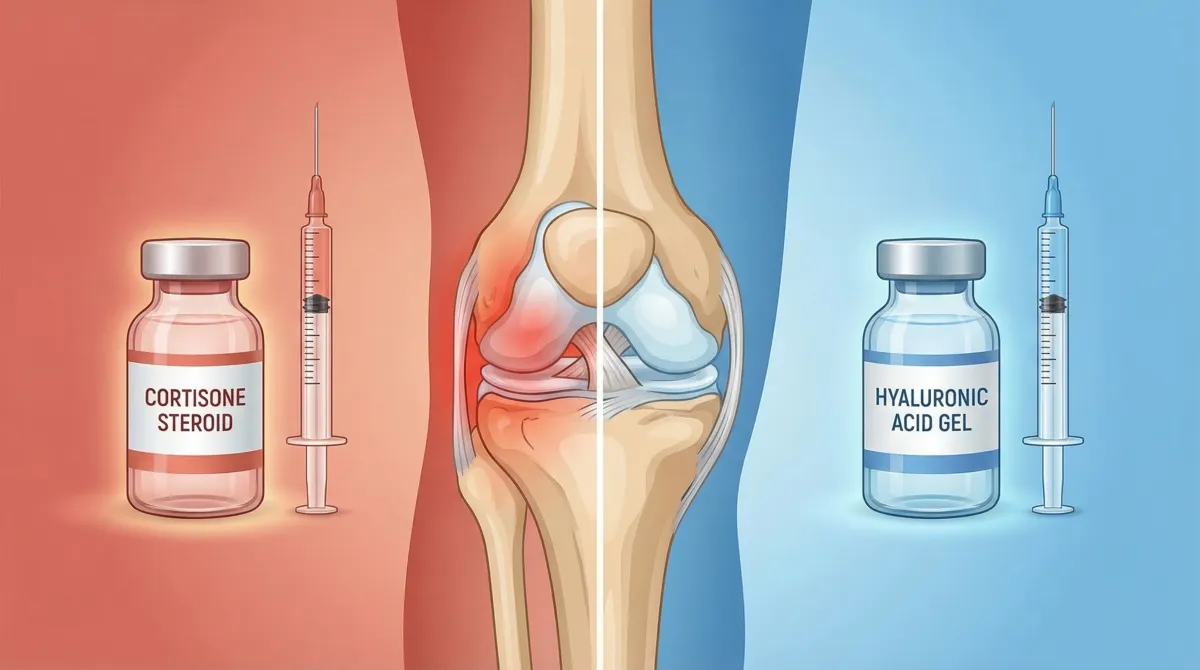
If you’ve been dealing with knee pain from osteoarthritis, you’ve likely been offered one of two injection options: a cortisone shot (corticosteroid) or a gel shot (viscosupplementation with hyaluronic acid). Your doctor may have recommended one or the other—but which one is actually better for your knee?
The short answer: it depends on your goals. Cortisone provides faster relief for acute flare-ups but wears off quickly and carries risks with repeated use. Gel shots take longer to kick in but last significantly longer and may actually protect your cartilage instead of damaging it.
After performing tens of thousands of knee injections at Joint Relief Institute, I’ve seen the full spectrum of outcomes with both treatments. Here’s what the evidence shows—and what I tell my patients when they ask which one to choose.
How Cortisone Shots Work
Cortisone (corticosteroid) injections deliver a powerful anti-inflammatory medication directly into the knee joint. They work by [1]:
- Suppressing the inflammatory response that causes pain and swelling
- Reducing fluid buildup in the joint
- Providing fast relief—most patients notice improvement within 2–3 days
Cortisone is essentially a fire extinguisher for joint inflammation. It’s effective at putting out the fire, but it doesn’t address what started it—and it doesn’t rebuild anything that was damaged.
How Long Cortisone Lasts
Most patients get 6–12 weeks of relief from a cortisone injection [1]. Some experience shorter relief (4 weeks), while others may see benefits for up to 3 months. The effect is almost always temporary, and many patients report diminishing returns with each subsequent injection.
How Gel Shots (Viscosupplementation) Work
Gel shots inject hyaluronic acid—a substance naturally found in healthy joint fluid—directly into the knee. Rather than suppressing inflammation, viscosupplementation works by [2]:
- Restoring joint lubrication that osteoarthritis has depleted
- Providing mechanical cushioning between bone surfaces
- Modifying the joint environment to reduce inflammation naturally
- Supporting remaining cartilage through protective biochemical effects
Think of it as replenishing the oil in an engine rather than just quieting the noise.
How Long Gel Shots Last
Clinical data shows gel shots provide relief for 6 months or longer in most patients [3]. A large multi-practice study found 79% of patients remained satisfied at the six-month mark, with outcomes improving over repeated treatment courses—up to 66% pain improvement after four courses [3].
Head-to-Head Comparison
| Factor | Cortisone Shot | Gel Shot (Viscosupplementation) |
|---|---|---|
| How it works | Suppresses inflammation | Restores joint lubrication and cushioning |
| Speed of relief | Fast (2–3 days) | Gradual (1–2 weeks) |
| Duration of relief | 6–12 weeks | 6+ months |
| Repeat frequency | Limited to 3–4 per year max | Every 6 months (no annual limit) |
| Cartilage effect | May accelerate damage with repeated use | May protect remaining cartilage |
| Medicare coverage | Yes | Yes (for qualifying patients) |
| Typical OOP with Medicare | ~$50–$150 | ~$100–$250 per series |
| Procedure time | 5 minutes | 5–10 minutes |
| Recovery | None | None |
| Best for | Acute flare-ups, quick relief | Long-term management, cartilage preservation |
The Hidden Risk of Repeated Cortisone: Cartilage Damage
This is the information most patients never hear—and it’s the single most important factor in the cortisone vs. gel shot decision.
What the Research Shows
Multiple studies have demonstrated that repeated corticosteroid injections can accelerate cartilage loss in osteoarthritic knees [4][5]:
-
A landmark 2017 randomized trial published in JAMA followed patients receiving cortisone injections every 3 months for 2 years. The cortisone group showed significantly greater cartilage volume loss compared to the placebo group—despite reporting similar pain levels [4].
-
A 2019 systematic review confirmed that while cortisone provides short-term pain relief, there is “a signal toward cartilage damage” with repeated use, raising concerns about accelerating the very disease the treatment is meant to manage [5].
-
Research has shown that corticosteroids can be toxic to cartilage cells (chondrocytes) at the concentrations delivered by intra-articular injection, potentially weakening the already-compromised cartilage matrix [5].
What This Means for You
If you’re getting cortisone shots every few months to manage chronic osteoarthritis, you may be trading short-term comfort for faster joint deterioration. This doesn’t mean cortisone is always bad—but using it as your primary ongoing treatment strategy for chronic OA carries real risks.
Gel shots, by contrast, show no evidence of cartilage damage. Multiple studies suggest hyaluronic acid may have chondroprotective properties—meaning it could help preserve the cartilage you still have [2][6].
When Cortisone Is the Right Choice
Cortisone injections still have an important role in knee pain management. I recommend cortisone when:
- You’re having an acute flare-up and need fast relief (a suddenly swollen, painful knee)
- You have a specific event coming up and need short-term function (a wedding, vacation, etc.)
- Gel shots haven’t been tried yet and you need bridge relief while starting the viscosupplementation process
- Your osteoarthritis is very early-stage and occasional cortisone is sufficient to manage symptoms
The key is treating cortisone as an occasional tool, not a standing prescription. Most orthopedic guidelines recommend no more than 3–4 cortisone injections per knee per year [1].
When Gel Shots Are the Better Choice
Viscosupplementation is typically the better long-term option when:
- You need ongoing pain management for chronic osteoarthritis
- You’ve been getting cortisone regularly and want to stop the cycle of diminishing returns
- You want to preserve your cartilage rather than risk accelerating damage
- You’re trying to delay or avoid knee replacement surgery
- You want longer-lasting relief without frequent injections
- You have bone-on-bone arthritis and need sustained joint support
For most patients with moderate-to-severe osteoarthritis, gel shots provide better value: longer relief per treatment, no cartilage risk, and cumulative benefits over multiple courses. If you’ve been told you’re bone-on-bone, our comprehensive treatment guide covers every option from conservative therapy to surgery.
Can You Get Both?
Yes—and at Joint Relief Institute, we routinely combine both cortisone and gel in the same visit. This isn’t a sequential approach where you wait weeks between treatments. Both are delivered together under fluoroscopy guidance in one procedure.
Why combine them? Cortisone provides immediate inflammation relief within 2–3 days, which bridges the 1–2 week onset period for gel injections. The gel then takes over, providing 6–12 months of joint cushioning and lubrication. Research suggests that combining hyaluronic acid with corticosteroids may provide more rapid improvement in pain scores compared to either treatment alone [2][6].
Most clinics frame cortisone and gel as an either/or decision because they work through different mechanisms. But those mechanisms are complementary, not contradictory: cortisone targets the inflammation while gel restores the mechanics.
Learn more about JRI’s combined cortisone and gel protocol →
The Fluoroscopy Advantage: Why Accuracy Matters for Both
Whether you’re getting cortisone or gel shots, accurate placement into the joint space is critical. An injection that misses the joint and lands in surrounding tissue won’t provide its intended benefit [7].
Research shows that blind (unguided) knee injections miss the joint space up to 30% of the time [7]. At Joint Relief Institute, we use fluoroscopy—real-time X-ray guidance—for every injection. This ensures:
- 100% accurate placement into the joint capsule
- Optimal distribution of the medication throughout the joint
- Better outcomes compared to blind injection techniques
- Reduced risk of injection into surrounding tissue
This precision matters especially for patients with severe arthritis, where the narrowed joint space makes accurate placement significantly more challenging.
Medicare Coverage: Both Are Covered
Both cortisone and gel shots are covered under Medicare Part B for qualifying patients [8]:
- Cortisone: Covered with standard 20% coinsurance. No specific qualification criteria beyond a clinical indication.
- Gel shots: Covered with 20% coinsurance for patients who meet qualification criteria (documented OA, 3+ months of failed conservative treatment). Learn the full details in our Medicare coverage guide.
For patients with supplemental insurance (Medigap), out-of-pocket costs for either treatment are often minimal.
Frequently Asked Questions
Which injection hurts more?
Both injections cause similar minimal discomfort—comparable to any standard injection. With fluoroscopy guidance, the procedure is precise and typically very well-tolerated. Some patients experience mild soreness for 1–2 days after either injection.
How quickly will I feel results from each?
Cortisone typically provides noticeable relief within 2–3 days, sometimes sooner. Gel shots are more gradual—most patients notice improvement within 1–2 weeks, with full benefits developing over 4–6 weeks.
Can cortisone shots cause knee damage?
Research indicates that repeated cortisone injections (multiple times per year over several years) are associated with accelerated cartilage loss [4][5]. Occasional use for acute flare-ups appears to carry less risk. This is why most guidelines limit cortisone to 3–4 injections per knee per year.
I’ve been getting cortisone every 3 months. Should I switch?
If you’ve been relying on regular cortisone for chronic osteoarthritis management, it’s worth discussing a transition to viscosupplementation with your physician. Gel shots can provide the ongoing relief you need without the cartilage damage concerns associated with repeated corticosteroid use.
Are gel shots just a more expensive version of cortisone?
No—they work through completely different mechanisms. Cortisone suppresses inflammation. Gel shots restore joint mechanics and may protect cartilage. The longer duration of relief (6+ months vs. 6–12 weeks) means gel shots often provide better value per dollar spent, especially with Medicare coverage.
What about PRP or stem cell injections?
Platelet-rich plasma (PRP) and stem cell therapies are emerging options but are not covered by Medicare and lack the extensive clinical evidence supporting viscosupplementation. If you’re interested in these options, discuss them with your physician, but be aware they typically cost $1,000–$5,000+ out of pocket. You may also have heard about Arthrosamid, a newer hydrogel injection—read our comparison to understand how it stacks up against gel injections.
Make an Informed Decision
The choice between cortisone and gel shots doesn’t have to be guesswork. At Joint Relief Institute, we evaluate each patient’s specific condition, treatment history, and goals to recommend the approach that will provide the best long-term outcome.
Call (800) 238-9307 today to schedule a consultation. Our board-certified physicians will review your imaging, discuss your options honestly, and help you choose the treatment that’s right for your knees. Learn more about why patients trust Joint Relief Institute.
Sources
-
Corticosteroid Injections for Osteoarthritis of the Knee: A Systematic Review. American Academy of Orthopaedic Surgeons, 2023. https://www.aaos.org/
-
A Comprehensive Review of Viscosupplementation in Osteoarthritis of the Knee. Orthopedic Reviews, 2021. https://orthopedicreviews.openmedicalpublishing.org/article/25549
-
Long-Term Outcomes of Single versus Multiple Courses of Viscosupplementation for Osteoarthritic Knee Pain: Real-World, Multi-Practice Experience Over a Six-Year Period. PMC, 2021. https://pmc.ncbi.nlm.nih.gov/articles/PMC8364370/
-
Effect of Intra-articular Triamcinolone vs Saline on Knee Cartilage Volume and Pain in Patients With Knee Osteoarthritis: A Randomized Clinical Trial. JAMA, 2017. https://jamanetwork.com/journals/jama/fullarticle/2626573
-
Intra-articular Corticosteroids and Cartilage Damage: A Systematic Review. Clinical Rheumatology, 2019. https://link.springer.com/article/10.1007/s10067-019-04671-6
-
EUROVISCO Consensus Guidelines for the Use of Hyaluronic Acid Viscosupplementation in Knee Osteoarthritis. Journal of Orthopaedic Surgery and Research, 2024. https://journals.sagepub.com/doi/10.1177/19476035241271970
-
Accuracy of Blind vs. Image-Guided Intra-Articular Knee Injections. Journal of Clinical Medicine, 2022. https://www.mdpi.com/journal/jcm
-
Medicare Coverage for Hyaluronic Acid Injections for Knee Osteoarthritis. Centers for Medicare & Medicaid Services, 2025. https://www.cms.gov/medicare-coverage-database/


