
Viscosupplementation: The Complete Guide to Gel Injections for Knee Pain
If your knees ache when you stand up from a chair, stiffen after a short walk, or keep you awake at night, you’re not alone. Knee osteoarthritis affects roughly 33.6% of adults over 65 in the United States [1], and the most common question these patients ask is: What can I do besides surgery? If your knee pain has persisted for months, you may be dealing with chronic knee pain that needs a targeted treatment approach.
Viscosupplementation — also called gel injections, hyaluronic acid injections, or sometimes “rooster comb” shots — is one of the most effective non-surgical answers available. It’s FDA-approved, covered by Medicare, and backed by decades of clinical evidence. Yet many patients have never heard of it, or have received incomplete information about how it works, what it costs, and whether it’s right for them.
After performing over 400,000 procedures and treating more than 40,000 patients at Joint Relief Institute since 2015, I’ve seen viscosupplementation change lives — helping people return to gardening, golfing, walking their grandchildren to school, and living without the constant burden of knee pain. This guide covers everything you need to know to make an informed decision.
What Is Viscosupplementation?
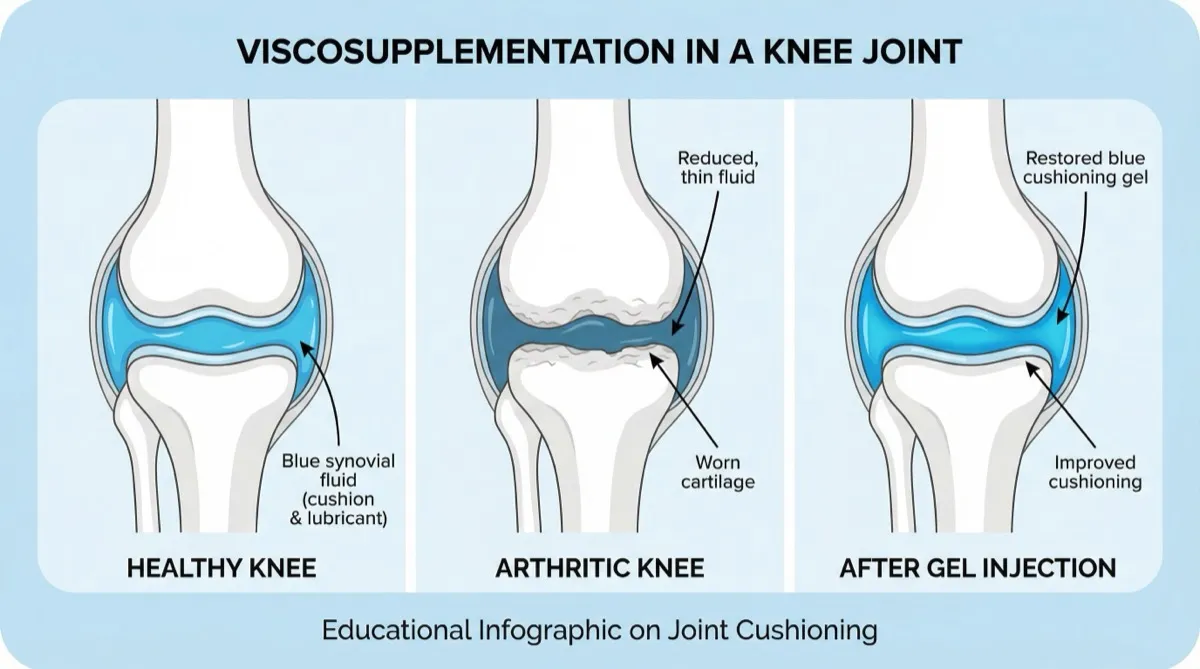
Viscosupplementation is a medical procedure in which a gel-like substance — hyaluronic acid — is injected directly into the knee joint. The goal is to restore the natural lubrication and cushioning that osteoarthritis gradually destroys.
Here’s the simplest way to think about it: inside every healthy knee, there’s a thick, slippery fluid called synovial fluid. This fluid acts like motor oil in an engine — it reduces friction between the bones, absorbs shock when you walk or climb stairs, and helps the joint move smoothly [2]. In a healthy knee, synovial fluid contains high concentrations of hyaluronic acid, a naturally occurring substance that gives the fluid its thick, gel-like consistency.
When osteoarthritis develops, two things happen. First, the cartilage lining the joint surfaces begins to wear away. Second, the synovial fluid breaks down — it becomes thinner, less viscous, and less capable of protecting the joint [2]. The result is bone grinding against bone with less cushioning, which causes the pain, stiffness, and swelling that make everyday activities difficult.
Viscosupplementation supplements what your body can no longer produce in sufficient quantities. By injecting medical-grade hyaluronic acid directly into the joint space, the procedure restores lubrication, reduces inflammation, and provides a protective cushion between the bones [2][3].
How Viscosupplementation Works: The Science
The mechanism behind viscosupplementation goes deeper than simply adding lubricant. Research has identified multiple ways that hyaluronic acid injections benefit the arthritic knee [3]:
Mechanical lubrication. The injected gel restores the viscoelastic properties of synovial fluid. “Viscoelastic” means the fluid acts as both a lubricant during slow movements (like walking) and a shock absorber during sudden impacts (like stepping off a curb). This dual function is critical for protecting the joint during everyday activities.
Anti-inflammatory effects. Hyaluronic acid binds to receptors on the cells lining the joint, suppressing the production of inflammatory molecules (cytokines and prostaglandins) that drive arthritis pain [3]. This is why many patients notice pain relief that lasts far longer than the injected gel itself remains in the joint.
Cartilage protection. Laboratory and clinical studies suggest that hyaluronic acid stimulates the production of natural hyaluronic acid by the joint’s own cells and may slow cartilage degradation [3][4]. In other words, the treatment doesn’t just mask symptoms — it may help protect the joint from further damage.
Pain signal modulation. Hyaluronic acid interacts with nerve endings in the joint lining, reducing the transmission of pain signals [3]. This helps explain why patients often report progressive improvement over several weeks as the anti-inflammatory and neuro-modulatory effects build.
The combined result is that most patients experience meaningful pain reduction starting 2-4 weeks after injection, with peak benefits occurring between 4-12 weeks and lasting 6-12 months or longer [4][5].
FDA-Approved Viscosupplementation Options Compared
One of the most important things to understand about viscosupplementation is that not all products are the same. There are more than a dozen FDA-approved hyaluronic acid formulations, and they differ in molecular weight, structure, source, number of injections required, and clinical performance. At Joint Relief Institute, we stock 12+ options so we can match the right product to each patient’s specific condition.
The Complete Product Comparison
| Product | Manufacturer | Molecular Weight | Structure | Source | Injections | FDA Approved |
|---|---|---|---|---|---|---|
| Synvisc | Sanofi | 6,000 kDa | Cross-linked | Rooster comb | 3 weekly | 1997 |
| Synvisc-One | Sanofi | 6,000 kDa | Cross-linked | Rooster comb | 1 single | 2009 |
| Supartz FX | Bioventus | 620-1,170 kDa | Non-cross-linked | Rooster comb | 3-5 weekly | 2001 |
| Euflexxa | Ferring | 2,400-3,600 kDa | Non-cross-linked | Bacterial fermentation | 3 weekly | 2004 |
| Gel-One | Zimmer Biomet | Cross-linked hydrogel | Cross-linked | Bacterial fermentation | 1 single | 2011 |
| Hyalgan | Fidia Pharma | 500-730 kDa | Non-cross-linked | Rooster comb | 3-5 weekly | 1997 |
| Orthovisc | Anika Therapeutics | 1,000-2,900 kDa | Non-cross-linked | Rooster comb | 3-4 weekly | 2004 |
| Monovisc | Anika Therapeutics | Cross-linked | Cross-linked | Bacterial fermentation | 1 single | 2014 |
| GenVisc 850 | DePuy Synthes | 620-1,170 kDa | Non-cross-linked | Rooster comb | 3-5 weekly | 2015 |
| Durolane | Bioventus | 2,000+ kDa | Cross-linked | Bacterial fermentation | 1 single | 2009 |
| Visco-3 | Zimmer Biomet | Intermediate | Non-cross-linked | Rooster comb | 3 weekly | N/A |
| Hymovis | Fidia Pharma | 500-730 kDa (HYADD4 technology) | Partially cross-linked | Bacterial fermentation | 2 weekly | 2015 |
| ZILRETTA | Pacira | N/A (triamcinolone acetonide) | Microsphere extended-release | Synthetic | 1 single | 2017 |
Note: ZILRETTA is an extended-release corticosteroid injection, not a hyaluronic acid product. It is included because patients frequently ask about it in the context of knee injection options. For a detailed comparison of all gel types, see our guide on types of gel injections for knees.
Key Differences That Matter
Molecular weight is one of the most important differentiators. Higher molecular weight formulations (like Synvisc at 6,000 kDa) provide greater viscoelastic properties — meaning they offer more cushioning and shock absorption. Research suggests that high-molecular-weight hyaluronic acid (HMWHA) provides more significant pain relief than both non-selective NSAIDs and selective COX-2 inhibitors [6]. Lower molecular weight products (like Hyalgan at 500-730 kDa) more closely resemble natural synovial fluid and may be better tolerated by some patients.
Cross-linked vs. non-cross-linked refers to the molecular structure. Cross-linked products (Synvisc, Gel-One, Monovisc, Durolane) are chemically modified to resist breakdown, which means they stay in the joint longer. Non-cross-linked products (Euflexxa, Supartz, Hyalgan, Orthovisc) have a more natural structure that the body processes more easily.
Source material matters for patients with allergies. Products derived from rooster comb (avian-sourced) include Synvisc, Supartz, Hyalgan, Orthovisc, and GenVisc 850. Patients with chicken or egg allergies should use bio-fermented (non-avian) alternatives: Euflexxa, Gel-One, Monovisc, Durolane, or Hymovis.
Number of injections ranges from a single injection (Synvisc-One, Gel-One, Monovisc, Durolane) to a series of 3-5 weekly injections. Single-injection products offer convenience but deliver the entire dose at once. Multi-injection series provide a more gradual buildup of hyaluronic acid in the joint, which some physicians prefer for more severe cases.
How We Choose the Right Product for You
There is no single “best” gel injection. The right product depends on your arthritis severity, body weight, activity level, allergy history, and insurance coverage. At Joint Relief Institute, we evaluate each patient individually and select from our full range of 12+ products. This is a significant advantage over practices that carry only one or two options and are forced to use the same product for every patient regardless of their specific needs.
Who Is a Candidate for Viscosupplementation?
Viscosupplementation is appropriate for a broad range of osteoarthritis patients, but it works best when the right candidates are identified. Generally, you may be a candidate if:
Ideal Candidates
- You have diagnosed knee osteoarthritis confirmed by X-ray showing joint space narrowing, bone spurs, or cartilage loss (Kellgren-Lawrence grades 2-4)
- Conservative treatments haven’t provided adequate relief — you’ve tried rest, physical therapy, over-the-counter pain medications, or cortisone injections without lasting improvement
- You want to delay or avoid knee replacement surgery — viscosupplementation can provide years of relief for patients who aren’t ready for or aren’t good candidates for surgery
- You have mild to moderate osteoarthritis (KL grades 2-3) — this is where viscosupplementation shows the strongest evidence of benefit, though many patients with severe (grade 4) disease also respond well [4]
- You’re active and want to maintain mobility — golfers, walkers, gardeners, and anyone who wants to stay moving
Patients Who May Not Be Ideal Candidates
- Active joint infection in the knee
- Known allergy to avian products (if considering rooster comb-derived gels — bio-fermented options remain available)
- Skin disease or infection around the injection site
- Significant joint instability requiring surgical correction
An important note: many patients are told they are “bone-on-bone” and that nothing short of surgery will help. In our experience treating over 40,000 patients, a substantial number of these patients respond well to viscosupplementation — especially when the right product is selected and the injection is placed accurately under fluoroscopy. For more on this topic, see our guide: Do gel injections work for bone-on-bone knees?
The Procedure: What to Expect Step by Step
Understanding exactly what happens during a viscosupplementation appointment helps ease anxiety. The entire procedure takes approximately 20 minutes from start to finish.
Before the Procedure
- Your physician reviews your X-rays and medical history to confirm that viscosupplementation is appropriate
- The knee is examined for swelling, range of motion, and tenderness
- The skin around the injection site is cleaned with an antiseptic solution
- A topical numbing agent may be applied for comfort
During the Procedure
-
Positioning. You sit or lie comfortably with the knee slightly bent. The position allows optimal access to the joint space.
-
Fluoroscopy guidance. At Joint Relief Institute, every injection is performed under fluoroscopic (real-time X-ray) guidance. This is critical: research shows that non-guided (“blind”) knee injections miss the joint space up to 30% of the time [7]. When the injection misses the joint, the medication ends up in surrounding tissue where it provides little to no benefit. Fluoroscopy eliminates this guesswork by showing the physician exactly where the needle is in real time.
-
Joint aspiration. If there is excess fluid (effusion) in the knee, it is drained before the injection. Removing excess fluid reduces pressure, decreases pain, and creates space for the hyaluronic acid to distribute evenly throughout the joint.
-
Injection. The hyaluronic acid gel is slowly injected into the joint space. Most patients feel only mild pressure — the procedure is far less painful than most people expect.
-
Confirmation. Fluoroscopy confirms that the gel has been delivered to the correct location within the joint.
After the Procedure
- You can walk immediately after the injection
- Avoid strenuous activities (running, heavy lifting, prolonged standing) for 48 hours
- Some patients experience mild swelling or warmth at the injection site for 1-2 days — this is normal and resolves on its own
- Ice can be applied for 15-20 minutes if there is any discomfort
- Most patients return to normal daily activities the next day
If your treatment plan includes a multi-injection series (3-5 weekly injections), you’ll return at the same time each week until the series is complete.
How Long Do Results Last?
One of the most common questions we hear is: How long will I get relief? The honest answer is that it varies, but the data is encouraging.
Typical Timeline
- Weeks 1-2: The joint begins responding to the hyaluronic acid. Some patients notice improvement within days; others need more time.
- Weeks 4-12: Peak benefits. This is when most patients experience maximum pain reduction and improved function [4][5].
- Months 3-6: Sustained relief. The majority of patients continue to experience significant improvement during this period.
- Months 6-12: Gradual return of symptoms for some patients. Others maintain relief for a full year or longer.
Cumulative Benefits of Repeat Treatment
Viscosupplementation is repeatable — and the research shows that repeated courses produce cumulative benefits. A large real-world study tracking 782 patients over six years found [5]:
- Single course: 38% improvement in pain scores
- Two courses: Greater improvement than the first course alone
- Four courses: Up to 66% improvement, with 74% improvement in pain during daily activities
- Patient satisfaction: 88.7% of patients were satisfied with treatment after multiple courses
This cumulative effect is unique to viscosupplementation. Unlike cortisone, which becomes less effective and potentially harmful with repeated use, hyaluronic acid injections can be safely repeated every 6 months with progressively better outcomes [5][8].
Insurance and Medicare Coverage
Cost is understandably one of the first things patients ask about. The good news is that viscosupplementation is widely covered by insurance, including Medicare.
Medicare Coverage
Medicare Part B covers viscosupplementation for knee osteoarthritis when it is deemed medically necessary. To qualify, you generally need [9]:
- A diagnosis of knee osteoarthritis confirmed by X-ray
- Documentation of failed conservative treatment — typically at least 3 months of physical therapy, exercise, and/or oral medications without adequate relief
- No active joint infection
Once approved, Medicare pays 80% of the allowable charge. Your Medicare supplement (Medigap) policy typically covers the remaining 20%, meaning many patients pay little to nothing out of pocket. Repeat treatment series require at least 6 months between courses.
For a detailed breakdown, see our guide on Medicare coverage for knee gel injections.
Private Insurance
Most major private insurance plans cover viscosupplementation with similar criteria — a confirmed OA diagnosis and documentation that conservative treatments have been tried. Coverage specifics (copays, deductibles, prior authorization requirements) vary by plan.
What If You Don’t Have Coverage?
For patients without insurance coverage, costs vary depending on the specific product used and the number of injections in the series. Single-injection products tend to have higher per-injection costs but lower total treatment costs than multi-injection series. We work with every patient to explore their options. For a full cost breakdown, see our knee gel injections cost guide.
At Joint Relief Institute, we verify your insurance benefits before your first appointment so there are no surprises.
Viscosupplementation vs. Other Treatments
Understanding how viscosupplementation compares to other common knee treatments helps you see where it fits in the treatment spectrum.
Viscosupplementation vs. Cortisone Injections
Cortisone (corticosteroid) injections are the most common knee injection and are often the first injection therapy patients receive. They work by suppressing inflammation and can provide rapid pain relief within days. However, the comparison with viscosupplementation reveals important differences [8]:
| Factor | Cortisone | Viscosupplementation |
|---|---|---|
| Onset of relief | Days | 2-4 weeks |
| Duration | 4-12 weeks | 6-12 months |
| Mechanism | Suppresses inflammation | Restores joint lubrication + anti-inflammatory |
| Cartilage effect | May accelerate cartilage loss with repeated use | May protect cartilage |
| Repeat use | Limited (3-4 per year max) | Safely repeatable every 6 months |
| Long-term trajectory | Diminishing returns over time | Cumulative improvement over time |
A landmark meta-analysis found that while cortisone provides faster initial relief, viscosupplementation surpasses cortisone by week 8 and continues to outperform it through at least 26 weeks [8]. For patients who need both quick and lasting relief, some physicians use cortisone for the initial flare-up followed by viscosupplementation for sustained treatment.
For a deeper comparison, read our guide on cortisone shots vs. gel shots for knees.
Viscosupplementation vs. PRP (Platelet-Rich Plasma)
PRP involves drawing your own blood, concentrating the platelets, and injecting the resulting plasma into the knee. While promising, PRP has two significant drawbacks compared to viscosupplementation:
- Insurance coverage: PRP is generally not covered by Medicare or most insurance plans, costing $500-$2,000+ per injection out of pocket
- Standardization: PRP preparation varies widely between clinics, making outcomes less predictable
Research suggests PRP may offer slightly superior pain relief in mild OA (KL grades 1-2) [10], but for moderate to severe OA — which describes most patients seeking treatment — viscosupplementation remains the more practical and evidence-supported option.
Viscosupplementation vs. Knee Replacement Surgery
Total knee replacement is a major surgery with a 6-12 month recovery period, significant risk of complications, and a price tag of $30,000-$50,000+ even with insurance. It’s an appropriate option for patients with end-stage arthritis who have exhausted non-surgical treatments — but it should be the last resort, not the first recommendation.
Viscosupplementation can delay knee replacement by years. Many of our patients have been receiving regular gel injections for 5-10+ years, maintaining active lifestyles without surgery. For patients who eventually do need surgery, viscosupplementation serves as an effective bridge, keeping them comfortable and functional until they’re ready.
For a full cost and outcome comparison, see knee surgery cost vs. gel injections.
Why Joint Relief Institute
Not all viscosupplementation providers are equal. The quality of your outcome depends heavily on the clinic’s experience, the range of products available, and the injection technique used. Here’s what sets Joint Relief Institute apart:
400,000+ Procedures Performed
Joint Relief Institute has performed over 400,000 knee and shoulder procedures since 2015, making us one of the highest-volume viscosupplementation practices in the country. That volume translates directly into expertise — our physicians have seen every variation of osteoarthritis and know which products and techniques work best for each situation.
12+ FDA-Approved Gel Options
Most orthopedic clinics carry 1-2 gel products and use the same one for every patient. We stock 12+ FDA-approved options because different patients need different solutions. A 62-year-old golfer with moderate OA needs a different formulation than an 80-year-old with severe bone-on-bone disease and an avian allergy. Having a full product range means we can match the right gel to your specific condition.
Fluoroscopy-Guided Precision
Every injection at Joint Relief Institute is performed under fluoroscopic guidance — real-time X-ray imaging that confirms exact needle placement. This eliminates the 30% miss rate associated with blind injections [7] and ensures the medication reaches the joint space where it can do its job. Many clinics skip fluoroscopy because it requires specialized equipment and adds time. We consider it non-negotiable.
5,800+ Patient Reviews
Our patients have left over 5,800 reviews across our three locations, reflecting consistently high satisfaction with both outcomes and experience. That kind of sustained patient feedback doesn’t happen by accident — it reflects a commitment to thorough evaluation, honest recommendations, and excellent care.
Three Convenient Chicago-Area Locations
- Orland Park, IL — serving the south and southwest suburbs
- Oak Brook, IL — serving the western suburbs
- Glenview, IL — serving the north and northwest suburbs
Frequently Asked Questions
How much do viscosupplementation injections cost?
The cost of viscosupplementation varies based on the specific product used, the number of injections in the series, and your insurance coverage. With Medicare, patients typically pay 20% of the approved cost (often covered by a Medigap supplement). Without insurance, a complete treatment series ranges from approximately $800-$2,500 depending on the product. Single-injection products like Synvisc-One, Gel-One, and Monovisc tend to have lower total series costs than multi-injection products. For a detailed breakdown, visit our knee gel injections cost guide.
Is viscosupplementation covered by insurance?
Yes. Medicare Part B covers viscosupplementation for knee osteoarthritis when medically necessary, typically paying 80% of the approved amount. Most private insurance plans also provide coverage with similar medical necessity criteria. At Joint Relief Institute, we verify your benefits before your appointment so you know your expected costs upfront. Learn more about insurance coverage for knee gel injections.
Is viscosupplementation worth it?
For the right candidates, absolutely. An 88.7% patient satisfaction rate across 782 patients and six years of follow-up speaks for itself [5]. Patients who receive multiple courses report up to 66% improvement in pain and 74% improvement in daily function. Compared to the risks and costs of surgery, the limited duration of cortisone, and the out-of-pocket expense of PRP, viscosupplementation offers the best combination of effectiveness, safety, insurance coverage, and repeatability for most osteoarthritis patients. Read our full analysis: Is viscosupplementation worth it?
How many injections will I need?
That depends on the product selected for your treatment. Single-injection products (Synvisc-One, Gel-One, Monovisc, Durolane) require just one visit. Multi-injection products (Euflexxa, Supartz, Hyalgan, Orthovisc) require 3-5 weekly visits. Your physician will recommend the best option based on your arthritis severity, lifestyle, and insurance coverage.
Are there side effects?
Viscosupplementation is generally very well tolerated. The most common side effects are temporary and mild: slight pain, swelling, or warmth at the injection site lasting 1-2 days. Serious side effects are rare. Patients with avian allergies should use bio-fermented products (Euflexxa, Gel-One, Monovisc, Durolane, Hymovis) rather than rooster comb-derived options. For a complete overview, see our guide on gel injection side effects.
Can I get viscosupplementation in both knees?
Yes. Many of our patients receive treatment in both knees, either simultaneously or in sequence. Your physician will determine the best approach based on your individual situation and insurance coverage.
How soon can I return to normal activities?
Most patients resume normal daily activities the day after their injection. We recommend avoiding strenuous exercise, heavy lifting, and prolonged standing for 48 hours. Walking, light stretching, and gentle movement are encouraged immediately.
Take the First Step Toward Lasting Knee Relief
If knee pain is limiting your life — making it harder to walk, climb stairs, sleep through the night, or enjoy the activities you love — viscosupplementation may be the solution you’ve been looking for. The procedure is safe, effective, covered by Medicare and most insurance, and can be repeated as needed for years of relief.
At Joint Relief Institute, we’ll evaluate your knee, review your imaging, verify your insurance coverage, and recommend the best treatment option — even if that means a different approach. We’ve helped over 40,000 patients make informed decisions about their knee pain, and we’ll give you the same honest, thorough evaluation.
Call (800) 238-9307 today to schedule your evaluation, or visit our viscosupplementation page to learn more.
Three Chicago-area locations:
- Orland Park, IL
- Oak Brook, IL
- Glenview, IL
We accept Medicare and most insurance plans.
Sources
-
Frontiers in Medicine. “Recent advances in the management of knee osteoarthritis: a narrative review.” January 2025. https://pmc.ncbi.nlm.nih.gov/articles/PMC11790583/
-
Strauss EJ, et al. “Hyaluronic acid viscosupplementation and osteoarthritis: current uses and future directions.” American Journal of Sports Medicine. 2009;37(8):1636-1644. https://pubmed.ncbi.nlm.nih.gov/19168610/
-
Orthopedic Research and Reviews. “A Comprehensive Review of Viscosupplementation in Osteoarthritis of the Knee.” October 2021. https://pmc.ncbi.nlm.nih.gov/articles/PMC8567800/
-
EUROVISCO Consensus Guidelines for the Use of Hyaluronic Acid Viscosupplementation in Knee Osteoarthritis Based on Patient Characteristics. Journal of Orthopaedic Surgery and Research, 2024. https://journals.sagepub.com/doi/10.1177/19476035241271970
-
Long-Term Outcomes of Single versus Multiple Courses of Viscosupplementation for Osteoarthritic Knee Pain: Real-World, Multi-Practice Experience Over a Six-Year Period. PMC, 2021. https://pmc.ncbi.nlm.nih.gov/articles/PMC8364370/
-
Concoff A, et al. “Efficacy and safety of high-molecular-weight hyaluronic acid for knee osteoarthritis.” Osteoarthritis and Cartilage. 2017;25(Suppl 1):S165-S166.
-
National Center for Biotechnology Information. “Fluoroscopic-guided procedures of the lower extremity.” August 2022. https://pmc.ncbi.nlm.nih.gov/articles/PMC9362560/
-
Bannuru RR, et al. “Therapeutic trajectory of hyaluronic acid versus corticosteroids in the treatment of knee osteoarthritis: a systematic review and meta-analysis.” Arthritis & Rheumatism. 2009;61(12):1704-1711. https://pubmed.ncbi.nlm.nih.gov/19950318/
-
Centers for Medicare & Medicaid Services. Medicare Coverage Database: Viscosupplementation for knee osteoarthritis. https://www.cms.gov/medicare-coverage-database
-
Tan J, et al. “Platelet-Rich Plasma Versus Hyaluronic Acid for Treatment of Knee Osteoarthritis: A Systematic Review and Meta-analysis of 40 Randomized Controlled Trials.” Archives of Physical Medicine and Rehabilitation. 2025;106(1):12-25. https://pubmed.ncbi.nlm.nih.gov/38561052/


