Shoulder Pain Treatment in Chicago: Non-Surgical Options That Work
Shoulder pain has a way of taking over your entire life. Reaching for a coffee mug in the cabinet becomes a negotiation. Putting on a jacket turns into a two-minute ordeal. Sleeping through the night without waking from a dull, persistent ache in your shoulder starts to feel like a distant memory.
If any of that sounds familiar, you are not alone. Shoulder pain is the third most common musculoskeletal complaint in the United States, affecting roughly 18 to 26 percent of adults at any given time [1]. And for many people, the pain does not resolve on its own. It lingers, worsens, and gradually chips away at independence and quality of life.
The encouraging news is that surgery is not the only path forward. At Joint Relief Institute, we have performed over 400,000 procedures and treated more than 40,000 patients across our three Chicago-area locations. We have seen firsthand that the right non-surgical shoulder treatment can deliver meaningful, lasting relief for the vast majority of patients who walk through our doors.
This guide covers the most common causes of shoulder pain, the full range of non-surgical treatments available today, and how advanced gel injections are helping Chicago patients avoid shoulder surgery altogether.
When Shoulder Pain Won’t Go Away
Most people assume shoulder pain will eventually resolve with rest. For acute injuries like a minor strain, that is often true. But when shoulder pain persists for weeks or months despite rest, over-the-counter medications, and ice, something deeper is usually happening inside the joint.
Chronic shoulder pain — pain lasting more than three months — typically points to a structural or degenerative issue that will not improve without targeted intervention. The shoulder is an incredibly mobile joint, which also makes it inherently unstable and vulnerable to a wide range of conditions.
Warning signs that your shoulder pain needs professional evaluation include:
- Pain that wakes you at night, especially when lying on the affected side
- Progressive loss of range of motion — difficulty raising your arm overhead, reaching behind your back, or rotating your shoulder
- Pain that limits daily activities like dressing, cooking, driving, or lifting groceries
- Grinding, clicking, or popping sensations during movement
- Weakness in the arm that makes it difficult to hold objects or perform routine tasks
- Pain that has not responded to two or more weeks of rest and over-the-counter anti-inflammatory medications
If you are experiencing any of these symptoms, waiting longer rarely makes things better. Shoulder conditions tend to worsen over time as compensatory movement patterns develop and the underlying joint damage progresses.
Common Causes of Shoulder Pain
Understanding the root cause of your shoulder pain is the first step toward effective treatment. Here are the conditions we diagnose and treat most frequently at Joint Relief Institute.
Shoulder Osteoarthritis
Osteoarthritis is the most common form of arthritis affecting the shoulder, particularly the glenohumeral joint where the upper arm bone meets the socket of the shoulder blade. As the protective cartilage lining the joint surfaces wears down over time, bone begins grinding against bone, causing pain, stiffness, and inflammation [2].
Shoulder osteoarthritis develops gradually. Early symptoms include a deep ache in the joint that worsens with activity and improves with rest. As the condition progresses, you may hear grinding or clicking sounds during movement, notice increasing stiffness — particularly in the morning — and find that your range of motion is shrinking month by month.
Risk factors include age (most common in adults over 50), previous shoulder injuries, repetitive overhead work or sports, and a family history of osteoarthritis.
Rotator Cuff Injuries
The rotator cuff is a group of four muscles and their tendons that stabilize the shoulder joint and enable the wide range of arm movements we rely on every day. Rotator cuff injuries range from mild inflammation (tendinitis) to partial tears to complete tears of one or more tendons.
Rotator cuff problems are extremely common, particularly in adults over 40. Research suggests that partial or full-thickness rotator cuff tears are present in up to 30 percent of adults over age 60 — many of whom have no symptoms at all [3]. When symptoms do develop, they typically include pain with overhead reaching, weakness when lifting or rotating the arm, and a catching sensation during certain movements.
Importantly, not all rotator cuff tears require surgery. Many partial tears and even some full-thickness tears respond well to non-surgical treatments, particularly when combined with targeted physical therapy.
Frozen Shoulder (Adhesive Capsulitis)
Frozen shoulder is one of the most frustrating shoulder conditions because it develops slowly, restricts movement dramatically, and can take 12 to 18 months to fully resolve without treatment. The condition occurs when the capsule of connective tissue surrounding the shoulder joint thickens and tightens, severely limiting range of motion.
Frozen shoulder typically progresses through three stages:
- Freezing stage (6 to 9 months) — pain increases gradually and range of motion begins to decrease
- Frozen stage (4 to 12 months) — pain may actually improve, but stiffness becomes severe, making everyday tasks extremely difficult
- Thawing stage (6 to 24 months) — range of motion gradually returns
Women are more likely to develop frozen shoulder than men, and the condition is particularly common in people with diabetes, thyroid disorders, and those recovering from prolonged immobilization after surgery or injury.
Shoulder Bursitis
Bursae are small, fluid-filled sacs that cushion the bones, tendons, and muscles around joints. When the bursae in the shoulder become inflamed — a condition called bursitis — the result is pain, tenderness, and swelling that worsens with movement, particularly overhead activities.
Shoulder bursitis often develops alongside rotator cuff tendinitis and is a leading cause of pain on the outside of the upper arm. Repetitive motions, direct trauma, and underlying conditions like rheumatoid arthritis or gout can all trigger shoulder bursitis.
Shoulder Impingement Syndrome
Shoulder impingement occurs when the tendons of the rotator cuff and the bursa become compressed — or “impinged” — between the bones of the shoulder during arm elevation. This compression causes pain, inflammation, and progressive damage to the soft tissues.
Impingement is particularly common in people who perform repetitive overhead motions — athletes in sports like swimming, tennis, and baseball, as well as workers in occupations that involve repeated reaching or lifting. The hallmark symptom is a sharp pain in the front or side of the shoulder that worsens when raising the arm above shoulder height.
Non-Surgical Treatment Options for Shoulder Pain
The good news for most shoulder pain patients is that surgery is not the first-line recommendation. The American Academy of Orthopaedic Surgeons and virtually every major clinical guideline recommend exhausting non-surgical options before considering surgical intervention. Here is the full spectrum of non-surgical treatments available for shoulder pain, from least to most advanced.
Physical Therapy
Physical therapy is the foundation of nearly every shoulder pain treatment plan. A skilled physical therapist can design a program that addresses your specific condition, targeting weakness, tightness, and abnormal movement patterns that contribute to pain.
For shoulder osteoarthritis, physical therapy focuses on gentle range-of-motion exercises to maintain mobility, strengthening exercises for the rotator cuff and scapular stabilizers, and manual therapy techniques to reduce stiffness and improve joint mechanics.
For rotator cuff injuries, therapy emphasizes progressive strengthening of the intact muscles to compensate for damaged tendons, along with postural correction and activity modification to reduce strain on the injured tissue.
Research consistently shows that physical therapy can reduce pain and improve function for a wide range of shoulder conditions [4]. However, for moderate to advanced osteoarthritis, physical therapy alone is often insufficient. It works best when combined with other treatments that address the underlying joint deterioration.
Medications
Over-the-counter anti-inflammatory medications like ibuprofen (Advil, Motrin) and naproxen (Aleve) can help manage mild to moderate shoulder pain and inflammation. Acetaminophen (Tylenol) is an alternative for pain relief without the anti-inflammatory effect.
For patients with more persistent pain, prescription options may include stronger NSAIDs, topical anti-inflammatory creams, or short courses of oral corticosteroids to reduce acute inflammation.
While medications can provide symptom relief, they do not address the underlying structural problem. Long-term use of NSAIDs also carries risks including gastrointestinal bleeding, kidney problems, and cardiovascular events — risks that increase with age and duration of use.
Corticosteroid Injections
Cortisone shots deliver a powerful anti-inflammatory medication directly into the shoulder joint or surrounding bursae. They can provide rapid pain relief — often within 24 to 48 hours — and are commonly used for shoulder bursitis, tendinitis, frozen shoulder, and osteoarthritis flare-ups.
However, corticosteroid injections have significant limitations:
- Temporary relief — effects typically last 6 to 12 weeks before pain returns
- Diminishing returns — repeated injections tend to become less effective over time
- Tissue damage — research shows that repeated cortisone injections can actually accelerate cartilage degeneration and weaken tendons, potentially making the underlying condition worse [5]
- Frequency limits — most physicians recommend no more than 3 to 4 cortisone injections per joint per year due to cumulative tissue effects
For these reasons, cortisone injections are best viewed as a short-term bridge — useful for acute flare-ups but not a long-term solution for chronic shoulder pain.
Gel Injections for Shoulder Pain (Viscosupplementation)
Viscosupplementation — commonly known as gel injections — represents a fundamentally different approach to treating shoulder arthritis. Rather than simply suppressing inflammation like cortisone, gel injections restore the lubricating and cushioning properties of the joint fluid itself.
This is the treatment where Joint Relief Institute specializes, and where we see the most transformative results for patients with shoulder osteoarthritis.
Gel Injections for Shoulder Pain: How They Work
Healthy shoulder joints contain synovial fluid rich in hyaluronic acid, a naturally occurring substance that acts as both a lubricant and a shock absorber. In osteoarthritic joints, the concentration and quality of hyaluronic acid are significantly diminished. The joint fluid becomes thin and watery, losing its ability to protect the cartilage surfaces during movement.
Gel injections replenish that lost hyaluronic acid by delivering a medical-grade gel directly into the shoulder joint space. Once injected, the gel:
- Restores lubrication — reducing friction between cartilage surfaces during movement
- Provides cushioning — absorbing shock and reducing bone-on-bone contact
- Reduces inflammation — hyaluronic acid has been shown to have direct anti-inflammatory properties
- Stimulates natural production — research suggests that exogenous hyaluronic acid may stimulate the body’s own production of the substance [6]
- Protects remaining cartilage — by reducing mechanical stress on damaged joint surfaces
What the Research Shows
Clinical evidence for hyaluronic acid injections in the shoulder has grown substantially in recent years. Multiple studies have demonstrated meaningful improvements in pain, function, and range of motion for patients with shoulder osteoarthritis treated with viscosupplementation [6].
Unlike cortisone, which provides rapid but short-lived relief, gel injections build their benefits over weeks and tend to provide longer-lasting results. Many patients report sustained improvement for 6 months or longer after a treatment series.
Critically, gel injections do not carry the tissue-damaging effects associated with repeated cortisone use. They can be safely repeated when the benefits begin to wear off, making them a viable long-term management strategy for shoulder osteoarthritis.
The JRI Approach: Fluoroscopy-Guided Precision
At Joint Relief Institute, every shoulder gel injection is performed under fluoroscopic guidance — real-time X-ray imaging that allows our physicians to see exactly where the needle is positioned before injecting the gel.
This matters because the shoulder is a complex, deep joint surrounded by critical structures including tendons, bursae, nerves, and blood vessels. Blind injections — those performed without imaging guidance — miss the joint space a significant percentage of the time, reducing effectiveness and potentially causing unnecessary discomfort.
With fluoroscopy, our physicians can confirm precise needle placement within the glenohumeral joint before delivering the gel. This precision translates directly into better outcomes for our patients: more effective pain relief, fewer repeat procedures, and a higher overall success rate.
The procedure itself takes approximately 15 to 20 minutes. Most patients experience minimal discomfort during the injection and can return to normal activities the same day. There is no anesthesia, no incisions, and no recovery period.
Who Is a Good Candidate?
Gel injections for the shoulder are most effective for patients who:
- Have been diagnosed with shoulder osteoarthritis (mild to moderate is ideal, but severe cases can benefit as well)
- Have not found adequate relief from physical therapy and medications alone
- Want to avoid or delay shoulder surgery
- Are looking for a treatment that can be safely repeated over time
- Are not candidates for surgery due to age, health conditions, or personal preference
If you are unsure whether gel injections are right for your shoulder pain, we offer risk-free evaluations at all four of our Chicago-area locations.
Joint Relief Institute: Shoulder Pain Treatment Across Chicago
Joint Relief Institute is Chicago’s leading provider of non-surgical joint pain treatment, with more than 400,000 procedures performed and over 5,800 five-star patient reviews. We specialize in both knee and shoulder treatment, with three convenient locations serving the greater Chicago metropolitan area.
Orland Park
Our Orland Park location serves the southwest suburbs, including Tinley Park, Mokena, Homer Glen, Frankfort, and New Lenox. With nearly 5,000 patient reviews, this is our flagship location and one of the highest-volume joint pain treatment centers in the Midwest.
Oak Brook
Our Oak Brook location provides easy access for patients in the western suburbs, including Naperville, Downers Grove, Elmhurst, Hinsdale, and Lombard. Conveniently located near the intersection of I-88 and I-294, Oak Brook is an ideal choice for patients throughout DuPage County.
Glenview
Our Glenview location serves the north and northwest suburbs, including Northbrook, Skokie, Evanston, Park Ridge, and Des Plaines. This newer location has quickly become a trusted resource for North Shore residents seeking alternatives to shoulder surgery.
All four locations offer the same advanced fluoroscopy-guided injection technology, the same experienced physicians, and the same commitment to exploring every non-surgical option before discussing surgery.
To schedule a risk-free shoulder evaluation at any location, call us at (800) 238-9307.
Comparing Shoulder Pain Treatments: What the Evidence Says
Understanding how the available treatments compare can help you and your physician make the best decision for your specific situation.
| Treatment | Pain Relief Duration | Invasiveness | Recovery Time | Repeatable | Long-Term Joint Health |
|---|---|---|---|---|---|
| Physical Therapy | Ongoing (with continued exercise) | Non-invasive | None | Yes | Positive |
| NSAIDs | Hours (per dose) | Non-invasive (oral) | None | Limited by side effects | Neutral to negative |
| Cortisone Injection | 6-12 weeks | Minimally invasive | None | Limited (3-4/year) | Potentially harmful |
| Gel Injection | 6+ months | Minimally invasive | None | Yes (safely) | Protective |
| Shoulder Surgery | Varies (months to permanent) | Highly invasive | 3-12 months | No | Irreversible changes |
For most patients with shoulder osteoarthritis, the optimal approach combines physical therapy for strength and mobility with gel injections to address the deteriorated joint environment. This combination attacks the problem from both sides — improving the biomechanics around the joint while restoring the internal conditions needed for comfortable movement.
When Shoulder Surgery May Be Necessary
While we are strong advocates for non-surgical treatment, we also believe in being honest with our patients. There are situations where shoulder surgery may be the best or only option:
- Complete rotator cuff tears in young, active patients — particularly when the tear is acute (from an injury rather than gradual degeneration) and the patient needs full strength and function for work or sport
- Severe bone-on-bone arthritis with complete cartilage loss — when imaging shows no remaining cartilage and non-surgical treatments have been thoroughly tried without adequate relief
- Structural instability — recurrent shoulder dislocations that have not responded to physical therapy and activity modification
- Large bone spurs or loose bodies — mechanical obstructions within the joint that physically block movement and cannot be addressed non-surgically
- Failed conservative treatment — when a patient has genuinely tried all appropriate non-surgical options for an adequate period (typically 3 to 6 months minimum) without meaningful improvement
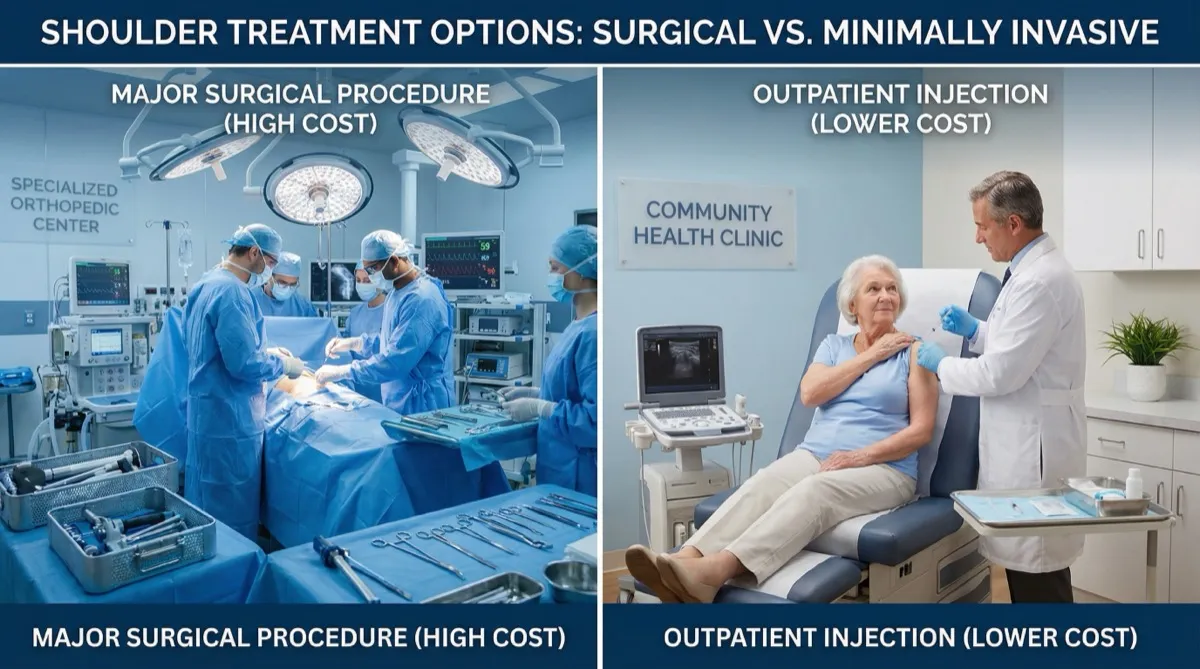
Even in these situations, we encourage patients to explore gel injections vs. shoulder surgery before committing to an irreversible procedure. Surgery permanently alters the anatomy of the shoulder. Gel injections do not. You lose nothing by trying the conservative approach first — and if it works, you gain everything.
If gel injections provide even partial relief, they may be worth continuing while complementing the treatment with physical therapy and lifestyle modifications. Many of our patients find that the combination is sufficient to maintain the quality of life they want without ever needing surgery.
What to Expect at Your First Visit
If you are ready to explore non-surgical shoulder treatment at Joint Relief Institute, here is what the process looks like:
- Risk-free evaluation — We review your symptoms, medical history, and any existing imaging (X-rays, MRIs). If you do not have recent imaging, we can order it.
- Diagnosis — Our physicians determine the specific cause of your shoulder pain and assess the severity of any joint damage.
- Treatment plan — Based on your diagnosis, we discuss all appropriate treatment options, including whether gel injections, physical therapy, or a combination is right for you.
- Insurance verification — We verify your coverage before any treatment begins so there are no surprises. Many private insurance plans cover shoulder gel injections.
- Treatment — If you decide to proceed, gel injections can often be performed the same day as your evaluation.
There is no pressure and no obligation. Our goal is to give you the information you need to make the best decision for your shoulder — and your life.
Frequently Asked Questions
How long do gel injections last for shoulder pain?
Most patients experience relief lasting 6 months or longer after a gel injection series. Some patients report benefits persisting for 9 to 12 months. The duration varies depending on the severity of the arthritis, activity level, and individual response to treatment. Unlike cortisone, which typically wears off in 6 to 12 weeks, gel injections provide longer-lasting relief and can be safely repeated.
Are gel injections for the shoulder covered by insurance?
Many private insurance plans cover shoulder viscosupplementation for diagnosed shoulder osteoarthritis. However, shoulder gel injections are considered off-label and are not currently covered by Medicare. At Joint Relief Institute, we verify your insurance coverage before treatment so you know exactly what to expect. Call us at (800) 238-9307 for a free insurance check.
Do gel injections hurt?
Most patients report only mild, brief discomfort during the injection — comparable to a standard blood draw. At Joint Relief Institute, we use fluoroscopic guidance to ensure precise needle placement, which minimizes unnecessary passes and discomfort. The entire procedure takes about 15 to 20 minutes, and you can drive yourself home afterward.
Can gel injections help bone-on-bone shoulder arthritis?
Yes, though the degree of benefit varies. Patients with mild to moderate arthritis tend to experience the greatest improvement, but even patients with bone-on-bone changes often report meaningful pain reduction and improved function. Gel injections restore lubrication to the joint space regardless of cartilage thickness, which can reduce pain from friction and inflammation even in advanced cases.
What is the difference between cortisone and gel injections?
Cortisone is a corticosteroid that reduces inflammation. It works fast (24 to 48 hours) but wears off in weeks and can damage cartilage and tendons with repeated use. Gel injections contain hyaluronic acid, which restores the natural lubrication of the joint. They take longer to reach full effect (2 to 4 weeks) but provide longer-lasting relief (6 months or more) and are safe to repeat without tissue damage. Learn more in our cortisone vs. gel injection comparison.
Is shoulder viscosupplementation FDA approved?
Hyaluronic acid injections are FDA approved for knee osteoarthritis. Their use in the shoulder is considered off-label, meaning physicians use the same proven medication for a joint it was not specifically approved for. Off-label use is common and legal in medicine — physicians use their clinical judgment to apply established treatments where evidence supports their effectiveness. Clinical studies have demonstrated positive outcomes for shoulder viscosupplementation, and the treatment is widely performed by orthopedic and pain management specialists.
How soon can I return to normal activities after a gel injection?
Most patients resume normal daily activities immediately after the procedure. We recommend avoiding strenuous overhead activity or heavy lifting for 24 to 48 hours. After that, you can gradually return to your full routine. There is no immobilization, no sling, and no physical therapy requirement following the injection itself — though we may recommend PT as part of your overall treatment plan.
Ready to find out if gel injections can help your shoulder pain? Call Joint Relief Institute at (800) 238-9307 to schedule your risk-free shoulder evaluation at our Orland Park, Oak Brook, Glenview, or Stony Island location. We will review your condition, verify your insurance, and walk you through your options — no obligation.
Learn more about shoulder pain treatment | Shoulder gel injections vs. surgery | Shoulder osteoarthritis
Sources:
[1] Luime JJ, et al. “Prevalence and incidence of shoulder pain in the general population; a systematic review.” Scandinavian Journal of Rheumatology. 2004;33(2):73-81.
[2] Kerr R, et al. “Osteoarthritis of the glenohumeral joint: a radiologic-pathologic study.” American Journal of Roentgenology. 1985;144(5):967-972.
[3] Yamamoto A, et al. “Prevalence and risk factors of a rotator cuff tear in the general population.” Journal of Shoulder and Elbow Surgery. 2010;19(1):116-120.
[4] Desjardins-Charbonneau A, et al. “The efficacy of manual therapy for rotator cuff tendinopathy: a systematic review and meta-analysis.” Journal of Orthopaedic & Sports Physical Therapy. 2015;45(5):330-350.
[5] McAlindon TE, et al. “Effect of intra-articular triamcinolone vs saline on knee cartilage volume and pain in patients with knee osteoarthritis: a randomized clinical trial.” JAMA. 2017;317(19):1967-1975.
[6] Kwon YW, et al. “Clinical outcomes of hyaluronic acid injections for glenohumeral osteoarthritis: a systematic review.” Journal of Shoulder and Elbow Surgery. 2023;32(2):442-451.
This article is for informational purposes only and does not constitute medical advice. Individual results may vary. Shoulder viscosupplementation is considered off-label and is not covered by Medicare. Many private insurance plans cover shoulder gel injections; coverage varies by plan. Consult your physician to determine the best treatment for your condition.