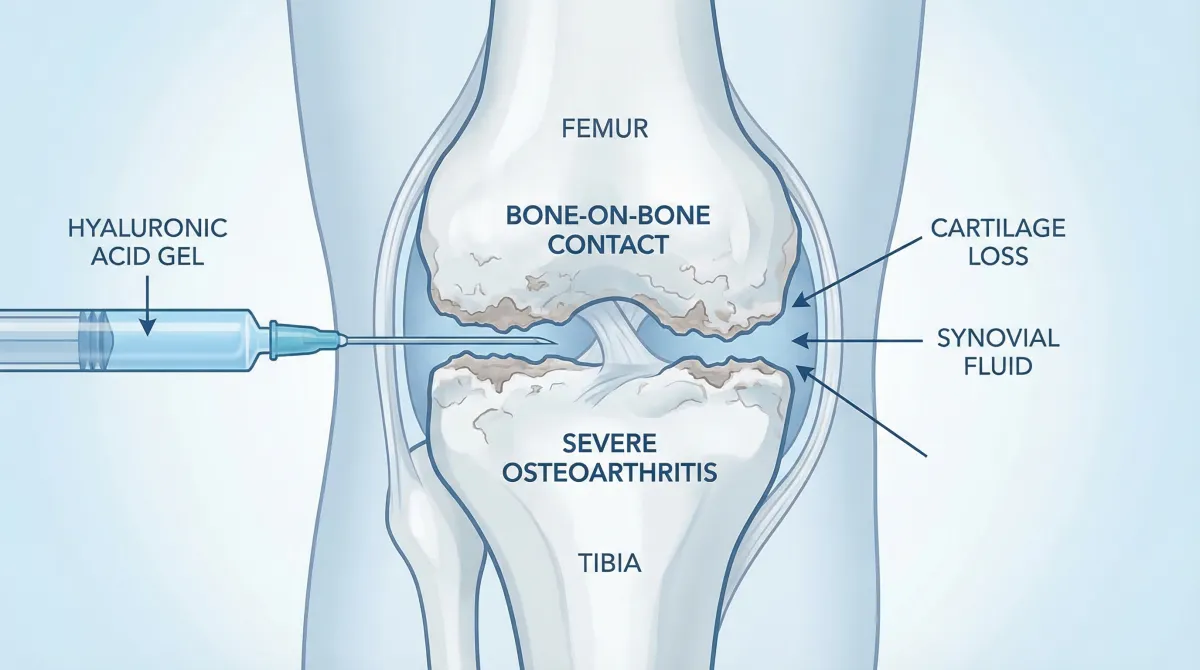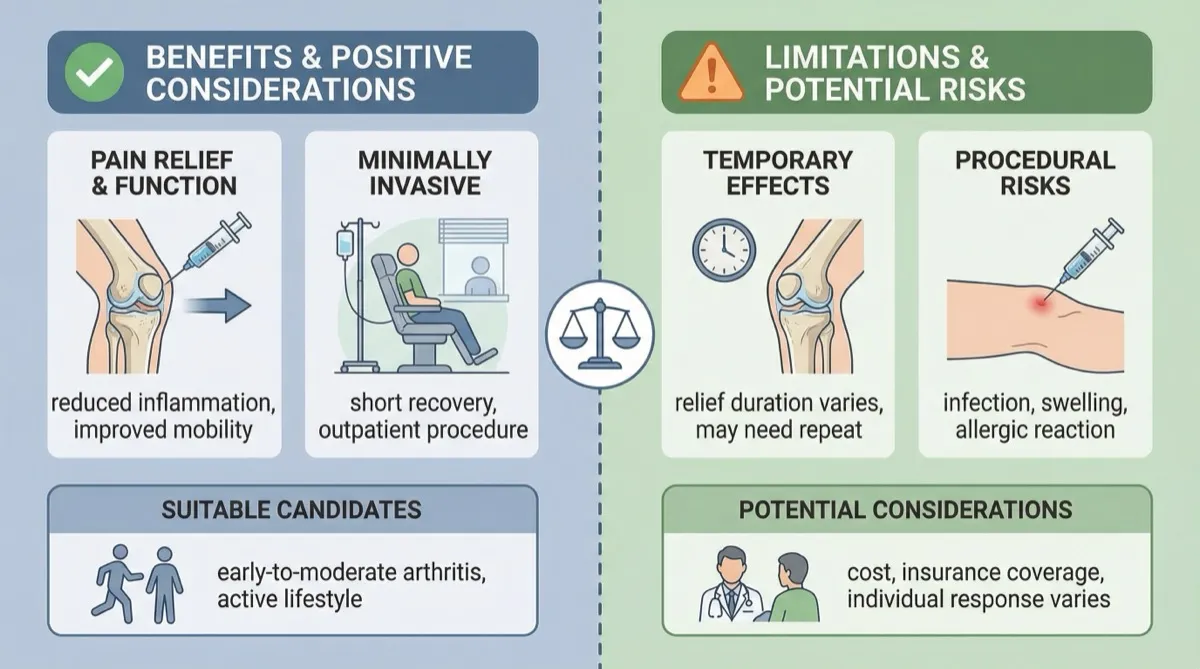
Yes, Medicare typically covers gel knee injections (viscosupplementation) for qualifying patients with knee osteoarthritis. Under Medicare Part B, most patients pay significantly less than they would out of pocket—often just a 20% coinsurance after meeting their deductible [1]. But qualifying isn’t automatic. There are specific medical criteria you must meet, and not every type of gel injection is covered.
Here’s exactly what Medicare covers, what you’ll pay, and how to find out if you qualify.
How Medicare Covers Gel Knee Injections
Gel knee injections—also called viscosupplementation or hyaluronic acid injections—fall under Medicare Part B (medical services). This means they’re covered as an outpatient procedure when performed in a doctor’s office or clinic [1].
Medicare Part B covers:
- The injection procedure itself (administration by a physician)
- The hyaluronic acid product (FDA-approved formulations)
- Fluoroscopy or imaging guidance when used to ensure accurate placement
What Medicare Pays vs. What You Pay
Once you’ve met your annual Part B deductible, Medicare covers 80% of the approved amount for the procedure. You’re responsible for the remaining 20% coinsurance [1].
Typical out-of-pocket breakdown:
| Cost Component | Medicare Pays | You Pay |
|---|---|---|
| Procedure (administration) | 80% | 20% coinsurance |
| Hyaluronic acid product | 80% | 20% coinsurance |
| Imaging guidance | 80% | 20% coinsurance |
| Estimated total OOP | — | ~$100–$250 per treatment series |
If you have supplemental coverage (Medigap): Most Medigap plans cover part or all of the 20% coinsurance. Depending on your plan, your out-of-pocket cost could be minimal—many patients with Medigap coverage pay little to nothing beyond their premiums [2].
If you have Medicare Advantage (Part C): Coverage varies by plan. Most Medicare Advantage plans cover viscosupplementation, but copays, prior authorization requirements, and network restrictions differ. Check with your plan directly [2].
Qualification Requirements: What Medicare Requires
Medicare doesn’t cover gel knee injections for everyone with knee pain. You must meet specific clinical criteria [1][3]:
1. Documented Knee Osteoarthritis
You need radiographic evidence (X-ray or other imaging) confirming osteoarthritis in the knee joint. A verbal diagnosis alone is not sufficient—Medicare requires imaging documentation in your medical record.
2. Failed Conservative Treatment (Minimum 3 Months)
Before approving viscosupplementation, Medicare requires that you’ve tried at least three months of conservative treatments that did not provide adequate relief. Qualifying conservative treatments include:
- Physical therapy
- Over-the-counter pain medications (acetaminophen, NSAIDs)
- Weight management
- Activity modification
- Assistive devices (braces, canes)
Your physician must document that these treatments were attempted and proved insufficient.
3. Medical Necessity
Your treating physician must establish that viscosupplementation is medically necessary for your condition. This documentation supports the claim submitted to Medicare.
4. FDA-Approved Product
The hyaluronic acid product used must be FDA-approved for intra-articular knee injection. At Joint Relief Institute, we use only FDA-approved formulations and offer over 10 different options to match each patient’s specific needs.
How Often Does Medicare Cover Repeat Treatments?
Medicare covers repeat viscosupplementation treatments at a minimum interval of six months between series [1][3]. This means you can receive treatment up to twice per year for each knee.
Many patients find that their relief lasts six months or longer after a treatment course. A multi-practice study tracking 782 patients found that repeated courses actually produced better outcomes over time—up to 66% improvement in pain scores after four treatment courses [4]. This is especially relevant for patients with bone-on-bone arthritis, who often see the greatest cumulative benefits from ongoing treatment.
What Medicare Does NOT Cover
Understanding coverage limitations is just as important as knowing what’s covered:
Shoulder Viscosupplementation
Important: Viscosupplementation for shoulder pain is considered off-label use and is not covered by Medicare [5]. While hyaluronic acid injections are FDA-approved for knee osteoarthritis, they do not carry FDA approval for shoulder joints. If you’re seeking shoulder pain treatment, discuss alternative options with your physician.
Unrelated Joint Injections
Medicare coverage for viscosupplementation applies specifically to knee osteoarthritis. Injections into other joints (hip, ankle) may not be covered under the same guidelines.
Products Without FDA Approval
Any hyaluronic acid product that lacks FDA approval for intra-articular knee injection will not be covered by Medicare.
Step-by-Step: How to Get Medicare-Covered Gel Knee Injections
Getting started is straightforward. Here’s what the process looks like:
Step 1: Schedule a consultation. Call (800) 238-9307 to schedule an evaluation. Our team will verify your Medicare coverage before your appointment.
Step 2: Medical evaluation. Your physician will examine your knee, review imaging, and document your treatment history to confirm you meet Medicare’s qualification criteria.
Step 3: Insurance verification. Our billing team handles the Medicare pre-authorization process and confirms your coverage and estimated out-of-pocket costs before treatment.
Step 4: Treatment. The injection itself takes just 5–10 minutes. At Joint Relief Institute, every injection is performed under fluoroscopy guidance (real-time X-ray) to ensure 100% accurate placement into the joint space.
Step 5: Follow-up. You can return to normal activities the same day. Most patients begin noticing improvement within 1–2 weeks.
Cost Comparison: With vs. Without Medicare
Understanding the financial difference Medicare makes can help you appreciate the value of coverage:
| Scenario | Estimated Cost Per Series |
|---|---|
| With Medicare + Medigap | $0–$50 for most patients |
| With Medicare only (no supplement) | ~$100–$250 |
| With Medicare Advantage | Varies by plan (typically $50–$300) |
| Without insurance (self-pay) | $1,000–$2,500 |
| Knee replacement surgery | $30,000–$50,000+ |
For qualifying patients, Medicare makes viscosupplementation one of the most affordable treatment options for knee osteoarthritis—especially when compared to the cost of knee surgery [6]. For more details on what to expect cost-wise, see our complete gel injection cost guide [7].
Frequently Asked Questions
Do I need a referral from my primary care doctor?
Original Medicare (Parts A and B) does not require a referral for viscosupplementation. However, some Medicare Advantage plans may require a referral or prior authorization. Check with your plan.
Does Medicare cover gel injections in both knees?
Yes. Medicare covers viscosupplementation for both knees if both meet the qualification criteria. Each knee can be treated on the same day or on separate visits.
How long does the approval process take?
In most cases, Medicare approval is straightforward and doesn’t significantly delay treatment. At Joint Relief Institute, our team handles the insurance verification process and can often confirm coverage within a few days.
What if I don’t qualify for Medicare coverage?
If you don’t meet Medicare’s criteria—for example, if you haven’t yet completed three months of conservative treatment—your physician can help you develop a treatment plan that fulfills the requirements. In some cases, self-pay options are available at a reduced cost.
Are there any age requirements?
Medicare eligibility typically begins at age 65, though some younger individuals qualify through disability. There is no upper age limit for viscosupplementation coverage—as long as you meet the clinical criteria, age alone does not disqualify you.
What about newer treatments like Arthrosamid?
Arthrosamid is a newer hydrogel injection approved in Europe and Canada but not FDA-approved or available in the US. It is not covered by Medicare or any US insurance. If you’re curious about how it compares to gel injections, read our detailed comparison.
Can I get gel injections and cortisone shots covered by Medicare?
Yes, Medicare covers both viscosupplementation and corticosteroid injections as separate treatments. However, your physician will recommend the best approach based on your specific condition. Learn more about the differences between cortisone and gel injections.
Take the Next Step
The best way to find out if Medicare covers gel knee injections for your situation is to talk to specialists who handle Medicare patients every day.
At Joint Relief Institute, we’ve treated over 40,000 patients since 2015, and our team is experienced in navigating Medicare coverage for viscosupplementation. We’ll verify your benefits and explain your estimated costs before any treatment begins. Learn more about our credentials and why patients trust JRI.
Call (800) 238-9307 today to schedule your consultation and insurance verification. Most patients can be seen within days.
Sources
-
Medicare Coverage for Hyaluronic Acid Injections for Knee Osteoarthritis. Centers for Medicare & Medicaid Services, 2025. https://www.cms.gov/medicare-coverage-database/
-
Medigap and Medicare Advantage Coverage for Outpatient Procedures. Medicare.gov, 2025. https://www.medicare.gov/supplements-other-insurance
-
Local Coverage Determination for Viscosupplementation for Knee Osteoarthritis. CMS LCD Database, 2025. https://www.cms.gov/medicare-coverage-database/
-
Long-Term Outcomes of Single versus Multiple Courses of Viscosupplementation for Osteoarthritic Knee Pain: Real-World, Multi-Practice Experience Over a Six-Year Period. PMC, 2021. https://pmc.ncbi.nlm.nih.gov/articles/PMC8364370/
-
Off-Label Use of Hyaluronic Acid in Shoulder Osteoarthritis. Journal of Shoulder and Elbow Surgery, 2023. https://www.jshoulderelbow.org/
-
Knee Surgery Cost vs. Gel Injections Under Medicare. Joint Relief Institute Blog. https://jointreliefinstitute.com/blog/knee-surgery-cost-vs-gel-injections-medicare
-
Viscosupplementation Cost Guide. Joint Relief Institute Blog. https://jointreliefinstitute.com/blog/knee-gel-injections-cost-guide